
- 71% of companies change their data migration approach mid-project (Natuvion study).
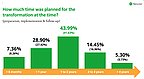
- 44% of major U.S. transformations take 1-2 years, making rigid plans obsolete.
- 39% of U.S. companies choose Brownfield, 17% Greenfield (Natuvion study).
Experts agree that rigid Greenfield or Brownfield data migration strategies are increasingly ineffective, as modern enterprises require flexible, hybrid approaches like Selective Data Transition (SDT) to adapt to evolving business needs.
Beyond Greenfield: Why Your Data Migration Plan Is Already Obsolete
MUNICH, GERMANY – June 10, 2026 – For any executive overseeing a large-scale IT overhaul, the kickoff meeting feels like a moment of decisive clarity. The path is chosen: a "Greenfield" approach to start fresh on a new platform, or a "Brownfield" migration to lift-and-shift the existing system. This binary choice has long defined the strategic foundation of enterprise transformation. But a staggering new report suggests this foundational decision is often the first, and most critical, mistake a company can make.
A new study from data transformation specialist Natuvion, conducted with NTT DATA Business Solutions, delivers a dose of reality to strategic planners: 71 percent of companies are forced to change their data migration approach mid-project. This isn't an anomaly; it's the norm. The finding reframes the entire debate, suggesting that the biggest risk isn't choosing the wrong path, but choosing a path that cannot be changed.
The Anatomy of a Broken Plan
The allure of a rigid plan is understandable. Greenfield promises a clean break from legacy debt, while Brownfield offers continuity and perceived lower risk. In the U.S., 39% of companies opt for Brownfield, with another 17% choosing Greenfield, according to the Natuvion study. Yet, these paths are fundamentally brittle. They are designed for a static target, a luxury modern enterprises simply do not have.
The study highlights that 44% of major transformations in the USA take between one and two years to complete. In that timeframe, the business landscape becomes a moving target. New competitors emerge, customer expectations pivot, mergers or divestitures are announced, and regulatory bodies introduce new compliance mandates. The pristine plan conceived in a boardroom 24 months prior becomes a liability, an anchor holding the project back while the business world sails on.
"When a strategy is too stiff to bend, it breaks," says Joanne Lang, CEO of Natuvion Americas. "This leads to slipped timelines, budget hemorrhaging, and stalled innovation." The failure, she argues, isn't one of execution by the project team but a failure of the initial strategy itself—a strategy too rigid to account for reality. When unexpected complexities arise—and they always do, from corrupt legacy data to unforeseen system dependencies—a rigid Greenfield or Brownfield plan offers no elegant way to adapt. The only options are often to brute-force a solution, accept a costly delay, or go back to the drawing board.
The Rise of the 'Third Way'
If the binary choice is a trap, what is the alternative? The answer lies in a more sophisticated, hybrid methodology often called 'Selective Data Transition' (SDT), or sometimes 'Bluefield.' This approach rejects the all-or-nothing premise of its predecessors and instead provides a framework for flexibility. It is not a mere compromise but, as Lang puts it, a "strategic capability."
SDT allows organizations to surgically select which elements of their legacy environment to keep and which to discard or redesign. This means valuable, clean historical data can be migrated while obsolete or corrupt data is left behind. Business-critical custom processes can be preserved while others are re-engineered to take advantage of the new platform's capabilities. For complex organizations undergoing an SAP S/4HANA migration, this "Goldilocks option" has become a powerful tool. Technologically, it often involves creating a 'shell' of the production system, upgrading it, and then meticulously migrating only the necessary data and processes.
This is the specialized domain of firms like Natuvion, a founding member of SAP’s own S/4HANA Selective Data Transition Engagement Community. Using proprietary software like its Data Conversion Suite (DCS), these specialists can orchestrate complex, phased migrations that remain aligned with business goals even as those goals evolve. The ability to pivot—for example, to start with a Brownfield-like scope and later incorporate Greenfield elements to build a new business process—transforms the migration from a monolithic, high-risk project into an agile, iterative program.
Agility as a Strategic Imperative
The lessons from the data migration front lines have profound implications for all C-suite strategy. The Natuvion study is a microcosm of a larger truth: in an era of continuous disruption, long-term, static plans are an endangered species. The new currency of competitive advantage is organizational agility—the ability to adapt without losing momentum.
This need is amplified by powerful external forces. New data privacy laws can emerge mid-project, demanding fundamental changes to how customer information is handled and stored. A sudden merger or acquisition requires the rapid integration of entirely separate IT landscapes, a task for which rigid plans are hopelessly unprepared. The rise of AI is another factor, acting as both a catalyst and a complication. AI can dramatically accelerate migration tasks and improve data quality, but it also demands clean, well-structured data, forcing companies to be more selective and strategic about what they bring into their new systems.
This new reality demands a new set of rules for leaders embarking on transformation. As Natuvion CEO Patric Dahse states, "Transformation is not a static concept; it is a moving target." He argues that success hinges on a plan that "remains viable when reality shifts tomorrow." The practical advice derived from the study is clear:
- Prioritize partners who support flexibility. Choosing a vendor or tool locked into a single methodology is a strategic dead end.
- Ensure a Greenfield path can incorporate legacy data. A "clean slate" must have on-ramps for essential historical data when it inevitably becomes relevant.
- Demand surgical precision from a Brownfield approach. A "lift-and-shift" must include the ability to selectively exclude or restructure data without breaking the entire system.
Ultimately, the debate is not about which initial path is correct. The study proves that in most cases, the initial path will change. The critical question leaders must now ask is not "Greenfield or Brownfield?" but rather, "Is our strategy, our partner, and our technology agile enough to handle the inevitable twists in the road ahead?" For the 71 percent of companies that find their plans upended, the answer to that question will define the line between a costly failure and a resilient, successful transformation.