
- $200 billion battery industry: Ateios Systems' certification marks a significant shift in this massive market.
- 98.8% global population exposure: PFAS chemicals detected in nearly all people, highlighting the urgency of elimination.
- 40% more usable capacity: Ateios claims its PFAS-free technology offers superior performance.
Experts would likely conclude that Ateios Systems' certified PFAS-free battery technology represents a pivotal industry shift, transforming regulatory compliance into a competitive advantage while addressing critical environmental and health concerns.
Beyond Compliance: How Certified PFAS-Free Batteries Are Redefining Value
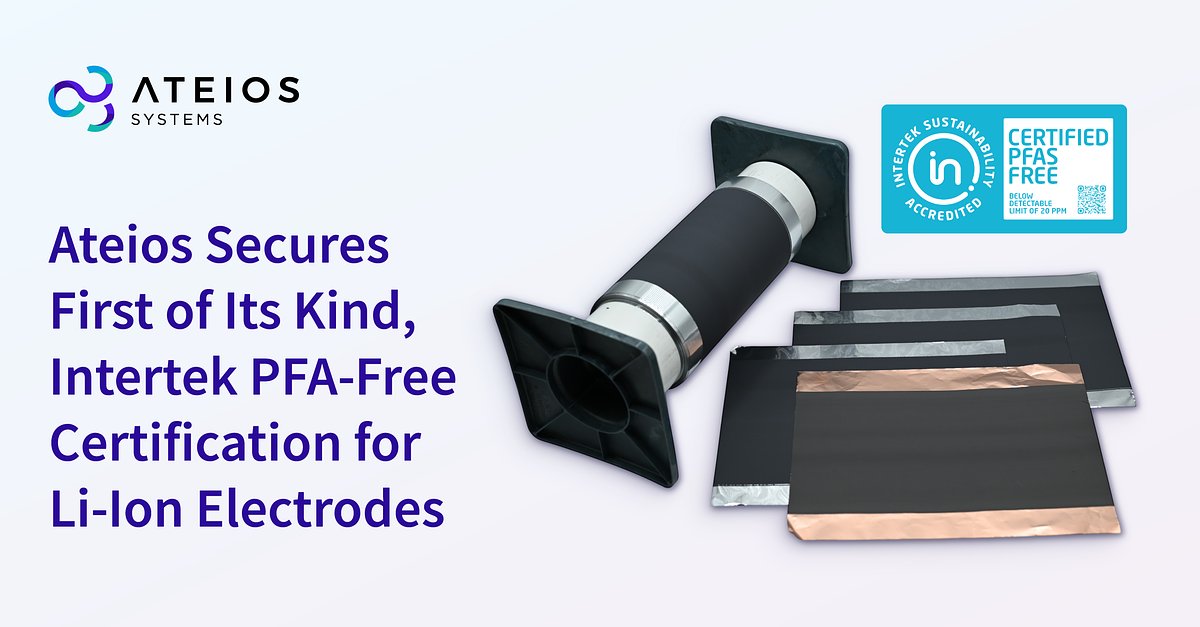
NEWBERRY, IN – June 23, 2026 – In a move that signals a tectonic shift for the $200 billion battery industry, U.S. manufacturer Ateios Systems has announced it secured what it calls a first-of-its-kind certification, verifying its entire portfolio of battery electrodes is free from PFAS, the notorious “forever chemicals.” The certification from global assurance provider Intertek isn’t just a technical milestone; it’s a shot across the bow for an industry that has long relied on these toxic materials as a necessary evil for performance.
For decades, the lithium-ion battery sector has depended on fluorinated binders like PVDF to hold electrodes together. That dependency has come at a steep environmental and health cost. PFAS (per- and polyfluoroalkyl substances) are infamous for their persistence in the environment and have been linked by health authorities to a grim roster of diseases. Now, with regulatory pressure mounting worldwide, the calculus is changing. Ateios’s certification moves the conversation beyond mere compliance, reframing the absence of PFAS not as a cost center, but as a critical competitive advantage and, increasingly, a condition for market access.
“Battery manufacturers no longer must choose between performance and compliance,” said Rajan Kumar, CEO of Ateios Systems, in a statement. He asserts that the company’s RaiCore™ electrodes not only eliminate the hazardous chemicals but also outperform their PVDF-based counterparts, a claim backed by pilot programs with major OEMs. This development suggests the end of a long-held compromise and the beginning of a new standard where safety and performance are intertwined.
The End of a Toxic Compromise
The battery industry’s reliance on fluorinated binders has always been a paradox. The same chemical stability that makes PVDF an effective binder is what makes it a persistent environmental menace. These forever chemicals have been detected in the blood of an estimated 98.8% of the global population, creating a public health crisis that can no longer be ignored. The shift away from these materials is not just a trend, but an imperative.
Ateios’s achievement is anchored in a rigorous, verifiable process. The Intertek PFAS-Free certification (PF-10025-2026a) covers the company’s full RaiCore™ composite portfolio, including LCO, NMC, and LFP cathodes, as well as graphite anodes. To earn the certification, products must demonstrate Total Organic Fluorine levels below 20 mg/kg, a stringent threshold measured under the ASTM D7359-23 standard. This isn't a self-declared claim; it's a verifiable standard listed in a public directory.
“Independent evaluation, certification, and ongoing oversight help confirm that claims rest on a consistent, defensible process,” noted Faye Ricker, PhD, Sustainability Certification Manager at Intertek. This third-party validation is crucial in an era of rampant “greenwashing,” providing procurement teams and consumers with a reliable benchmark for what “PFAS-free” truly means.
A New Blueprint for Performance
Eliminating a foundational material like PVDF without sacrificing performance has been the industry’s primary challenge. Ateios claims to have solved this puzzle with its proprietary RaiCure™ manufacturing platform. The process uses a rapid, light-based curing method that instantly hardens the electrode materials without the need for toxic solvents like NMP or the energy-intensive drying ovens common in conventional battery production. The company reports this method not only removes harmful chemicals but also enhances battery quality and performance.
While Ateios’s comprehensive portfolio certification is a first, it is part of a broader industry-wide pivot. Competitors are also racing to develop PFAS-free alternatives. Swiss manufacturer Leclanché has utilized a water-based binder process for over a decade, while companies like Dragonfly Energy are pioneering dry electrode manufacturing to eliminate both PFAS and toxic solvents. This growing ecosystem of innovation validates the market’s direction, but Ateios has gained a significant head start by securing certification across its entire commercial electrode range.
According to materials science experts, replacing PVDF requires binders that can maintain strong particle adhesion and mechanical flexibility, especially in high-voltage applications. Ateios states its technology not only meets but “exceeds PVDF-based materials across every key metric.” Earlier reports and company statements have pointed to significant gains, including up to 40% more usable capacity in some applications due to superior material adhesion and electrode quality. If these performance gains are consistently realized at scale, it would dismantle the final argument for clinging to toxic, outdated chemistries.
From Liability to Revenue Gatekeeper
The most profound implication of this development lies not in the chemistry, but in the economics. For years, the risk of PFAS was a distant liability on a balance sheet. Today, it is an immediate and tangible barrier to revenue. The press release from Ateios bluntly calls PFAS-free status a “revenue gatekeeper,” and the evidence is compelling.
Regulators are closing in. The European Union’s sweeping REACH proposal is poised to heavily restrict PFAS use, sending shockwaves through the battery supply chain. In the United States, the EPA is escalating its actions. Simultaneously, market-driven standards are becoming just as powerful. Ecolabels like EPEAT, which are critical for selling into government and large enterprise contracts, now flag PFAS as Chemicals of Concern. Procurement departments in the EU and U.S. are already tying eligibility to these new sustainability standards.
“For OEMs in automotive and consumer electronics, sourcing certified PFAS-free components is rapidly moving from a ‘nice-to-have’ for their ESG reports to a non-negotiable requirement for market entry in key regions,” an industry analyst noted. The risk is no longer a potential fine in the distant future; it’s the loss of a major contract tomorrow. This transforms the entire financial equation. The cost of requalifying a supply chain with PFAS-free components now pales in comparison to the cost of being locked out of key markets.
Ateios is capitalizing on this shift by offering electrode samples and qualification support, helping OEMs benchmark the new materials ahead of tightening restrictions. This strategic move positions the company not just as a component supplier, but as a crucial partner in navigating a complex and rapidly evolving regulatory and market landscape. By providing a certified, high-performance, drop-in solution, Ateios is offering the industry a path forward, turning an existential threat into a tangible opportunity for innovation and growth.