
- AI Agent Market Growth: Projected to expand from $5 billion in 2024 to nearly $50 billion by 2025
- Enterprise Software Adoption: Expected to rise from 1% in 2024 to 33% by 2028 (Gartner)
- Skills Gap: Over 60% of employers cite skill gaps as the primary barrier to AI transformation (World Economic Forum)
Experts agree that Agentic AI represents a transformative shift from predictive to autonomous systems, creating urgent demand for new technical skills and reshaping the future of work in tech.
Beyond Chatbots: Why Agentic AI Is Tech's New Must-Have Skill
SANTA CLARA, CA – December 02, 2025 – While generative AI captured the world's imagination with its ability to create text and images, a quieter, more profound shift is underway in corporate labs and engineering departments. The industry is moving beyond AI that merely predicts or generates, towards AI that acts. This is the domain of Agentic AI—systems of autonomous agents that can reason, plan, and execute complex, multi-step tasks, fundamentally altering the fabric of enterprise operations.
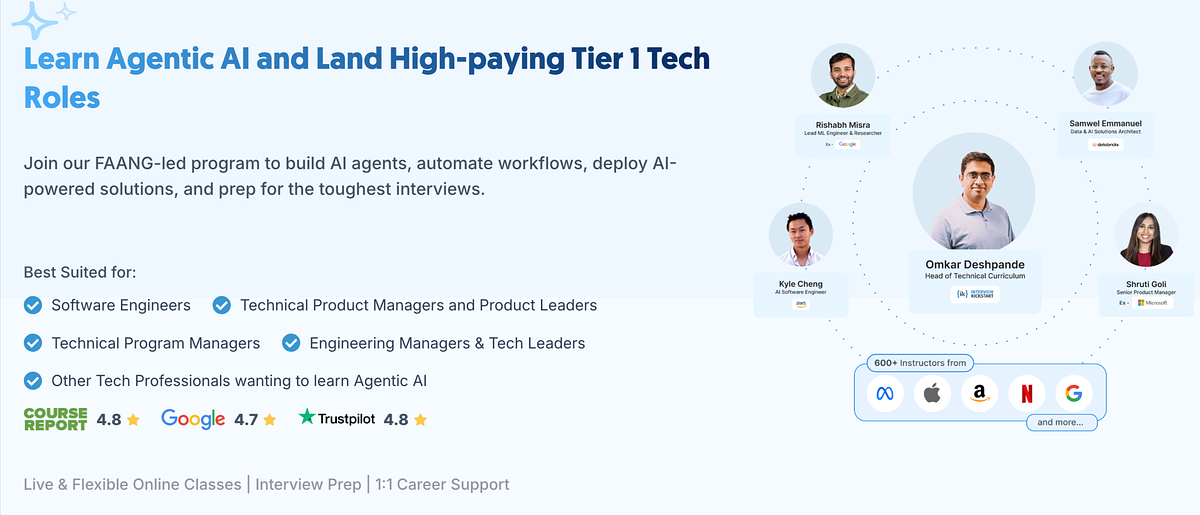
Recognizing this pivotal moment, Silicon Valley-based upskilling platform Interview Kickstart has launched a new specialized curriculum focused on Agentic AI. The move signals a critical inflection point for the tech workforce: the skills that defined the last decade of software engineering are no longer sufficient for the next. As businesses race to harness AI for more than just content creation, the demand for professionals who can build, manage, and orchestrate these "digital employees" is exploding.
From Prediction to Autonomous Action
For years, artificial intelligence has been primarily a tool of prediction and classification. Machine learning models could forecast sales, identify spam, or recommend a movie. Generative AI added the ability to create novel content. Agentic AI represents the next logical leap: from thinking to doing. These systems link large language models (LLMs) with a company's tools, data, and workflows, granting them the capacity for autonomous action.
Think of an AI agent not as a chatbot, but as an automated project manager. In finance, agents are already monitoring transactions in real-time to block fraud and initiate investigations without human intervention. In logistics, they are optimizing delivery routes on the fly, reacting to traffic and weather while reshuffling production schedules in response to factory floor disruptions. Companies like Uber Freight use AI platforms to reduce empty miles for truckers, while autonomous delivery fleets from firms like Starship Technologies adjust routes to ensure secure package handoffs.
This capability is driving a massive market expansion. Projections show the AI agent market potentially growing from just over $5 billion in 2024 to nearly $50 billion by 2025. According to Gartner, a meager 1% of enterprise software applications included Agentic AI in 2024; that figure is expected to jump to 33% by 2028. These aren't niche tools; they are becoming core components of the enterprise software stack, designed to manage business processes, optimize resource allocation, and augment technical workflows with unprecedented efficiency.
A Widening Skills Gap in the Age of Agents
The rapid corporate adoption of Agentic AI is creating a significant talent bottleneck. The World Economic Forum has highlighted that over 60% of employers see skill gaps as the primary barrier to successful business transformation. As AI automates more routine tasks, the very nature of technical roles is changing, creating a pressing need for a new class of skills.
This is the gap that educational providers are racing to fill. While platforms like Coursera, Udacity, and Udemy have begun rolling out courses on AI agents, Interview Kickstart is targeting a specific, high-stakes segment: mid-career software engineers and tech leaders aiming for roles at top-tier technology firms. Their new curriculum, designed and taught by practitioners from FAANG and other major tech organizations, focuses on the practical, real-world challenges of deploying these systems.
"Agentic AI represents a meaningful shift in how systems function," a spokesperson for Interview Kickstart explained. "Instead of simply predicting outcomes, these systems can evaluate context, plan actions, and collaborate with other agents. Our programs aim to help professionals understand how these capabilities can be applied responsibly and effectively within modern organizations."
The program’s structure, which includes live instruction, hands-on labs, and a capstone project, delves into the complex architecture of these systems. It covers not just the "how" of building agents with frameworks like LangChain or AutoGen, but the "why" behind design choices in LLM orchestration, context management, and multi-agent collaboration.
Learning from the Industry's Front Lines
In a field as nascent and fast-moving as Agentic AI, the value of learning from those on the front lines cannot be overstated. Theoretical knowledge quickly becomes outdated. The true challenge lies in deployment, where issues of safety, alignment, cost, and observability become paramount. An agent that works perfectly in a sandbox can behave unpredictably when connected to live production systems.
This is where the "FAANG advantage" that Interview Kickstart promotes becomes a significant differentiator. By learning from active hiring managers and senior engineers at Google, Amazon, and other tech giants, participants gain insight into the practical constraints and trade-offs that define real-world AI development. These instructors bring lessons from building and managing large-scale agent-based systems, offering a perspective that textbooks and online tutorials often miss.
The curriculum reflects this practical focus, emphasizing topics essential for production environments. Learners examine safety protocols to prevent unintended actions, evaluation frameworks to measure agent performance, and observability tools to monitor and debug autonomous systems. The capstone projects are not academic exercises; they require participants to design and build an end-to-end agentic workflow that mirrors real operational conditions, a crucial proof-point for hiring managers seeking talent that can "move the AI needle."
The Future of the Tech Professional
The rise of Agentic AI is set to redefine what it means to be a software engineer, AI practitioner, or tech leader. Experts predict this shift will be less about job replacement and more about profound job augmentation. Repetitive tasks like basic code generation, data entry, and routine testing will increasingly be handled by AI agents, freeing up human professionals to focus on more strategic work.
For software engineers, the role will evolve from writing explicit, logic-based code to becoming "AI orchestrators." Their primary function will be designing, supervising, and integrating systems of autonomous agents, with a heavy focus on system architecture, security, and ethical oversight. For tech leaders, the challenge will be managing hybrid teams of humans and AI, setting the rules for responsible autonomy, and ensuring that agent goals remain aligned with human and business objectives.
This evolution is already creating a host of new roles, from AI orchestrators and prompt engineers to human-AI collaboration coaches. The World Economic Forum projects that AI will create 170 million new roles globally by 2030, even as it displaces others. The key determinant for professionals navigating this transition will be their capacity for continuous learning and adaptation. Programs designed to bridge the gap between traditional software development and the new agentic paradigm are no longer just a career accelerator; they are becoming an essential tool for remaining relevant in an industry being reshaped by autonomous systems.