
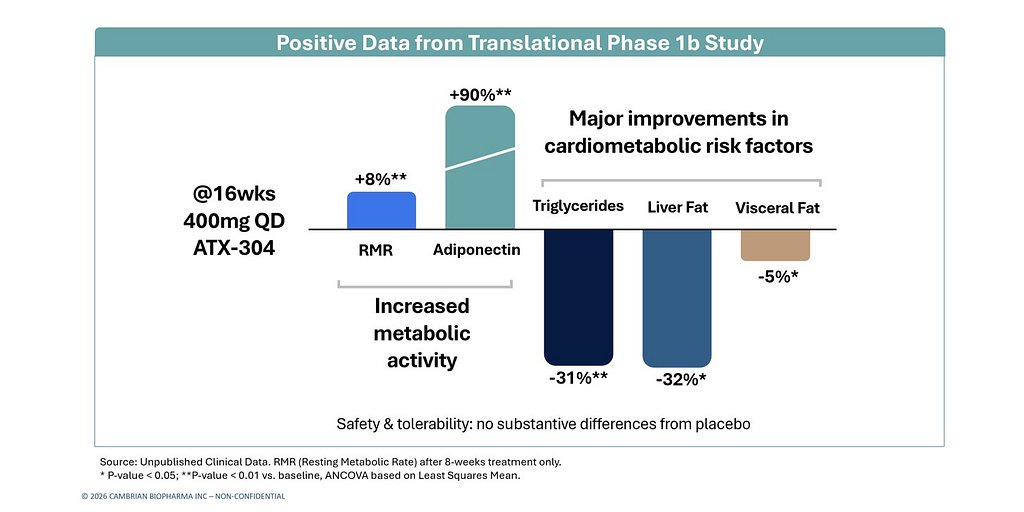
- 8% increase in resting metabolic rate (RMR) after 8 weeks of treatment with ATX-304.
- Significant reductions in liver fat and visceral adipose tissue as observed via MRI scans.
- No adverse events related to mitochondrial uncoupling, ensuring a clean safety profile.
Experts would likely conclude that ATX-304 represents a promising breakthrough in metabolic medicine, offering a novel approach to enhancing energy expenditure and improving metabolic health without the muscle loss associated with appetite-suppressing drugs.
Beyond Appetite Control: A Drug That Aims to Reignite Our Metabolic Engine
NEW YORK, NY – June 18, 2026 – The era of GLP-1 agonists like Ozempic and Wegovy has reshaped our cultural and clinical conversations around weight, offering millions a powerful tool to curb appetite and shed pounds. Yet, as this revolution in metabolic medicine unfolds, its limitations are becoming clearer. The focus remains on reducing caloric intake, and the resulting weight loss often comes at the cost of precious muscle mass, a significant concern for long-term health, particularly as we age. But what if we could approach the problem from the other side of the equation? What if, instead of just eating less, we could safely prompt our bodies to burn more?
This is the promise behind a groundbreaking development from Cambrian Bio, a clinical-stage company focused on the biology of aging. At the American Diabetes Association’s recent scientific sessions in New Orleans, the company presented the first positive human data for ATX-304, a drug that doesn't suppress appetite but instead aims to reignite the body's own metabolic furnace. It represents the first successful human trial of an AMP-activated protein kinase (AMPK) Network Activator, a target that has been a "holy grail" for metabolic drug development for nearly three decades. The results, though early, suggest the dawn of a new paradigm—one focused on restoring metabolic function, not just managing its symptoms.
The Decades-Long Quest for a Metabolic Master Switch
Deep within each of our cells is an enzyme called AMPK, which acts as a master energy sensor or "fuel gauge." When it detects low energy levels, it springs into action, flipping a series of switches that boost energy production—by pulling glucose from the blood and burning fat—while halting energy-consuming processes. It’s the same system activated by exercise, a fundamental mechanism for maintaining metabolic balance. For this reason, scientists have long believed that a drug capable of safely activating AMPK could be a transformative treatment for obesity, type 2 diabetes, and other diseases of metabolic decline.
The quest, however, has been fraught with challenges. For 30 years, researchers have struggled to develop a molecule that could activate this complex pathway effectively and safely. Many early attempts were indirect, working by stressing the cell's energy production to trick AMPK into turning on, a crude approach that carried risks of off-target effects.
Cambrian Bio’s ATX-304 appears to have cracked the code with a more sophisticated mechanism. Described as an "AMPK Network Activator," it simultaneously encourages cells to take up more fuel (like glucose) and ramps up the mitochondrial engines that burn it. This balanced approach, as confirmed in mechanistic studies presented alongside the clinical data, activates the network without causing the cellular energy distress that plagued earlier efforts.
“Unlocking the potential of AMPK activation has been a major drug development goal for almost 30 years, and for the first time, we have demonstrated activity of an AMPK activator in humans,” said James Peyer, PhD, CEO and Founder of Cambrian Bio. He described the drug’s effect as increasing energy expenditure “in a manner that closely resembles aerobic exercise training.” It’s a powerful analogy that gets to the heart of this new approach: enhancing the body’s innate capacity for metabolic health.
A New Blueprint for Metabolic Health
The initial human trial, a Phase 1b study involving 23 adults with obesity and prediabetes, was designed primarily to see if the drug’s promise, observed in preclinical models, would translate to people. The results were compelling. After eight weeks of treatment, participants showed statistically significant improvements across a range of critical metabolic markers.
Most notably, the drug increased resting metabolic rate (RMR)—the number of calories the body burns at rest—by a significant 8%. This provides direct evidence that ATX-304 is successfully stoking the body's metabolic furnace. Furthermore, it demonstrated a targeted effect on the most harmful types of fat storage. MRI scans revealed significant decreases in both liver fat and visceral adipose tissue, the deep abdominal fat strongly linked to cardiovascular disease and insulin resistance. Participants also saw their lipid profiles improve, with decreases in triglycerides and increases in adiponectin, a beneficial hormone that helps regulate glucose levels and fatty acid breakdown.
While only minimal weight loss was observed at the 400 mg dose used in the study, this was consistent with the company's predictions. The primary goal was not to demonstrate weight loss, but to prove that the drug’s mechanism of action was working safely and effectively in humans. On that front, the trial was a clear success.
“The Phase 1b data for ATX-304 demonstrate statistically significant improvements across multiple metabolic parameters,” noted Ruth Thieroff-Ekerdt, MD, Chief Medical Officer of Cambrian Bio. Critically, she highlighted the drug's safety profile, pointing out, "The absence of any adverse events indicative of mitochondrial uncoupling, including no increase in continuously monitored core body temperature or 24-hour heart rate, is a particularly important finding for a drug that increases energy expenditure." This clean safety record is paramount for any therapy intended for long-term use in a broad population.
Redefining the Battle Against Obesity
The emergence of ATX-304 arrives at a pivotal moment. The success of GLP-1 agonists has proven that there is massive public and clinical demand for effective obesity treatments. Yet, it has also illuminated the need for more diverse strategies. A significant concern with rapid, appetite-suppression-driven weight loss is the concurrent loss of lean muscle mass, which can compromise strength, mobility, and overall metabolic health, especially in an aging population already vulnerable to sarcopenia.
This is where an energy expenditure-based approach could offer a profound advantage. By stimulating metabolic processes that mimic exercise, an AMPK activator could theoretically promote fat loss while preserving, or even building, muscle. While this remains to be proven in larger trials, it is a key focus of Cambrian’s future development and a central part of the drug’s potential appeal. A therapy that helps patients lose the "right" kind of weight—fat, not muscle—would represent a major leap forward.
This strategy also aligns perfectly with Cambrian Bio’s broader mission to develop therapeutics that target the root causes of age-related decline. AMPK activity naturally wanes as we get older, contributing to the metabolic slowdown and increased disease risk that characterize aging. A drug that can safely restore this activity isn't just a potential obesity treatment; it's a tool for promoting "healthspan," the period of life spent in good health. It shifts the focus from managing a single condition to restoring a fundamental system of physiological resilience.
With these promising early results in hand, Cambrian is planning two larger Phase 2 studies. The REWIRE-1 and REWIRE-2 trials will explore higher doses of ATX-304 to evaluate its effect on muscle function and to demonstrate proof of concept for significant weight loss. This will be the true test of whether the drug can deliver on its potential to become a cornerstone of metabolic medicine. The path through clinical development is long and uncertain, but this first step has successfully opened the door to a new and compelling chapter in our fight against chronic disease.