
- Financial Inclusion Index: Indonesia's financial inclusion index reached 85.10% in 2022.
- Financial Literacy Rate: Only 49.68% of Indonesians demonstrated financial literacy in 2022.
- Amartha's Impact: Disbursed over IDR 47 trillion ($3.1 billion) to 4 million women-led MSMEs across 50,000 villages.
Experts would likely conclude that the Indonesian Coalition for Financial Health (ICFH) represents a critical shift from mere financial inclusion to fostering genuine financial well-being, leveraging proven models and strategic partnerships to address systemic economic vulnerabilities.
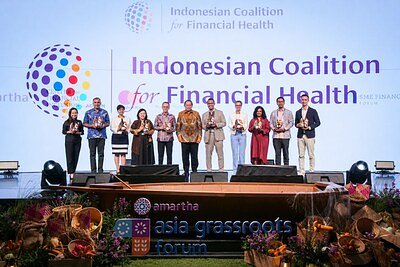
Beyond Access: A New Coalition's Strategic Play for Indonesia's Financial Health
JAKARTA, Indonesia – June 05, 2026 – In the world of development finance, 'access' has long been the holy grail. The strategic focus for decades has been connecting the unbanked to the formal financial system. But a landmark announcement from Jakarta this week suggests the goalposts are moving. The launch of the Indonesian Coalition for Financial Health (ICFH) represents a quiet but profound pivot—a recognition that having a key doesn't matter if you don't know how to open the door, or if the room on the other side is empty.
Initiated by Indonesian fintech powerhouse Amartha and a roster of global partners including Mastercard and the Center for Financial Inclusion at Accion, the coalition is more than just another public-private partnership. With the high-profile backing of Her Majesty Queen Máxima of the Netherlands in her role as the UN's Special Advocate for Financial Health, the ICFH is a declaration that the era of measuring success by account-opening metrics alone is over. The new strategic imperative is financial health: the ability of individuals and small businesses to manage daily finances, absorb shocks, and pursue opportunities. For Indonesia, and potentially for emerging markets globally, this changes everything.
The End of the Inclusion-Only Era
The strategic rationale for the ICFH is grounded in Indonesia's own success and its persistent challenges. The country has made remarkable strides in financial inclusion. According to the Financial Services Authority (OJK), the national financial inclusion index hit 85.10 percent in 2022. Yet, the financial literacy rate lagged significantly at just 49.68 percent. This gap between access and understanding is where economic potential leaks away. It's the micro-entrepreneur who gets a loan but lacks the skills to manage the cash flow, or the family that has a bank account but is one medical emergency away from ruin.
This is the problem the coalition is built to solve. "Financial inclusion has advanced significantly, but access doesn't guarantee financial health," noted Jayshree Venkatesan, a VP at the Center for Financial Inclusion at Accion, during the launch. This sentiment was echoed by Mastercard's Center for Inclusive Growth. "Financial inclusion has traditionally been measured by how many people have access to financial services," said Subhasini Chandran, Senior Vice President of Social Impact. "We must ensure that this access leads to usage and resilience."
The very mandate of the coalition's highest-profile supporter, Queen Máxima, reflects this global shift. Her UN role was updated in 2024 from focusing on 'Inclusive Finance' to 'Financial Health,' a subtle but critical change in emphasis. Her visit to Amartha's clients in Central Java in late 2025 was not a simple photo opportunity; it was a field assessment of a model that was already delivering the resilience and well-being she now champions on the global stage. The ICFH is, in many ways, the institutionalization of this new paradigm.
A Coalition Built on a Proven Model
For this ambitious agenda to be credible, it needed an anchor—a partner with a proven track record of operating at scale in the very communities the coalition aims to serve. That anchor is Amartha. Since 2010, the company has quietly built a formidable financial services infrastructure for Indonesia's grassroots.
Amartha's numbers are compelling: it has disbursed over IDR 47 trillion (approximately $3.1 billion) in working capital to more than four million women-led micro, small, and medium enterprises (MSMEs) across 50,000 villages. But the raw data understates the strategic value of its operational model. The company's 'phygital' approach, combining a sophisticated digital finance application (AmarthaFin) with a network of over 10,000 on-the-ground field officers, has cracked the code for serving rural Indonesia. The field officers provide the essential human touch—onboarding, training, and building trust—while the digital platform provides efficiency and scale.
This hybrid model directly addresses the core challenges faced by the 64.5% of Indonesian MSMEs that are led by women: a lack of collateral, low digital literacy, and a systemic trust deficit with formal banking. By focusing on group lending and character-based assessments facilitated by its field agents, Amartha has built a system that works for, not against, these entrepreneurs. The coalition isn't starting from a theoretical white paper; it's leveraging a battle-tested, scalable engine for last-mile financial delivery.
"Through ICFH, we hope that the financial inclusion paradigm can evolve beyond access and focus more on resilience and well-being as tangible outcomes," said Aria Widyanto, who heads the coalition's secretariat. This isn't just aspirational talk; it's the next logical step for an organization that has already brought millions into the formal economy and now seeks to deepen their engagement.
The Three-Pillar Playbook for Systemic Change
Rather than launching a single program, the ICFH has been designed as a comprehensive ecosystem builder, operating on three strategic fronts. This structure reveals a sophisticated understanding of the levers needed to create lasting change.
First is Research & Evidence Generation. The coalition aims to become Indonesia's primary knowledge engine for financial health, developing metrics and data that are context-specific and gender-sensitive. This moves beyond importing generic frameworks and commits to understanding the lived financial realities of Indonesian communities, providing the data-driven foundation for effective policy and product design.
Second is the Financial Health Innovation Hub. This pillar acts as a 'living laboratory' where public and private actors can co-design, test, and scale new solutions. Leveraging Amartha's existing infrastructure, the hub will focus on practical innovations like alternative credit scoring, open finance for the unbanked, and community-based services. It’s an R&D engine designed to accelerate the development of products that are not just accessible, but genuinely useful and empowering.
Third is the Convening Platform. Using the annual Asia Grassroots Forum as its flagship event, the coalition will work to align agendas and drive commitments across government, finance, and civil society. This is the crucial political and diplomatic work required to turn innovative ideas and solid research into mainstream practice and supportive regulation.
This three-pillar strategy is a playbook for systemic influence. It aims to simultaneously generate the proof (research), build the tools (innovation), and foster the will (convening) necessary to embed financial health into the fabric of the nation's economy.
A Blueprint for Emerging Economies?
While its immediate focus is on Indonesia, the strategic implications of the Indonesian Coalition for Financial Health extend far beyond the archipelago. The world is filled with countries that have celebrated rising financial inclusion rates only to find that deep-seated economic vulnerability remains. The ICFH represents a potential blueprint for how to tackle this second, more complex chapter of economic development.
The model is compelling: anchor a national initiative with a successful, at-scale local fintech leader. Bring in global partners for their expertise, capital, and best practices. Secure high-level political validation to align national and international agendas. Then, execute through a structured, multi-pronged strategy that addresses research, innovation, and policy simultaneously.
As the global development community continues to grapple with how to build truly inclusive and resilient economies in the post-pandemic era, the experiment now underway in Indonesia will be watched closely. The coalition's success could provide a new model for public-private collaboration, demonstrating that the path to sustainable prosperity is paved not just with access, but with genuine financial well-being.