
- C$244 million: Exploration spending for copper in BC in 2023, accounting for nearly 40% of all exploration expenditures in the province.
- 237.3 meters grading 0.51% Copper Equivalent: Impressive drilling results at the Thira alteration corridor, confirming a robust mineralizing system.
- Two new high-priority target areas: Copper Pond and Camp Lake, displaying a distinct geophysical “fingerprint” similar to the Thira discovery.
Experts would likely conclude that Vizsla Copper’s advanced geophysical approach at the Poplar Project significantly de-risks exploration, positioning British Columbia as a critical new frontier in the global copper supply chain.
BC's Copper Future: Geophysics Unlocks Vast New Potential
VANCOUVER, BC – November 25, 2025
The global transition to a green economy runs on copper. From electric vehicles and wind turbines to the sprawling data centers that power our digital lives, the demand for this conductive metal is projected to nearly double by 2040. Meeting this demand requires not just expanding existing mines, but discovering entirely new ones—a task that is becoming increasingly complex. In the resource-rich landscape of central British Columbia, however, an innovative approach is turning this challenge into a significant opportunity.
Vizsla Copper Corp., a Vancouver-based exploration company, has announced a breakthrough at its Poplar Project, using advanced geophysical technology to identify multiple new, large-scale drilling targets. These findings don't just add pins to a map; they suggest the presence of a cluster of major copper deposits, potentially positioning the region as a critical new frontier in the global supply chain for this essential metal.
Reading the Earth's Electrical Signature
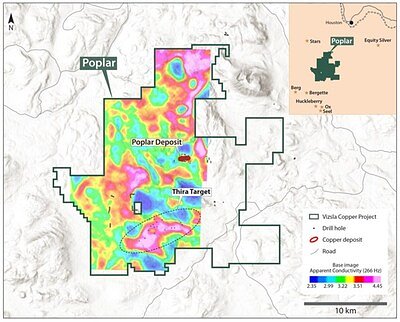
For centuries, mineral exploration relied on prospectors spotting clues on the surface. Today, the most promising discoveries are often hidden deep beneath layers of soil and rock. Vizsla Copper’s recent success at the Thira alteration corridor, located on its Poplar Project, is a testament to the power of modern science to see beneath this cover.
The company employed a method called Direct Current Induced Polarization (DCIP), a geophysical survey technique that functions like a form of medical imaging for the earth. By injecting electrical currents into the ground and measuring the response, geologists can detect subtle variations that indicate the presence of sulfide minerals, which are often associated with valuable copper deposits. The survey effectively creates a three-dimensional map of the subsurface geology, highlighting areas with the highest potential for mineralization.
The results from the recently expanded survey are compelling. They revealed two new high-priority target areas, named Copper Pond and Camp Lake, that display a distinct geophysical “fingerprint.” This signature—a core of moderate electrical chargeability surrounded by a halo of very high chargeability—is strikingly similar to the one that led to the company’s initial Thira discovery. Geologists interpret this pattern as the classic sign of a porphyry copper system: a mineral-rich core surrounded by a broader, pyrite-heavy alteration zone. The fact that these new anomalies are of a similar scale to the original discovery has sparked significant optimism.
“We have always thought that the 8 x 2 kilometre footprint is large enough to host multiple porphyry centers, and this survey supports that interpretation,” commented Steve Blower, Vizsla Copper's VP of Exploration. The success of the DCIP survey provides a clear, data-driven path forward, allowing the team to pinpoint the most promising locations for its next phase of drilling, planned for the first quarter of 2026. This scientific approach dramatically de-risks the costly process of drilling and transforms exploration from a game of chance into a calculated, strategic endeavor.
Powering the Future from Canada's West Coast
The timing and location of this potential discovery are of global significance. British Columbia is already Canada’s largest copper producer and a stable, highly regulated mining jurisdiction. As nations worldwide seek to secure reliable supply chains for critical minerals and reduce dependence on volatile sources, discoveries in regions like BC carry immense strategic weight.
Recognizing this, the provincial government has launched a Critical Minerals Strategy to bolster the sector and attract investment. The exploration industry has responded with enthusiasm; in 2023 alone, exploration spending for copper in BC reached C$244 million, accounting for nearly 40% of all exploration expenditures in the province. This intense focus underscores the collective belief that BC’s geology holds the key to meeting future demand.
The Poplar Project is situated within a geological belt of Mesozoic-aged rocks known to be highly prospective for porphyry-style deposits, which are the source of most of the world's copper. Vizsla Copper’s findings at Thira, located just 10 kilometers south of the project's established Poplar deposit, suggest the entire area could be part of a much larger mineralized system. Previous drilling at Thira has already returned impressive results, including an intercept of 237.3 meters grading 0.51% Copper Equivalent, confirming the presence of a robust mineralizing system. The new targets at Copper Pond and Camp Lake, which have yet to be tested, now represent the potential for a district-scale opportunity.
A Blueprint for Modern Exploration
Vizsla Copper’s methodical, technology-led approach at the Poplar Project serves as a blueprint for the future of mineral exploration. In an industry where risk is inherent, the integration of advanced geophysical modeling with traditional geological fieldwork provides a powerful tool for value creation. By identifying high-probability targets before a single drill rig is mobilized, the company maximizes its chances of success and makes a more compelling case for investment.
This strategy is resonating with a market that, according to industry analysts, is increasingly rewarding new, high-impact discoveries over the incremental expansion of existing resources. The company, backed by the resource-focused investment group Inventa Capital Corp., is executing a clear growth plan focused on discovery-led exploration in a top-tier jurisdiction. The upcoming winter drill program in Q1 2026 will be a pivotal moment, offering the first physical test of the compelling digital anomalies at Copper Pond and Camp Lake.
The journey from a geophysical signal on a computer screen to the copper wire inside a new electric vehicle is a long and complex one, involving years of further drilling, engineering studies, environmental assessments, and community engagement. Yet, it is precisely at this early stage—where innovation intersects with geological potential—that the foundations for the future are laid. The unfolding story at the Poplar Project is a powerful reminder that the raw materials for a sustainable tomorrow are being discovered today, through the intelligent application of science and strategy in our own backyard.