
- 80% of banking executives remain optimistic about the future, despite challenges.
- 49% of banks and 59% of credit unions have already deployed generative AI.
- 40% of banks and 50% of credit unions experienced higher fraud-related losses in 2025.
Experts agree that the banking industry is at a critical juncture, where successful navigation of AI integration, crypto adoption, and fraud prevention will determine which institutions thrive in 2026.
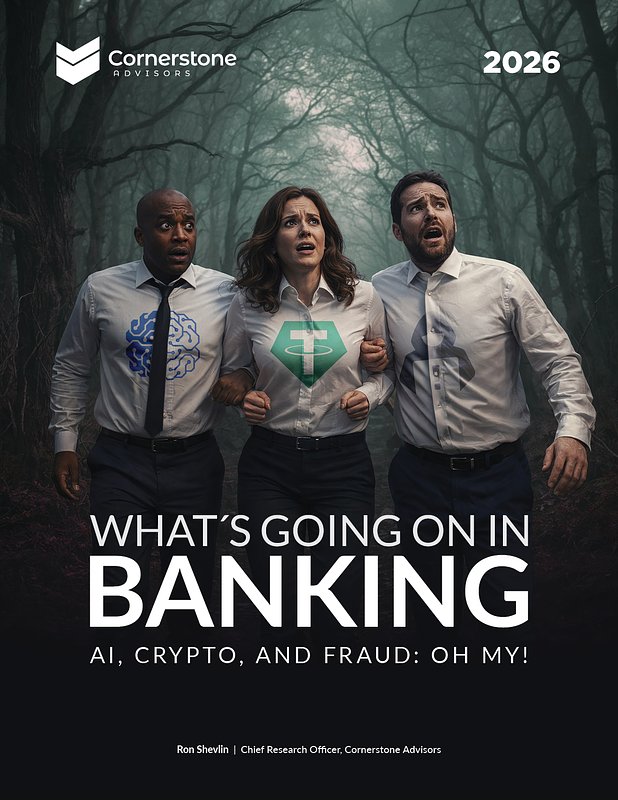
Banks Face AI, Crypto, and Fraud ‘Oh My!’ Moment in 2026
SCOTTSDALE, Ariz. – January 29, 2026 – The American banking industry stands at a critical crossroads, caught between the promise of revolutionary technology and the peril of unprecedented threats. A new report reveals that while over 80% of banking executives remain optimistic about the future, their optimism is tempered by a challenging trifecta: the rapid integration of artificial intelligence, the looming influence of cryptocurrency, and a dramatic escalation in financial fraud.
Cornerstone Advisors' 11th annual What's Going On in Banking report, based on a survey of 416 senior executives at U.S. banks and credit unions, paints a picture of an industry in urgent transition. The findings indicate that 2026 is the year emerging technologies move from the lab to the front lines, forcing institutions to grapple with operational realities and intense competitive pressures.
The AI and Crypto Revolution Hits Main Street Banking
For years, AI and crypto were boardroom buzzwords. Now, they are core operational priorities. The report finds that generative AI is moving into production at a stunning pace, with nearly half of banks (49%) and a majority of credit unions (59%) having already deployed the technology. Many more are planning significant investments this year.
This rapid adoption is a direct response to competitive pressure from fintechs and a strategic move to enhance efficiency, personalize customer service, and modernize infrastructure. Beyond simple chatbots, discussions are now advancing to agentic AI—autonomous systems that can perform complex tasks with minimal human oversight. While still in early stages, the fact that over half of institutions are discussing agentic AI at the executive level signals a profound shift in how banks envision their future operations, from automating credit memos to providing hyper-personalized financial advice.
Simultaneously, the world of digital assets is forcing its way onto the strategic agenda. While near-term deployment remains cautious, over 70% of banks have discussed stablecoins at the board level, and more than half have explored tokenized deposits and blockchain technology. This interest is driven not by speculative fervor, but by a defensive need to compete with crypto-native firms and meet evolving customer demands for faster, cheaper payments.
Recent regulatory developments, such as the GENIUS Act of 2025, are providing a clearer pathway for banks to issue and manage stablecoins. However, this new frontier is not without risk. Some industry analyses warn that widespread stablecoin adoption could lead to significant deposit outflows from traditional banks, potentially impacting lending capacity, particularly for regional institutions.
Fraud's Soaring Cost Becomes a Balance Sheet Crisis
While banks look to the future, a clear and present danger is wreaking havoc on their bottom lines. Fraud has escalated from a cost of doing business to a balance-sheet-level crisis. According to the Cornerstone report, roughly 40% of banks and 50% of credit unions experienced higher fraud-related losses in 2025, with most expecting that trend to continue or worsen in 2026.
The nature of the threat has also evolved. A significant portion of the damage is now self-inflicted, with first-party fraud—where individuals misrepresent their identity or intent to repay—accounting for more than 40% of total fraud losses. This surge is forcing a strategic pivot, with a full three-quarters of institutions increasing their fraud prevention budgets for the year ahead.
Fueling this crime wave is the democratization of advanced technology for malicious purposes. Criminals are leveraging generative AI to create sophisticated deepfakes, synthetic identities, and highly convincing phishing scams at an industrial scale. The rise of "fraud-as-a-service" on the dark web has lowered the barrier to entry, enabling organized criminal networks to launch complex attacks that were once the domain of nation-states. This has created a technological arms race, where banks are forced to deploy their own AI-powered defenses to detect and prevent AI-enabled attacks in real-time.
The Digital Dilemma: Bridging the Execution Gap
Perhaps the most telling finding in the report is the persistent disconnect between strategic ambition and operational reality. More than 80% of banks and credit unions plan to increase their technology spending in 2026, yet a significant number continue to fall short on planned system deployments. This "execution gap" highlights a critical challenge for the industry.
Simply throwing money at technology is not a solution. The research suggests the gap is caused by a confluence of factors, including a severe shortage of skilled tech talent, the immense challenge of integrating new platforms with outdated legacy systems, and a lack of clear strategic alignment between IT initiatives and business goals. Many institutions are discovering that buying a new software solution is easy; integrating it securely, training staff effectively, and extracting measurable value is extraordinarily difficult.
This challenge is at the heart of the 2026 banking narrative. "AI, crypto, and fraud are no longer future-state discussions—they're reshaping banking right now," says Ron Shevlin, chief research officer at Cornerstone Advisors and author of the report. "What separates leaders from laggards in 2026 won't be who experiments the most, but who operationalizes these technologies with discipline and purpose."
As community banks and credit unions navigate this complex landscape, their success will depend on their ability to balance innovation with execution. The optimism of banking leaders is warranted only if they can successfully manage the immense operational, technological, and security challenges that define this new era of finance.
Topics & Related
Artificial Intelligence
Generative AI
Blockchain & Web3
Regulation & Compliance
Cybersecurity & Privacy
Revenue
Banking
Software & SaaS
ChatGPT
Corporate Finance
Related Company Pulse