
- $90 billion: The industrial AI market is projected to grow to this size by 2034, up from $7.4 billion in 2025.
- 25-30%: Predictive maintenance can reduce maintenance costs by this percentage.
- 45%: Unplanned downtime can be cut by up to this amount with AI solutions.
Experts view Augury's Industrial AI Workforce as a transformative step in manufacturing, enabling proactive, role-based AI collaboration that enhances human productivity and operational efficiency.
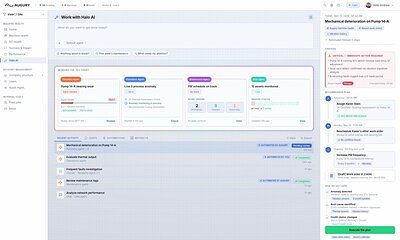
Augury's AI Workforce Aims to Redefine the Factory Floor
MILAN, May 18, 2026 – Industrial AI leader Augury today announced its progress in developing the "Industrial AI Workforce," a new platform of role-based AI agents designed to collaborate with human workers and usher in an era of self-optimizing manufacturing. The initiative, built on a strategic partnership with Google Cloud and AVEVA, integrates machine health data, broad operational context, and advanced AI reasoning to transform industrial insights into immediate, effective action on the factory floor.
Previewed ahead of the AVEVA World conference in Milan, the new offering represents a significant philosophical shift in industrial software. Instead of requiring workers to adapt to complex technology, Augury's AI agents are designed to adapt to the specific workflows of reliability, maintenance, and operations teams, acting as digital partners to enhance human productivity.
A New Class of Digital Co-Worker
For decades, industrial software has often added complexity to the factory floor, forcing employees to jump between disparate systems in what is commonly known as "swivel chair operations." Augury aims to eliminate this inefficiency by creating AI agents tailored to the daily objectives and challenges of specific roles. These agents are not just another tool in a crowded tech stack; they are designed to be proactive partners that automate routine tasks and streamline complex analyses.
"Augury has built a reputation helping global industrial leaders master asset reliability through world-class Machine Health insights," said Elan Greenberg, CEO of Augury. "Now, it's time to evolve from visibility to delivering an agentic offering that proactively supports the people running these plants."
This move from passive visibility to active support is at the core of the Industrial AI Workforce. By augmenting human expertise, the agents promise to free up skilled technicians and engineers to focus on higher-value activities like strategic improvements and complex problem-solving, rather than being bogged down by manual data correlation. This human-centric approach could also make manufacturing careers more appealing to a new generation of digital-native talent, addressing a critical skills gap in the industry. The long-term vision is a collaborative environment where human ingenuity is amplified by AI's analytical power.
The Power of Three: Data, Context, and AI
The intelligence behind the Industrial AI Workforce is powered by a potent combination of technologies from Augury, AVEVA, and Google Cloud. At its foundation is Augury's extensive machine health data, gathered from thousands of machines across global manufacturing sites. This provides the granular, real-time understanding of asset condition.
This data is then enriched with operational context from AVEVA CONNECT, a cloud-based industrial software platform that unifies information from various systems like Manufacturing Execution Systems (MES) and SCADA. This layer provides the 'why' behind a machine's behavior, connecting it to production schedules, quality parameters, and process data. The synthesis of these two data streams creates the "Industrial Context Graph," a dynamic and continuously evolving digital model of the entire production environment.
This rich, contextualized data is fed into Google's advanced Gemini models, which provide the sophisticated reasoning layer. "Gemini's ability to process long-term context and reason across complex datasets is a game-changer for the factory floor," noted Praveen Rao, Director of Manufacturing at Google Cloud. "With Augury's specialized Industrial AI agents built on Google Cloud, manufacturers can turn massive amounts of data into immediate, localized action."
This three-way synergy enables the AI agents to understand cause-and-effect relationships that span beyond individual machines. "By combining Augury's Machine data with AVEVA's operational context and Gemini's reasoning capabilities, we've created a foundation...powering intelligent industrial agents," explained Anoop Mohan, Chief Product and Technology Officer at Augury. Martin Jetté, VP Partner Sales at AVEVA, added that the integration helps customers "explore new ways to enhance and transform their operations."
From Theory to Factory Floor: Early Results and Business Impact
While the concept is ambitious, it is already being validated in real-world industrial settings. Global specialty minerals leader ICL Group is an early adopter, using the agents to drive tangible business outcomes. "Augury's role-based agents allow us to respond quickly to market demands and maintain consistent product quality," said Avi Boublil, R&D Director at ICL Iberia. He highlighted the platform's potential for "much quicker Root Cause Analysis (RCA) on reliability issues and more sophisticated yield analysis."
Although specific metrics from ICL's pilot are not yet public, the potential return on investment for such technology is well-documented. The industrial AI market is projected to grow from around $7.4 billion in 2025 to over $90 billion by 2034. A significant driver of this growth is predictive maintenance, which has been shown to reduce maintenance costs by 25-30%, eliminate 70-75% of breakdowns, and cut unplanned downtime by up to 45%. Augury itself claims that its existing customers typically achieve payback in six months or less, a benchmark the new agentic offering aims to surpass by delivering even deeper operational value.
Navigating a Competitive and Evolving Landscape
Augury's announcement comes as the entire industrial sector races to embrace AI. The company faces stiff competition from established giants like Siemens, which is developing its own "Industrial Copilot," and Rockwell Automation, which is advancing edge-based generative AI. Other major players like GE Digital, IBM, and Microsoft are also heavily invested in providing AI and IoT solutions for manufacturing.
In this crowded field, Augury differentiates itself with its comprehensive "Machine Health as a Service" model and its unique "Guaranteed Diagnostics™" program, which provides downtime compensation for missed detections. The creation of the Industrial AI Workforce, powered by its strategic partnerships, further solidifies its position by offering a deeply integrated solution that moves beyond simple predictive alerts to enabling genuine operational autonomy.
The development of the Industrial Context Graph is particularly significant, as it directly addresses one of the biggest hurdles to successful AI implementation: poor data quality and integration. By creating a unified, dynamic data layer, Augury is building the foundation necessary for reliable and scalable AI. As the manufacturing industry moves toward a future defined by data-driven decisions, the ability to securely and intelligently manage vast, interconnected datasets will be a critical competitive advantage.