
- Chip Size: 7x7 millimeter BGA100 package
- Motor Control: Single MCU manages up to three motor control systems
- Market Growth: Humanoid robot market projected to exceed $100 billion within a decade
Experts would likely conclude that Artery's new microcontroller represents a significant advancement in robotics miniaturization, offering a competitive edge in motor control integration and positioning the company as a key player in the rapidly expanding humanoid robot market.
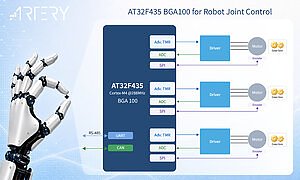
ARTERY's Tiny Chip Signals a Giant Leap for Humanoid Robot Dexterity
HSINCHU, TAIWAN – June 18, 2026 – In the world of high-stakes technology, sometimes the biggest shifts are driven by the smallest components. Today, Artery Technology announced a new, diminutive microcontroller unit (MCU) that barely covers a pencil eraser. But for the rapidly expanding humanoid robot market, this launch could be a pivotal moment. The company has added a 7x7 millimeter BGA100 package to its high-performance AT32F435/437 series, a move aimed squarely at solving one of the biggest challenges in modern robotics: packing immense computational power into impossibly tight spaces. This isn't just another component refresh; it's a strategic salvo into a market projected by some analysts to surpass $100 billion within the next decade, signaling a clear intent to become a foundational supplier for the next generation of intelligent machines.
The Miniaturization Imperative
To understand the significance of Artery's announcement, one must look at the evolution of robotics itself. For years, the dominant design paradigm was centralized control, where a single, powerful computer acted as the robot's brain, sending commands out to relatively simple limbs. That model is being rapidly replaced by a distributed architecture, where intelligence is pushed out to the edge—directly into the joints, fingers, and end-effectors. This shift is essential for achieving the fluid, multi-degree-of-freedom motion required for tasks that demand human-like dexterity. As one engineer in the field noted, "The future of robotics is not a central brain with dumb limbs, but a network of smart, collaborating nodes."
This is where the challenge intensifies. A single robotic finger might contain multiple joints, each requiring its own motor, driver, and sensor. Embedding a dedicated control system for each within such a confined space is an extreme engineering feat. The demand for miniaturized, highly integrated solutions is no longer a preference; it is a fundamental requirement. Industry forecasts validate this trend, with the market for advanced dexterous hands projected to grow at a compound annual rate exceeding 40%. The much larger humanoid robot market is poised for even more explosive growth, with some estimates projecting a CAGR over 50% through 2034. This expansion is contingent on hardware breakthroughs that allow for more compact, efficient, and cost-effective designs. Artery's new 7x7mm package is a direct response to this imperative, enabling developers to integrate sophisticated control circuits into the very mechanics of a robot's extremities.
A Single Chip to Command the Joint
Beyond its small footprint, the AT32F435/437 MCU packs a formidable punch. At its heart is an Arm Cortex-M4 core running at up to 288MHz, equipped with digital signal processing (DSP) and a floating-point unit (FPU). For a robotics developer, this translates to the computational horsepower needed for the complex, real-time mathematical calculations behind advanced motor control algorithms, such as field-oriented control (FOC).
More critically, the company highlights that a single MCU can manage up to three separate motor control systems. This is a game-changer for high-density applications. Instead of requiring multiple controllers for a complex joint or a multi-jointed finger, a single, tiny chip can orchestrate the entire assembly. This integration drastically reduces system complexity, shrinks the required circuit board area, and lowers the overall bill of materials—a crucial factor for commercial viability. Furthermore, the inclusion of two built-in CAN 2.0B communication interfaces directly supports the distributed control architecture that is becoming standard. These interfaces allow the numerous "mini-brains" within a robot to communicate with each other at high speed, ensuring the synchronous and collaborative operation necessary for graceful and precise movement.
Navigating a Crowded Battlefield
Artery Technology is not entering an empty arena. The market for high-performance MCUs for robotics is dominated by established giants like STMicroelectronics, NXP, and Renesas. These titans have spent years building vast ecosystems around their products, offering extensive software libraries, development tools, and massive developer communities that represent a significant competitive moat. STMicroelectronics, in particular, offers its popular STM32 series in similarly compact 7x7mm BGA packages, presenting a direct and formidable competitor.
For Artery, the challenge is twofold. First, it must prove that its hardware is not just comparable but offers a distinct advantage, whether in raw performance, power efficiency, or specific peripheral features tailored for robotics. The claim of controlling three motors from a single MCU is a strong selling point. Second, and perhaps more difficult, it must convince engineers to adopt its platform over the familiar and well-supported ecosystems of its rivals. Success in the semiconductor space is often less about the single best chip and more about the path of least resistance for developers. Artery's strategy likely hinges on a compelling cost-performance ratio, offering a solution that is powerful enough for cutting-edge applications but priced aggressively enough to entice developers and manufacturers away from entrenched competitors, especially in a market where scale and cost-efficiency are paramount.
Beyond Robots: A Play for High-Density Control
While humanoid robots capture the imagination, the utility of Artery's new offering extends far beyond them. The same pressures for miniaturization and performance are present across a wide range of high-tech industries. Unmanned aerial vehicle (UAV) flight controllers, for example, are constantly battling for every gram of weight and cubic millimeter of space to improve flight time and agility. Smart camera gimbals require powerful, real-time processing to deliver smooth, stabilized video, all within a compact housing.
By targeting these adjacent markets, Artery is not just launching a product; it is deploying a platform technology. The combination of a high-speed core, multi-axis motor control, and a tiny footprint is a versatile solution for any application where performance and density are in tension. This strategic breadth diversifies the company's market exposure and reinforces its identity as a specialist in high-performance embedded control. As intelligent devices continue to proliferate and embed themselves more deeply into our world, the demand for such enabling components will only grow, making the relentless pursuit of integration and efficiency a key catalyst for the next phase of technological evolution.