
- $6M Funding: Artemis secures $6 million to scale its AI platform for the solar industry.
- 98% Faster Turnaround: Customers report up to 98% faster project completion times using Artemis's platform.
- 27-Fold Growth: The company has expanded 27 times over the last nine months.
Experts would likely conclude that Artemis's AI platform is poised to revolutionize the solar industry by significantly streamlining workflows, reducing costs, and accelerating the adoption of distributed energy solutions.
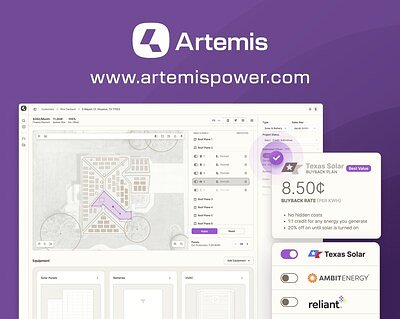
Artemis Raises $6M to Scale AI Platform for Solar Industry
HOUSTON, March 4, 2026 – Artemis, a Houston-based climate tech firm, has secured $6 million in a new financing round to scale its AI-powered platform, which it describes as the "operating system for distributed energy." The funding, co-led by Long Journey Ventures and Copec WIND Ventures, coincides with the company's rebrand from its former identity, Monalee. The fresh capital will fuel the expansion of its software, designed to slash the time it takes for contractors to design, sell, and finance residential solar and battery projects from days to mere seconds.
The funding round also saw participation from a syndicate of investors including Ludlow Ventures, Shrug Capital, Coalition Operators, Plug and Play Ventures, FJ Labs, Tribeca Ventures, Palm Tree Crew, and Scott Banister, signaling strong confidence in Artemis's mission to overhaul the fragmented and often sluggish workflows that hinder the pace of the green energy transition.
From Installer to Industry Backbone
Artemis's journey began in 2019 under the name Monalee, operating as a vertically integrated installer of solar panels and battery storage systems. It was during this time, while navigating the complex web of utility regulations and permitting requirements across the United States, that the team developed its own sophisticated internal software. This proprietary system, powered by artificial intelligence, was built out of necessity to streamline its own operations and gain a competitive edge.
In 2024, the company made a strategic pivot, recognizing that its most valuable asset was not its installation service but the powerful digital infrastructure it had created. It spun out the software as a standalone platform, rebranding to Artemis and shifting its focus from competing with installers to empowering them.
"The rebrand marks our evolution from a tech-enabled construction business to the digital backbone for distributed energy," said Walid Halty, co-founder and CEO of Artemis. Halty explained the new name's significance, stating, "We chose the name Artemis, twin sister of Apollo and protector of the earth, to reflect our mission to harness the sun and modernize the grid." This evolution positions the company as a foundational technology provider aiming to become an indispensable tool for the entire sector.
An OS to Unclog the Energy Transition
The residential solar industry, despite its rapid growth, is plagued by operational bottlenecks. The global distributed energy generation market, valued at over $380 billion in 2024, is expanding quickly, yet installers face significant hurdles. Projects can take over 100 days from initial quote to final installation, a timeline inflated by cumbersome design processes, fragmented software tools, and complex financing and compliance procedures. This friction not only slows down the adoption of clean energy but also squeezes the profit margins of the thousands of small and medium-sized contractors who form the backbone of the industry.
Artemis aims to eliminate this friction. Its platform acts as a unified operating system, integrating AI-powered system design, embedded financing options, and compliance automation into a single, seamless workflow. According to the company, customers using the software have reported dramatic efficiency gains, including up to 72% lower software costs and a 98% faster project turnaround. For sales teams, this acceleration can be transformative, with some clients reportedly seeing five times higher conversion rates compared to legacy tools.
"Installers shouldn't need six tools and a week of back-and-forth to sell a project," Halty remarked. "This funding gives us the fuel to scale our mission to compress design, financing, and compliance into a single flow so every installer can operate like a modern energy company. We're not just speeding up deals, we're modernizing how distributed energy gets built." The platform's impact is already being felt by early adopters. GoodLeap, a major financing provider, saw its direct sales team cut design-to-sale times from a full week to just one minute, while installer Dynamic SLR reduced its operational costs by 72%.
Strategic Capital and Leadership for a Growing Market
The $6 million investment is more than just financial fuel; it represents a strategic endorsement from investors deeply embedded in technology and energy. Arielle Zuckerberg, General Partner at Long Journey, praised the company's approach. "Artemis is transforming the complexity of distributed energy into elegant simplicity," she stated. "It's the kind of magically weird company we love at Long Journey — technically ambitious, deeply grounded in real-world operations, and building the invisible software that makes the energy transition actually move."
The participation of Copec WIND Ventures, the corporate venture arm of Latin American energy giant Copec, highlights Artemis's international potential. This partnership provides a direct channel into burgeoning energy markets south of the border. "Artemis is building the software backbone for distributed energy, and we're excited to help bring that to Latin America," said Brian Walsh of Copec WIND Ventures.
Further bolstering its strategic direction, Artemis has appointed Alexander Urban as its new Chief Financial Officer. Urban joins from Shell Ventures, where he spent nearly a decade, most recently as a Principal deploying hundreds of millions of dollars into energy transition startups. His extensive experience in capital allocation and operational discipline within the distributed energy space is expected to be crucial as Artemis manages a period of explosive growth, having reportedly expanded 27-fold over the last nine months. Urban will oversee the deployment of the new funds to scale the engineering, sales, and support teams.
Global Ambitions and the Latin American Frontier
With a foothold in the U.S., Artemis is setting its sights on a global market opportunity it estimates at over $200 billion. The distributed energy generation market is expanding rapidly worldwide, with some projections forecasting it to exceed $1 trillion by 2034, driven by falling technology costs and a global imperative to decarbonize.
The company's first international foray will be into Latin America, facilitated by its partnership with Copec. Artemis is launching pilot programs in Chile and Colombia, two nations with aggressive renewable energy targets and growing demand for distributed generation. Chile aims for 80% of its energy to come from renewables by 2030 and possesses some of the world's best solar resources. Colombia is also actively diversifying its energy matrix, with government initiatives promoting residential and industrial solar self-consumption. By digitizing workflows for Copec's vast network of customers and partners in these countries, Artemis can test and refine its platform for new markets while helping accelerate solar adoption in the region.
The new funding will be instrumental in this expansion and in advancing the company's product roadmap. Artemis is actively hiring engineers and AI researchers to enhance its platform's capabilities, with plans to deepen integrations with financing partners and permitting authorities. The ultimate goal is to enable every home improvement and solar contractor to operate with the speed and efficiency of a modern software company, bringing clean, affordable energy to millions more homes across the globe.
Topics & Related
Software & SaaS
AI & Machine Learning
Artificial Intelligence
Generative AI
Related Company Pulse