
- Infinite Magazine Depth: BAE's ROOK system offers continuous electronic countermeasures, eliminating the need for limited interceptors. - Multi-Layered Defense: The Army's strategy integrates soft-kill, hard-kill, and armor solutions for comprehensive vehicle protection. - Program of Record: The contract solidifies ROOK's role in the Army's long-term modernization plans.
Experts agree that the adoption of soft-kill electronic warfare systems like BAE's ROOK represents a critical advancement in vehicle protection, offering a sustainable and cost-effective defense against evolving drone and missile threats.
Army Taps BAE for 'Infinite' Shield Against Drones and Missiles
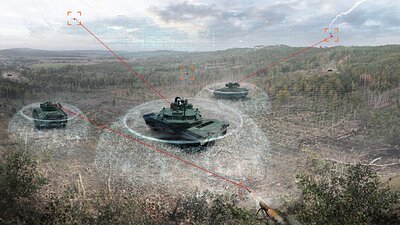
AUSTIN, TX – May 27, 2026 – The U.S. Army has awarded a major contract to defense giant BAE Systems to equip its ground combat vehicles with a new generation of electronic armor. The Soft Kill Active Protection System (APS) program will integrate BAE's Rapid Optical Observation and Kill (ROOK) system, a technology designed to invisibly shield soldiers by jamming and confusing the guidance systems of incoming threats like anti-tank missiles and the swarming drones that now dominate modern battlefields.
This move signals a significant shift in the Army's vehicle protection strategy, embracing sophisticated electronic warfare (EW) as a primary line of defense. The contract, designated a "program of record," cements the technology's role in the military's long-term modernization plans.
A New Era of Electronic Armor
Unlike traditional "hard-kill" systems that physically shoot down incoming projectiles with interceptors, BAE Systems' ROOK is a "soft-kill" solution. It operates within the electromagnetic spectrum, detecting threats and then deploying countermeasures to disrupt their sensors and guidance logic, causing them to miss their target or become inert.
The primary advantage of this approach is what the company describes as an "infinite magazine depth." While a hard-kill system has a limited number of interceptors, the ROOK system can continuously emit its electronic countermeasures, offering a sustainable and cost-effective defense against a high volume of threats. This is critical in a complex battlespace where a single vehicle might face multiple threats simultaneously.
"Modern ground warfare demands a layered defense, and soft-kill technologies are a critical, complementary component," said Dave Gillespie, director of Optics and Countermeasure Solutions at BAE Systems, in the company's announcement. "ROOK offers a cost-effective, sustainable defense with an infinite magazine depth, continuously disrupting enemy systems."
This capability is designed to work in concert with other defensive layers. By neutralizing threats electronically at a distance, the soft-kill system preserves the vehicle's limited hard-kill munitions for last-resort situations or for threats that cannot be jammed, such as unguided rocket-propelled grenades (RPGs).
Responding to a Battlefield Transformed by Drones
The urgency behind the Army's adoption of soft-kill technology is a direct response to the rapidly evolving character of ground combat. Recent conflicts have provided a stark and bloody demonstration of the vulnerability of even the most heavily armored tanks and fighting vehicles to cheap, plentiful, and increasingly sophisticated threats.
Advanced anti-tank guided missiles (ATGMs) and, most notably, small unmanned aerial systems (UAS)—or drones—have reshaped tactical calculations. Drones, ranging from commercially available quadcopters modified to drop munitions to purpose-built loitering munitions (often called "kamikaze drones"), can attack vehicles from above, targeting the weaker top armor. Furthermore, the potential for "swarming" tactics, where dozens of autonomous drones attack a single target at once, threatens to overwhelm conventional point-defense systems.
Traditional armor is often insufficient against these top-attack profiles, and hard-kill systems can be quickly depleted by a drone swarm. Electronic warfare systems like ROOK offer a compelling solution by creating a protective bubble around the vehicle that can jam the control links or navigation signals of multiple drones at once, effectively neutralizing a swarm without firing a single shot.
The Army's Layered Protection Strategy
This contract is a key component of the U.S. Army's broader effort to create a multi-layered, adaptable defense for its vehicle fleet. The strategy moves away from a reliance on any single solution and instead builds a comprehensive shield using passive armor, reactive armor, soft-kill countermeasures, and hard-kill interceptors.
This integrated approach is formalized under the Army's Modular Active Protection System (MAPS) framework. MAPS establishes an open-systems architecture, allowing the Army to plug-and-play different sensors, processors, and countermeasures from various suppliers onto a common controller. This prevents vendor lock-in and enables rapid upgrades as new threats and technologies emerge.
The integration of BAE's Soft Kill APS is a perfect illustration of this philosophy in action. It will complement existing and future hard-kill systems, such as the Rafael-made Trophy APS already deployed on some M1 Abrams tanks. A typical engagement might see the ROOK system first attempt to jam an incoming ATGM. If that fails or the threat is not susceptible to jamming, the system's sensors would then cue the hard-kill interceptor to engage the threat at close range, creating a resilient, multi-opportunity defense.
Solidifying Leadership in a Competitive Field
For BAE Systems, the program of record award is a major strategic victory that solidifies its leadership in the highly competitive electronic warfare and vehicle survivability markets. While competitors like Israel's Rafael and Elbit Systems have made significant inroads with their hard-kill systems, this contract highlights the growing importance of the EW domain where BAE has deep expertise.
The ROOK system is part of the company's Intrepid Shield™ concept, a vision for a full-spectrum, layered defense that integrates radio-frequency and electro-optical/infrared capabilities to create a 360-degree sphere of protection. The Army's investment will not only field the current ROOK system but will also fund continued development of BAE's next-generation countermeasure technologies, including the Stormcrow™ and TERRA RAVEN™ systems.
This long-term commitment ensures that as adversaries develop new sensors and guidance techniques, the Army's protective systems can evolve in lockstep. The work will be centered at BAE Systems' facilities in Austin, Texas, and Merrimack, New Hampshire, contributing to the domestic industrial base for these critical defense technologies. As the digital battlefield becomes ever more complex, systems that can control the electromagnetic spectrum are becoming as vital as the thickness of a vehicle's steel plate.