
- Surface Sample Grades: Up to 18.15% copper and 114.44 g/t of platinum-group metals (PGMs)
- Channel Sampling Results: 6.85% copper and 23.64 g/t PGMs over 3.5 meters
- Stock Surge: SPC Nickel Corp.'s stock soared over 50% on the TSX Venture Exchange
Experts view the Muskox Project as a potentially world-class mineral discovery with strategic importance for the global energy transition, though they caution that Arctic development presents significant logistical, financial, and regulatory challenges.
Arctic Bonanza: Nickel Find in Nunavut Could Reshape Critical Minerals
SUDBURY, ON – November 24, 2025 – In the high-stakes world of mineral exploration, where decades of quiet work can culminate in a single game-changing discovery, junior explorer SPC Nickel Corp. may have just hit a geological jackpot. The company announced assay results from its Muskox Project in Nunavut that are nothing short of spectacular, revealing some of the highest-grade copper, nickel, and platinum-group metal (PGM) concentrations seen in a new discovery in recent memory. The findings, located in a remote but stable Canadian jurisdiction, have ignited investor interest and raised the tantalizing prospect of a new, world-class mining district vital for the global energy transition.
The announcement detailed surface sample grades as high as 18.15% copper and a staggering 114.44 grams per tonne (g/t) of PGMs. For context, these figures dwarf the average grades of many of the world's most profitable operating mines. The news sent the company's stock soaring over 50% on the TSX Venture Exchange, a clear signal that the market sees the monumental potential locked within the Arctic rock.
Decoding 'World-Class' Grades
For investors and industry observers, the key is to look beyond the headline-grabbing 'grab sample' numbers, which by nature are selective. More telling are the results from channel sampling, a more systematic method that provides a better indication of a deposit's true potential. Here, too, the Muskox Project delivered, with one channel at the Equinox Target returning an average of 6.85% copper and 23.64 g/t PGMs over a width of 3.5 metres.
To place these results in perspective, legendary deposits like Voisey's Bay in Labrador were built on ore grading around 2.8% nickel and 1.7% copper. The massive Norilsk-Talnakh district in Russia, a primary geological analogue for Muskox, operates on ores averaging around 1.8% nickel and 3.6% copper. SPC Nickel's findings, particularly the copper and precious metal values, are in a league of their own, validating the company's long-held belief in the project's potential. As CEO Grant Mourre stated, the results "underscore the unique geologic potential of the Muskox Project and position it as a leading exploration opportunity."
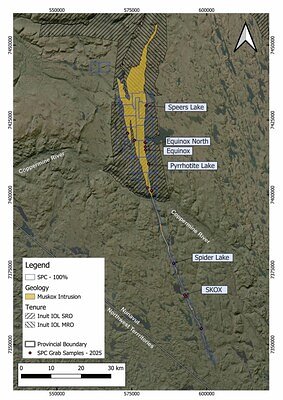
What excites geologists most is not just the richness of the samples, but their distribution. High-grade mineralization was found across multiple targets—Equinox, Speers Lake, Pyrrhotite Lake, and the Feeder Dyke—spread along a 125-kilometer-long geological intrusion. This suggests Muskox is not a single small pocket of mineralization but a massive, metal-bearing magmatic system with the potential to host multiple deposits. Further diversifying the opportunity, explorers also uncovered a new style of mineralization at the Pyrrhotite Lake target, with one sample yielding 23.7% zinc and an astonishing 7,500 g/t silver, hinting at an even broader polymetallic system than previously understood.
A Strategic Prize in the Critical Minerals Race
The timing of this discovery could not be more significant. The metals found at Muskox—copper, nickel, and PGMs like palladium and platinum—are the foundational materials of the 21st-century economy. Copper is essential for all things electric, from wiring to wind turbines. Nickel is a primary component of high-performance batteries for electric vehicles (EVs). Palladium and platinum are indispensable in catalytic converters and are increasingly used in hydrogen fuel cells.
As Western nations race to decarbonize their economies and secure their supply chains, the geopolitical value of these metals has skyrocketed. Much of the world's current supply is concentrated in geopolitically complex regions, with Russia being a dominant producer of both nickel and palladium. The prospect of a major new source in Nunavut, Canada—a politically stable, Tier-1 mining jurisdiction—is a strategic game-changer. A deposit of this scale could significantly bolster North American self-sufficiency, de-risking the supply chains for everything from Ford's F-150 Lightning to the continent's growing grid-scale battery storage infrastructure.
The Arctic Gauntlet: From Discovery to Development
While the geological prize is immense, the path from a high-grade surface discovery to a producing mine is a long and arduous one, especially in the Canadian Arctic. The Muskox Project lies 75 kilometers south of the coastal hamlet of Kugluktuk, in a region with no permanent roads and minimal infrastructure. The logistical challenges are formidable.
Building a mine here would require a capital investment likely running into the billions of dollars. This would necessitate constructing an all-weather access road, an airstrip capable of handling heavy cargo, worker accommodations, and possibly port facilities for shipping concentrate. All construction and operations are constrained by a harsh climate and a short summer sea-lift window, which dramatically increases costs and complexity. The experiences of other Arctic mines, such as Agnico Eagle's Meadowbank Complex and Baffinland's Mary River Mine, serve as stark reminders of the operational and financial hurdles.
Furthermore, any proposed development will face one of the world's most rigorous environmental assessment processes through the Nunavut Impact Review Board (NIRB). Permitting is a multi-year affair involving deep consultation and scrutiny of potential impacts on the fragile Arctic ecosystem, particularly on caribou migration routes and marine life. For SPC Nickel, the stunning assay results are just the first step; proving the project is economically viable and environmentally sustainable is the true challenge.
Nunavut at a Crossroads
The final, and perhaps most critical, piece of the puzzle is the human element. The project falls within the Kitikmeot Region, and its future hinges on a successful partnership with the local Inuit. The Kitikmeot Inuit Association (KIA), which manages Inuit-owned lands, has a sophisticated understanding of resource development. There is a clear desire within communities like Kugluktuk for the jobs, training, and economic opportunities that a major mine can provide.
However, this support is conditional. Under the Nunavut Land Claims Agreement, SPC Nickel will eventually need to negotiate an Impact and Benefit Agreement (IBA) with the KIA. These agreements are comprehensive contracts that ensure the project delivers tangible, long-term benefits to the Inuit while mitigating negative social and environmental impacts. The KIA has a track record of supporting well-managed projects that respect Inuit rights and protect the traditional harvesting lifestyle that remains central to the culture. SPC Nickel's ability to build a relationship based on trust and mutual benefit will be as crucial to its success as any drill result.
The remarkable grades at the Muskox Project represent a pivotal moment for SPC Nickel, transforming it from a little-known explorer into a company with a potentially world-altering asset. The market's enthusiastic response reflects this newfound potential. Yet, the journey ahead is a marathon, not a sprint. The company must now navigate the immense financial, logistical, and regulatory challenges of the Arctic while building a durable partnership with the people of Nunavut. The discovery is made, but the real work has just begun.