
- 40 TOPS: Total AI performance of the ARES-2100 system
- 17 TOPS: Dedicated NPU 5.0 performance for industrial inference tasks
- Operating Range: -20°C to 60°C (-4°F to 140°F) for rugged industrial environments
Experts would likely conclude that the ARES-2100 represents a significant advancement in edge AI for industrial applications, offering a powerful, compact, and durable solution that addresses critical needs for real-time processing and reliability in demanding environments.
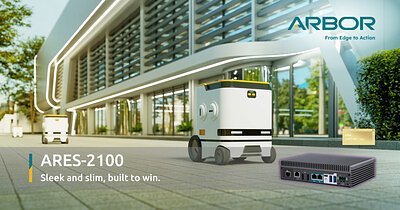
ARBOR's ARES-2100 Brings Compact AI Power to the Industrial Edge
TAIPEI, Taiwan – May 07, 2026 – ARBOR Technology Corp. has unveiled its ARES-2100 Series, an ultra-slim, fanless computing system designed to bring powerful artificial intelligence capabilities directly to the demanding environments of factory floors, warehouses, and mobile robotic platforms. The launch signals a significant step forward in making advanced AI more accessible and reliable for industrial automation, machine vision, and smart factory applications.
Powered by Intel’s new Core Series 3 processors, codenamed “Wildcat Lake,” the ARES-2100 is engineered to perform complex AI inference tasks locally, reducing the reliance on cloud computing and its associated latency. This move addresses a critical need in modern industry, where split-second decisions are essential for safety, efficiency, and quality control. By integrating high-performance computing into a ruggedized, compact chassis, ARBOR is positioning the new series as a cornerstone for the next generation of industrial intelligence.
The Power Inside the Box: A New Generation of Edge AI
At the heart of the ARES-2100 lies a sophisticated hybrid computing architecture. The system leverages Intel's Core Series 3 processor, which combines traditional high-performance CPU cores with advanced Intel Xe3 graphics and, most notably, an integrated Neural Processing Unit (NPU) 5.0. This trio of processing engines allows for a highly efficient distribution of workloads, a critical factor for power-constrained edge devices.
The system delivers up to 40 Tera Operations Per Second (TOPS) of total AI performance. Crucially, the dedicated NPU 5.0 contributes up to 17 TOPS on its own. This specialized silicon is designed to accelerate AI models for tasks like object detection and data analysis with remarkable power efficiency. By offloading these persistent, low-latency AI workloads to the NPU, the main CPU and GPU are freed up to handle other system tasks and more graphically intensive processes, respectively. This results in faster, more responsive AI applications, from real-time defect detection on a production line to navigational processing for an autonomous mobile robot (AMR).
While the platform's 40 TOPS meets the threshold for certain AI PC certifications, the 17 TOPS NPU performance places it in a specific category optimized for industrial inference rather than the most demanding consumer AI features. This focus is deliberate, targeting the practical needs of industrial settings where consistent, low-latency performance on specific AI tasks is paramount. The system supports a range of AI data types and is compatible with major software frameworks like OpenVINO™ and ONNX RT, giving developers the flexibility to deploy a wide variety of AI models.
Built for the Factory Floor: Redefining Industrial Durability
Beyond its processing power, the ARES-2100 is defined by its physical resilience. Recognizing that industrial environments are often unforgiving, ARBOR has engineered the system to withstand the rigors of 24/7 operation. The device is housed in an ultra-slim 1U chassis that is completely fanless. This design choice is critical for reliability, as it eliminates a common point of failure and prevents the ingress of dust, debris, and moisture that can cripple systems with active cooling fans.
Its rugged construction is certified to the MIL-STD-810H standard for durability, ensuring it can tolerate the shock and vibration common in manufacturing facilities and on mobile platforms. The system is designed to operate reliably in a wide temperature range, from a frigid -20°C to a sweltering 60°C (-4°F to 140°F), allowing it to be deployed in unconditioned cabinets or near heat-generating machinery without performance degradation.
Further enhancing its suitability for industrial deployment are features like a secure cable-lock design to prevent accidental disconnections, a wide-range 9–36V DC power input to handle voltage fluctuations, and up to three 2.5GbE LAN ports for high-speed network connectivity to sensors, cameras, and control systems. Its compact dimensions make it ideal for integration into space-constrained locations, such as the chassis of an AMR, a 1U server rack, or a slim industrial control cabinet, where every millimeter counts.
Driving Automation in Smart Factories and Logistics
The combination of powerful AI, a rugged build, and a compact form factor positions the ARES-2100 to address some of the most pressing challenges in industrial automation and logistics. The market for Edge AI is growing rapidly as companies seek to overcome the limitations of cloud-based processing, including network latency, bandwidth costs, and data security concerns. By processing data locally, the ARES-2100 enables the real-time decision-making that underpins Industry 4.0.
For autonomous mobile robots (AMRs) and automated guided vehicles (AGVs), the system provides the onboard intelligence needed for complex navigation, obstacle avoidance, and task execution in dynamic warehouse environments. In machine vision applications, its low-latency processing allows for high-speed quality inspections on production lines, identifying microscopic defects in real time and reducing waste.
In the broader context of the smart factory, multiple ARES-2100 units can be deployed to create a distributed intelligence network. This network can power predictive maintenance applications by analyzing sensor data from machinery to anticipate failures before they occur, minimizing costly downtime. It can also optimize energy consumption, monitor safety protocols, and provide managers with real-time operational insights, all while keeping sensitive production data securely on-premises.
A Strategic Alliance in a Competitive Market
The launch of the ARES-2100 also highlights the strategic collaboration between ARBOR Technology and Intel. This partnership merges Intel's leadership in processor technology with ARBOR's deep expertise in building robust computing hardware for specialized industrial markets. As the industrial Edge AI market becomes more crowded, with competitors like Advantech and ADLINK also offering powerful solutions, such alliances are crucial for driving innovation and setting new performance benchmarks.
By being one of the first to market with a ruggedized system based on Intel's Core Series 3 and its NPU 5.0, ARBOR is making a clear statement about its commitment to leading the next wave of edge innovation. The collaboration ensures that the latest advancements in silicon are quickly translated into deployable, real-world solutions that are hardened for the unique challenges of the industrial sector. This synergy is aimed at providing manufacturers and logistics operators with future-ready tools that are not only powerful but also reliable and scalable, enabling them to build the intelligent, autonomous systems of tomorrow.