
- $7 billion: Projected market size of the Network Detection and Response (NDR) market by the early 2030s.
- 12+ systems: Number of disconnected systems security teams often use, leading to tool sprawl.
- 30-day evaluation: Free trial period offered for ThreatGuard to lower adoption barriers.
Experts would likely conclude that APCON's ThreatGuard represents a strategic and innovative entry into the competitive NDR market, leveraging AI and deep network expertise to address critical challenges like tool sprawl and alert fatigue, though its success will depend on real-world performance against established players.
APCON Challenges NDR Market with AI-Powered ThreatGuard Platform
WILSONVILLE, OR – May 20, 2026 – In a strategic move to expand from network visibility into active cyber defense, APCON, Inc. has officially launched ThreatGuard, an AI-assisted cybersecurity platform designed to streamline threat detection and response for security teams of all sizes. The launch positions the long-standing network monitoring specialist to compete in the crowded and rapidly growing Network Detection and Response (NDR) market.
ThreatGuard aims to tackle a persistent challenge in cybersecurity operations: tool sprawl. Security teams often grapple with a dozen or more disconnected systems for monitoring, detection, and investigation, leading to alert fatigue, operational inefficiencies, and critical blind spots. APCON’s new platform directly addresses this by integrating real-time threat detection, deep packet inspection, traffic analysis, and AI-powered investigation into a single, unified environment.
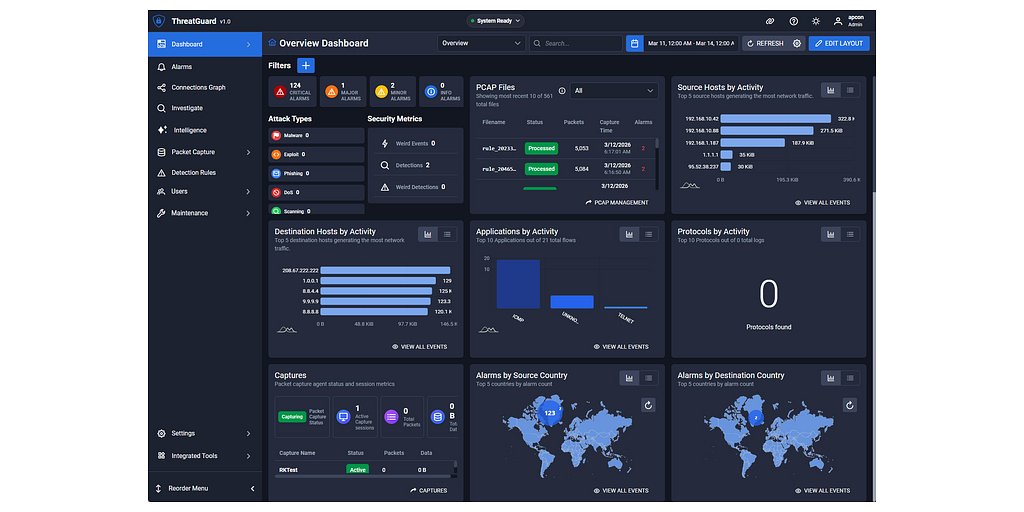
By consolidating alarms, network traffic, packet-level evidence, and session metadata into one investigative workspace, ThreatGuard is engineered to help security analysts move from an initial alert to a comprehensive analysis and response without the time-consuming process of pivoting between multiple tools and manually correlating data.
Unifying a Fragmented Security Landscape
The core value proposition of ThreatGuard lies in its unified approach. For years, security operations centers (SOCs) have been forced to stitch together disparate solutions, creating a complex and often fragile security posture. This fragmentation not only slows down response times but also increases the risk of sophisticated attackers slipping through the cracks.
ThreatGuard’s architecture is built to provide a holistic view of the network. Its deep packet inspection (DPI) capabilities are a key component, enabling it to perform both signature-based detection and stateful protocol analysis. This allows the platform to look beyond simple traffic headers and analyze the full content of data packets, giving it the ability to uncover suspicious behaviors, internal policy violations, and advanced intrusion attempts that might be missed by more superficial monitoring tools. Integrated dashboards provide immediate visibility into alarms, file transfers, application usage, and overall network activity, offering a centralized command center for security personnel.
Intuitive workflows are designed to guide users through the investigative process, helping them quickly connect the dots between anomalous events, forensic evidence, and the specific systems impacted within their environment. This emphasis on ease of use suggests an ambition to make advanced threat detection accessible not just to large enterprises with dedicated SOC teams, but also to mid-sized organizations with more limited resources.
The AI Differentiator and Visual Investigation
Powering the platform's intelligence is AI*p (APCON’s Intelligence Processor), an engine designed to reduce the manual burden on security teams. One of its standout features is the automation of rule updates. In a threat landscape where new attack vectors emerge daily, keeping detection policies current is a relentless task. By automating this process, ThreatGuard aims to ensure that its defensive posture evolves in real-time without constant human intervention, freeing up analysts to focus on higher-value investigative work.
Further enhancing the investigative experience is the platform's Connection Graph. This feature provides a dynamic visual map of the network, illustrating the relationships between hosts, active sessions, and security alerts. Instead of sifting through dense log files, analysts can use the graph to visually trace the path of an attack, identify all affected devices, and understand the scope of a breach more quickly. This visual approach is intended to help teams focus on what matters most, cutting through the noise of a busy network.
Recognizing the need for constant vigilance, APCON has also included a feature-rich mobile application for both Apple and Android devices. The app allows administrators to receive real-time notifications about security events and monitor alerts remotely, providing a crucial capability for teams that require 24/7 oversight, regardless of their physical location.
A Strategic Gambit in a Competitive Arena
The launch of ThreatGuard marks a significant strategic expansion for APCON. Founded in 1993, the company built its reputation as a trusted provider of network visibility solutions, including high-performance packet brokers and monitoring switches. While a leader in its niche, APCON is a smaller entity compared to the giants dominating the broader cybersecurity market.
By entering the NDR space, APCON is stepping into a highly competitive arena. The market is projected to grow to over $7 billion by the early 2030s and is currently led by major players like Cisco Systems and Palo Alto Networks, as well as specialized AI-driven firms such as Darktrace and Vectra AI. APCON is betting that its deep expertise in network traffic and packet analysis, combined with a focus on usability and integration, can carve out a meaningful share.
The move is a logical evolution, leveraging the company's core competency in providing total network visibility and applying it directly to security outcomes. ThreatGuard is not just a new product but a signal of APCON's ambition to transition from a provider of network infrastructure to a comprehensive security solutions vendor.
To ease adoption, ThreatGuard supports multiple deployment models. It can run on APCON’s own IntellaStore hardware appliance, as a standalone software platform in on-premises data centers, or within cloud environments. This flexibility, coupled with a 30-day evaluation period for authorized users, is a clear attempt to lower the barrier to entry for organizations looking to test its capabilities against their unique challenges.
As organizations continue to struggle with a global shortage of cybersecurity talent and the increasing sophistication of AI-driven attacks, the demand for intelligent, automated, and unified defense platforms is only set to grow. The market will be watching closely to see if APCON's blend of deep network expertise and user-centric design can deliver on its promise and prove to be a compelling alternative in the fight against modern cyber threats.