
- 5,000 attendees: The ceremony gathered 5,000 participants from across China and the globe.
- 2008 recognition: The ceremony was listed as a national intangible cultural heritage by the State Council.
- Global participation: Parallel ceremonies were held in countries like the U.S., U.K., Australia, and Malaysia.
Experts would likely conclude that the Yellow Emperor Ceremony serves as a powerful tool for cultural preservation and national unity, blending ancient traditions with modern diplomatic efforts to reinforce a shared identity among the Chinese people, both domestically and within the global diaspora.
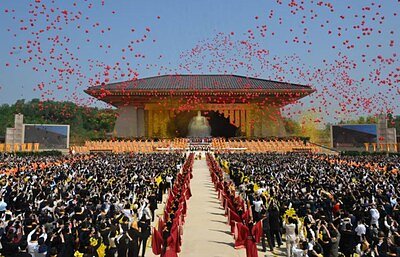
Ancient Roots, Modern Unity: China's Yellow Emperor Ceremony Gathers Thousands
ZHENGZHOU, China – April 20, 2026 – Under the theme of shared roots, peace, and harmony, a grand ceremony unfolded in Xinzheng, Henan province, as thousands gathered to pay homage to a figure who stands at the dawn of Chinese civilization. On April 19, the third day of the third lunar month, approximately 5,000 people from across China and the globe convened for the annual Ancestral Worship Ceremony at the Hometown of the Yellow Emperor, a potent display of cultural continuity and national identity.
The event, held in the Bingwu Year (2026) of the traditional Chinese calendar, honored Xuanyuan, the Yellow Emperor, a legendary sovereign revered as the common ancestor of all Chinese people. Participants joined in a series of ancient rites to pray for national prosperity and world peace, reaffirming a cultural connection that spans five millennia.
A Tradition Spanning Millennia
The Yellow Emperor, or Huangdi, is a figure of immense cultural and mythological importance. While historical evidence of his existence remains debated by scholars, his legacy as a founding father is deeply woven into China's national fabric. Traditional accounts, dating back over 2,000 years, credit him with a host of foundational innovations, including the Chinese calendar, early writing systems, traditional medicine, and the unification of tribes in the Yellow River Valley. This narrative has established him not just as a progenitor of the Han people, but as a unifying ancestor for the entire multi-ethnic Chinese nation, or Zhonghua minzu.
The tradition of honoring Huangdi in his reputed birthplace of Xinzheng dates back to the Spring and Autumn Period (770–476 B.C.). After a long hiatus, the modern ceremony was revived in the late 20th century and has since grown into a major cultural event. In 2008, its significance was formally recognized when the State Council listed the ceremony as a national intangible cultural heritage, cementing its place as a cornerstone of China's cultural preservation efforts.
The Spectacle of Nine Rituals
The 2026 ceremony was a meticulously choreographed event centered around nine traditional rituals. The proceedings began with ceremonial salutes, followed by offerings of flowers and incense, acts symbolizing respect and purification. Participants performed a collective homage, bowing in reverence before a statue of the emperor. A formal tribute was read aloud, recounting the virtues and achievements of Xuanyuan, followed by a choral performance of the Ode to the Yellow Emperor by singers from mainland China, Hong Kong, Macao, and Taiwan.
Ritual music and dance, with choreography inspired by recent archaeological finds in Henan, provided a bridge to the distant past. The ceremony also carried distinct symbolic weight for the present. The designation of 2026 as the "Bingwu Year" is significant within the Chinese sexagenary cycle. It combines the Heavenly Stem 'Bing,' associated with Yang Fire, and the Earthly Branch 'Wu,' representing the Horse, which is also linked to fire. This confluence suggests a year of immense energy, passion, and dynamic activity, themes that resonate with the event's focus on national rejuvenation.
In a segment dedicated to blessings for the nation, 19 representatives of Chinese descendants from around the world stamped a commemorative Bingwu seal onto a landscape scroll. The ceremony concluded with the lighting of a ceremonial torch and the release of doves and balloons, symbolizing prayers for harmony between Heaven, Earth, and humanity.
Unity Across Borders and a Tool of Soft Power
Beyond its cultural and historical significance, the ceremony is a powerful vehicle for promoting a specific vision of unity. The list of co-organizers—including the People's Government of Henan Province, the Taiwan Affairs Office of the State Council, and the All-China Federation of Taiwan Compatriots—underscores the event's political dimension. The consistent emphasis on participants from Hong Kong, Macao, and Taiwan highlights a strategic effort to foster a sense of shared identity and cultural cohesion across the Taiwan Strait.
This event is a key component of China's broader cultural diplomacy. By showcasing a rich, uninterrupted heritage centered on a common ancestor, the ceremony projects a narrative of civilizational strength and unity. It serves as a platform to strengthen ties with the vast global Chinese diaspora, reinforcing their connection to the ancestral homeland. On the same day as the main event in Xinzheng, parallel ceremonies were held by overseas Chinese communities in countries like the United States, the United Kingdom, Australia, and Malaysia, creating a synchronized global moment of cultural affirmation.
A Modern Pilgrimage for a Global People
For many attendees, the event is a deeply personal journey—a modern-day pilgrimage to connect with their roots. The crowd was a diverse mix of government officials, business leaders, cultural figures, and ordinary citizens from every corner of the world. Their presence speaks to the enduring power of ancestral identity in a globalized era.
In recent years, organizers have embraced technology to expand the ceremony's reach. An online worship platform, available since 2020, allows millions of Chinese people who cannot attend in person to participate virtually, lighting digital incense and leaving messages of tribute. This fusion of ancient tradition and modern technology ensures the story of the Yellow Emperor continues to resonate with younger, globally-dispersed generations.
As the doves ascended into the sky above Xinzheng, the ceremony served as a powerful reminder of how history and myth are continuously reinterpreted to serve the present. It is at once a solemn rite honoring the past, a vibrant celebration of cultural identity, and a carefully orchestrated statement about the future of a nation and its people, wherever they may be in the world.