
- $103 million in financing secured for luxury hotel rebrand
- 6.4 million passengers served at Ontario International Airport in 2023
- A+ credit rating from Standard & Poor's for National CORE
Experts would likely conclude that National CORE's innovative financing and strategic diversification demonstrate how nonprofits can successfully enter commercial markets to sustain social missions.
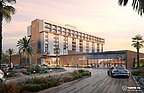
An Unlikely Landlord: The Story Behind a Nonprofit's Luxury Hotel Bet
RANCHO CUCAMONGA, Calif. – June 16, 2026 – On the surface, the numbers tell a familiar story of urban development. A major hotel and conference center near a booming airport gets a massive capital infusion for a luxury rebrand. But when you look closer at the players involved, the story becomes far more interesting. The developer behind the transformation of the former Ontario Airport Hotel into an upscale Hyatt Regency isn't a typical real estate giant. It's National CORE, one of the nation's largest nonprofit developers of affordable housing.
It’s a move that seems counterintuitive: a social-good organization, whose mission is to house low-income families, is now the owner and developer of a high-end hospitality destination. Yet, by securing approximately $103 million in financing, National CORE is not pivoting away from its mission, but rather engineering an innovative and sustainable way to fund it for decades to come. This isn't just about building a hotel; it's a calculated strategy to build a revenue engine that will, in turn, build more homes.
A Financial Masterclass in Social Enterprise
For any organization, securing over $100 million is a monumental task. For a nonprofit, it requires unimpeachable financial strength and a compelling vision. National CORE leveraged both. The key was a highly innovative financing structure that immediately caught the attention of investors. The package combined approximately $74.5 million in hotel revenue bonds with $27.3 million in Property Assessed Clean Energy (PACE) bonds, which are earmarked for energy-efficiency upgrades.
This hybrid approach, described by one partner as the "first hospitality tax-exempt bond financing for JLL," was a masterstroke. Investor demand, underwritten solely by JP Morgan, was so strong that it exceeded the bonds offered, allowing the interest rates to be lowered to a blended rate of just over 6%. "Investors responded to the strength of National CORE's balance sheet, our longstanding presence in the Inland Empire and our ability to execute complex development projects," explained Robert Diaz, National CORE executive vice president. That balance sheet is bolstered by an A+ credit rating from Standard & Poor's, a rare achievement for an affordable housing developer, which signals immense fiscal discipline and stability.
Marc Schillinger of JLL Capital Markets noted that National CORE's sterling credit rating and "vision and dedication to transform this asset were key factors in getting this transaction closed." The complexity of the deal required a powerhouse of financial and legal partners, including GreenRock Capital, which specializes in PACE financing, and FGS Realty Advisors, all working in concert. It’s a textbook example of how a nonprofit can leverage its reputation and financial health to compete in the commercial market, using sophisticated tools typically reserved for for-profit corporations.
From Distressed Asset to Economic Anchor
The project is more than a financial strategy; it's a physical revitalization at a critical economic gateway. The former Ontario Airport Hotel & Conference Center was a distressed asset acquired by National CORE out of a bankruptcy auction. The transformation represents what Chairman Jeff Burum calls "the rebirth of an iconic property that has long stood at the gateway to our community."
This rebirth is happening at a pivotal moment for the Inland Empire. The region is experiencing explosive growth, and the Ontario International Airport (ONT) is at its epicenter. In 2023, ONT served 6.4 million passengers, a 12% increase from the previous year that surpassed pre-pandemic levels. The hotel is perfectly positioned less than a mile from the airport and within minutes of over $10 billion in planned developments. These include the Brightline West high-speed rail terminal connecting Southern California to Las Vegas, a $200 million expansion of the Toyota Arena district, and the new Ontario Sports Empire Complex.
By transforming a struggling hotel into a premium Hyatt Regency, National CORE is not just renovating a building; it is creating a vital piece of infrastructure to support the region's burgeoning tourism and business travel. It's an investment that promises to generate jobs, increase local tax revenues, and elevate the hospitality landscape for the entire community.
Redefining the Mission: A Hotel That Builds Homes
Here lies the real story hidden in the financial data. How does a luxury hotel align with a mission to end generational poverty? For National CORE, the Hyatt Regency Ontario is a strategic diversification of its revenue. The stable, long-term income generated from the hotel will be funneled directly back into the organization's core work: developing more affordable housing and funding the resident services provided by its philanthropic arm, the Hope through Housing Foundation.
This project serves as a launching pad, not just for travelers, but for the community itself. As part of its strategy, National CORE is integrating the hotel into its "CORE Academy," a workforce development initiative. The Hyatt Regency will provide career pathways and hands-on training opportunities in the hospitality industry, creating accessible jobs and upward mobility for local residents, including those living in National CORE's own affordable communities.
"Our mission has always been about investing in communities in ways that create lasting impact," Burum stated. "This project reflects that same philosophy. We are building something that serves the region today while creating opportunities for the future." It's a powerful model of a social enterprise, where a commercial venture is explicitly designed to fuel a social mission, creating a self-sustaining cycle of community investment.
The Vision Takes Shape
The transformation is already underway, with a planned opening in early 2027. The architectural firm Gensler has envisioned a complete redesign inspired by the region's connection to the Monarch butterfly's migratory path. The renovation will reduce the room count from 309 to 295 to create larger, more luxurious suites. The guest experience will be elevated with a redesigned lobby, a new signature all-day restaurant called "Lozano" featuring coastal Mediterranean cuisine, an upgraded fitness center, and a reimagined outdoor pool area.
With Hyatt as the franchisor and the experienced Manhattan Hospitality Advisors managing operations, the hotel is poised to become a premier destination. The collaboration brings together world-class branding, operational excellence, and visionary design, all under the ownership of an organization dedicated to community uplift. As the renovation progresses, it stands as a testament to the idea that doing good and doing good business do not have to be mutually exclusive.