
- 87% of women in Rhode Island with fragility fractures receive no osteoporosis treatment
- $57 billion in annual U.S. healthcare costs for osteoporosis-related fractures
- 55% of patients in Hawaii (top performer) still untreated
Experts agree this represents a systemic healthcare failure with proven solutions available but underutilized.
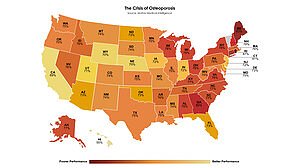
America's Osteoporosis Crisis: A Systemic Breakdown Exposed by Data
SAN FRANCISCO, CA – June 18, 2026 – A minor slip on a patch of ice. A stumble over a curb. For hundreds of thousands of American women over 50, these everyday mishaps result in a broken bone. This isn't just an injury; it's a blaring alarm, a "sentinel event" signaling that the underlying structure of their bones is failing. The diagnosis is often osteoporosis. The path forward, according to decades of medical consensus, is clear: test, treat, and prevent the next, potentially more devastating, fracture.
Yet, a groundbreaking new analysis reveals that this alarm is going unheard on a massive scale. A study released today by Motive Medical Intelligence, a healthcare performance analytics firm, lays bare a chasm between medical guidelines and clinical reality. After analyzing more than 100 million U.S. insurance claims, the report documents a staggering and systemic failure to provide essential osteoporosis care. The data shows that in every single state, a majority of women who suffer a fragility fracture are never evaluated or treated for the very disease that likely caused it, leaving them vulnerable to a future of chronic pain, lost independence, and even premature death.
This isn't a regional anomaly; it's a national crisis. The numbers are damning. In Rhode Island, the country's worst-performing state, an astonishing 87% of women who broke a bone due to underlying fragility received no subsequent osteoporosis treatment. The failure rates are nearly as high across the Northeast, with Maine at 83%, Connecticut at 81%, and New York at 78%. Even in Hawaii, the nation's top performer, the system still fails 55% of these patients. This widespread inaction comes with a staggering price tag—$57 billion in annual U.S. healthcare costs for osteoporosis-related fractures, a figure that doesn't begin to quantify the profound human suffering involved.
The Anatomy of a Systemic Failure
The guidelines from preeminent medical bodies like the Endocrine Society and the American College of Obstetricians and Gynecologists (ACOG) are unequivocal: a fragility fracture in a postmenopausal woman warrants prompt evaluation and treatment for osteoporosis. The evidence is robust, the treatments are proven, and the stakes are incredibly high. A hip fracture, one of the most severe consequences of untreated osteoporosis, carries a mortality rate that rivals many forms of cancer.
"These data are particularly disappointing, as we have so many proven treatments at our disposal," said Rich Klasco, MD, Chief Medical Officer at Motive. "It is our responsibility, as clinicians, to ensure that patients get the care they need."
Dr. Klasco's statement points to the core of the problem: a profound disconnect within the healthcare system itself. The journey of a patient with a fragility fracture often exposes the deep silos that define modern medicine. An orthopedic surgeon, laser-focused on mending the acute break, may not see the management of the chronic underlying condition as their responsibility. The patient is discharged, often without a referral to an endocrinologist or clear instructions for their primary care physician (PCP) to initiate osteoporosis management. The PCP, in turn, is frequently overwhelmed with competing priorities during brief appointments, and the critical window for intervention closes. The patient, often unaware of the link between their fracture and a chronic disease, falls through the cracks.
Interviews with health policy experts reveal this is a multifaceted problem. Beyond the lack of care coordination, they cite inadequate reimbursement for bone density screening and patient counseling, which disincentivizes proactive care. Furthermore, a recognized "communication gap" persists, where patients are not adequately educated about their risk, leaving them unequipped to advocate for their own health.
A Path Forward: Data, Coordination, and Accountability
While the Motive study paints a grim picture of the present, it also illuminates the path toward a better future—one defined by data-driven accountability and smarter, more coordinated systems of care. The very technology that exposed the problem holds the key to its solution.
Motive's 'Practicing Wisely' platform is a prime example of this shift. By mapping millions of anonymized clinical decisions from claims data against evidence-based standards, the system provides unprecedented visibility into how individual clinicians are performing. It moves beyond judging a hospital or a health system as a whole and provides granular, actionable insights that can be shared with physicians to help them adhere to best practices. This isn't about punishment; it's about transparency and improvement.
"We always see geographic variation in clinician performance, but in a case such as this—where there is so much opportunity for improvement—it is essential to raise awareness among both patients and clinicians," noted Julie Scherer, Ph.D., President and Chief Solutions Officer at Motive, who led the study. "This is a solvable problem."
Solving it requires more than just data; it demands new models of care. The most promising of these is the Fracture Liaison Service (FLS). An FLS is a coordinated, multi-disciplinary program implemented within a hospital or clinic. When a patient enters the emergency room with a fragility fracture, the FLS coordinator is automatically triggered. This coordinator—often a nurse practitioner or physician assistant—ensures the patient is tested for osteoporosis, initiates treatment or provides a referral to a specialist, and educates the patient on their condition before they are discharged. Studies have shown that health systems with FLS programs dramatically close the treatment gap, preventing thousands of subsequent fractures and saving millions of dollars.
The widespread adoption of FLS, powered by the accountability metrics from analytics platforms like Motive's, perfectly aligns with the healthcare industry's slow but steady march toward value-based care. In such a system, providers are rewarded not for the volume of procedures they perform, but for the quality of their patients' outcomes. Preventing a costly second hip fracture becomes far more valuable than simply treating the first one.
The Ripple Effect of a Single Fracture
The failure to treat osteoporosis is a case study in the inertia of a complex system. It highlights how easily preventable human and economic costs can accumulate when care is fragmented and reactive. The initial fracture is the first ripple, but the subsequent waves—chronic pain, disability, healthcare spending, and premature death—are far larger.
The tools to calm these waters are already in our hands. They are organizational, like the proven FLS model, and they are technological, like the powerful analytical engines that can turn a sea of data into a clear map for improvement. The challenge now lies not in innovation, but in implementation—in building a system that finally heeds the warning of that first, fateful break.