
- 50% of U.S. adults believe being born in the U.S. is important for being 'truly American', while 77% of AAPIs disagree.
- 44% of AAPIs report feeling worry, compared to 40% feeling hope, the only group where worry outranks hope.
- 71% of AAPIs believe tariffs on goods from China and India have negatively impacted their communities.
Experts would likely conclude that the survey highlights a significant disconnect between AAPIs' inclusive, values-based definition of American identity and the broader population's more nativist views, underscoring persistent historical tensions and policy-driven anxieties within the community.
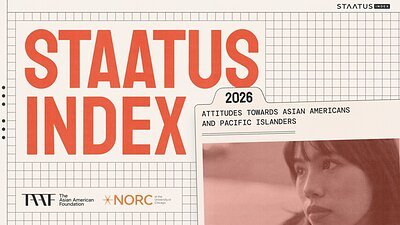
America's Identity Crisis: AAPI Survey Reveals a Nation Divided
SAN FRANCISCO, CA – May 01, 2026 – As the United States gears up for its 250th anniversary, a landmark study has exposed a deep and widening chasm in how its citizens define the very essence of being American. A new report from The Asian American Foundation (TAAF) reveals that the nation is starkly divided on questions of identity and belonging, with Asian Americans and Pacific Islanders (AAPIs) holding a profoundly different view of the country than the general population.
The sixth annual Social Tracking of Asian Americans in the U.S. (STAATUS) Index, conducted by the renowned NORC at the University of Chicago, finds that half of all U.S. adults (50%) believe being born in the United States is an important prerequisite to being considered “truly American.” In sharp contrast, an overwhelming 77% of AAPIs—the nation's fastest-growing racial group—disagree, a higher share than any other demographic.
This fundamental disagreement on national identity is just one of several perception gaps highlighted in the report, which paints a picture of a community grappling with anxiety, policy pressures, and a sense of invisibility despite its growing numbers and cultural contributions.
“The latest STAATUS Index provides our clearest look yet at the disconnect between how AAPIs experience life and how the rest of the country perceives us,” said Norman Chen, CEO of TAAF, in a statement accompanying the release. “Despite our community's growing power, a significant share of the public is still forming views about America's fastest-growing racial group with no direct connection or information.”
A Historical Echo in a Modern Debate
The survey's findings on birthright and belonging resonate through centuries of American history. The debate over who gets to be “truly American” is not new; it touches on a long and complex past, rooted in the 14th Amendment's guarantee of birthright citizenship. Ratified after the Civil War to grant citizenship to formerly enslaved people, this principle was later affirmed in the landmark 1898 Supreme Court case United States v. Wong Kim Ark, which ruled that children born in the U.S. to non-citizen parents were indeed citizens.
However, this legal standard has often been at odds with cultural sentiment and exclusionary policies, from the Chinese Exclusion Act of 1882, which barred Chinese immigrants from citizenship, to the fact that Native Americans were not universally granted citizenship until 1924. The STAATUS Index shows these historical tensions persist, with recent political efforts to challenge birthright citizenship through executive action adding fuel to the fire. The AAPI community's overwhelming rejection of birthplace as a criterion for Americanness—along with their high rates of dismissing race (93%) or religion (84%) as important—suggests a more inclusive, values-based definition of national identity that stands in contrast to a more nativist view.
The Weight of Worry and Policy
The report reveals a troubling emotional landscape for the nation's 25 million AAPIs. When asked about their feelings on life right now, AAPIs were the only racial or ethnic group for whom worry (44%) outranked hope (40%). For white, Black, and Hispanic adults, “hopeful” was the most common response.
This pervasive anxiety appears to be directly linked to the real-world consequences of federal policies. Nearly three-quarters of AAPIs (71%) believe that tariffs on goods from countries like China and India have negatively impacted their communities, a view shared by only 47% of the general public. Furthermore, AAPIs express significant distrust in the fairness of U.S. Immigration and Customs Enforcement (ICE), with 61% doubting the agency's ability to operate fairly in their communities, compared to 51% of U.S. adults overall.
These policy concerns are compounded by persistent safety issues. Years after the surge in anti-Asian violence during the COVID-19 pandemic, 1 in 5 AAPI adults report being harassed, threatened, or insulted because of their race or ethnicity in the past year. This sustained level of hostility contributes to a climate of fear and uncertainty, underscoring that the anxieties are not abstract but are rooted in tangible daily experiences.
An Invisible Community in Plain Sight
A key driver of the perception gap, according to the study, is a profound lack of connection and information. More than one in four U.S. adults (26%) report having none of seven common types of relationships—such as a friend, neighbor, or co-worker—with an Asian American. Nearly one-third (31%) say they receive no information about AAPI communities at all.
This invisibility has stark consequences for how the community is perceived. Only 7% of U.S. adults believe AAPIs have “a great deal” of influence on American culture, a surprisingly low figure given the mainstream success of AAPI-led films, music, and cuisine. While nearly a third of Americans (32%) acknowledge that AAPI influence has grown in the last five years, AAPIs themselves are far more likely to see this shift, with 50% perceiving their group's growing influence.
This disconnect extends to how AAPIs are racially categorized. The survey found that a majority of white Americans (64%) see the status of Asian Americans as more similar to that of white people. In stark contrast, nearly three-quarters of AAPIs (74%) see their own group’s status as more similar to other people of color. This finding helps explain why AAPIs are the most likely of all racial groups (66%) to support Diversity, Equity, and Inclusion (DEI) initiatives, even as such programs face rollbacks across the country.
Bridging the Gap Through Education and Storytelling
The report uncovers a significant knowledge deficit that perpetuates stereotypes and misunderstanding. An alarming 53% of Americans could not name a single significant event in Asian American history, highlighting a failure in the nation's educational curriculum to reflect its diverse population.
Yet, the findings also point toward a path forward. Americans express a clear willingness to learn and engage. When asked what solutions they would support to foster better understanding, 43% pointed to school and community programs that promote AAPI culture and history. Another 37% endorsed films and television shows that authentically portray AAPI experiences.
As the nation reflects on its history and future, the 2026 STAATUS Index serves as a critical call to action. It suggests that bridging the divides in American society requires not just acknowledging the AAPI community's anxieties and contributions, but actively working to write their stories back into the national narrative.