
- 518 deaths and 2,390 injuries from post-election violence
- TZS 125 billion in property destruction
- 1,300 witnesses and 202 affected locations investigated
Experts would likely conclude that the report highlights deep political divisions and systemic issues in Tanzania's electoral process, requiring urgent reforms and inclusive reconciliation efforts to prevent future violence.
Tanzania's Reckoning: A Nation Divided Over Post-Election Violence Report
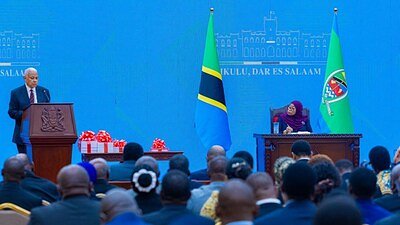
DAR ES SALAAM, Tanzania – April 24, 2026 – President Samia Suluhu Hassan today received a sobering report detailing the human and economic devastation from the violence that followed Tanzania's contentious October 2025 General Election. The findings of the Presidential Commission of Inquiry paint a grim picture: approximately 518 deaths, over 2,390 injuries, and property destruction exceeding TZS 125 billion. In a national address, President Hassan called the report a necessary, if bitter, medicine for the nation, urging for unity, accountability, and reform. However, the path to healing is already fraught with division, as major opposition parties have outright rejected the commission's findings, labeling the process a government-orchestrated cover-up.
A Nation's Painful Diagnosis
The report, delivered by the commission's chairman, former Chief Justice Mohamed Chande Othman, is the culmination of a 153-day nationwide investigation. The inquiry spanned 11 regions and 21 districts, gathering evidence from over 1,300 witnesses and thousands of citizen submissions across 202 affected locations. The commission concluded that the post-election chaos was not spontaneous but rather comprised "organised, coordinated and financed riots aimed at disrupting the general election," with the highest number of fatalities recorded in Dar es Salaam, Mwanza, Mbeya, and Arusha.
In her remarks upon receiving the report, President Samia acknowledged the profound impact of the losses on families and the nation at large. She framed the commission's work as an essential national diagnosis, providing a roadmap for recovery.
"The Commission has examined what affected us and has provided both treatment and guidance. Our task now is to apply that treatment effectively," President Samia stated. "At times, the remedy may be difficult, but if we are to heal, we must take it."
Chairman Othman noted that despite the pain and trauma expressed by victims, there was a consistent and powerful desire for reconciliation among citizens. "Those who engaged with the Commission made it clear that what happened does not reflect the true character of Tanzania," he said, emphasizing a collective will to "heal, ensure accountability where necessary, and, above all, to learn and move forward."
A Path Forward or a Deepening Divide?
The commission laid out several key recommendations, including pursuing deeper criminal investigations into the violence, launching an inclusive national reconciliation process, and, most significantly, accelerating constitutional reform. The report proposes forming an expert committee to deliver a new constitution by 2028, a document intended to guide future elections and serve as a cornerstone of national healing. The commission itself, however, clarified that it does not have the mandate to name or prosecute individuals, a limitation that has fueled criticism.
This proposed path forward was immediately rejected by the country's main opposition parties, Chadema and ACT-Wazalendo. Having been effectively barred from the 2025 presidential race, they dismissed the entire inquiry as illegitimate. In a joint statement, they argued that a government accused of orchestrating electoral fraud cannot be trusted to investigate itself. Chadema, which had boycotted the commission from its inception, confirmed it would solidify its official position later this week, but its initial reaction signals a deep and persistent political chasm.
The government's narrative of a collective journey toward healing is thus directly contradicted by the opposition's cry of a "government cover-up." This fundamental disagreement over the report's legitimacy threatens to undermine any reconciliation efforts before they even begin.
The Shadow of the 2025 Election
To understand the opposition's profound distrust, one must look back at the October 2025 General Election itself. President Samia Suluhu Hassan, representing the long-ruling Chama Cha Mapinduzi (CCM), was declared the winner with an improbable 97.66% of the vote. The electoral process was widely condemned by international and regional observers.
Both the Southern African Development Community (SADC) and the African Union (AU) election observation missions concluded that the election failed to meet democratic standards. Their reports cited a host of irregularities, including ballot stuffing, a nationwide internet blackout on election day that crippled independent monitoring, and the use of excessive force by security personnel against protesters.
Crucially, the main opposition parties were systematically sidelined. Chadema's leader, Tundu Lissu, was arrested and charged with treason after calling for electoral reforms, and his party was ultimately disqualified from the presidential contest. This exclusion led foreign observers to deem the election campaign fraudulent long before the first vote was cast. The subsequent violence was a direct response to an election that a significant portion of the populace and the international community viewed as illegitimate.
President Samia's Defining Moment
For President Hassan, this moment represents a critical test of her leadership. Since inheriting the presidency in 2021, her tenure has been a study in contradictions. Initial moves to lift a ban on political rallies and engage with the opposition sparked hope for a democratic opening. However, in the two years leading up to the 2025 election, her government oversaw a significant crackdown on dissent, with restrictions on media, arrests of critics, and dozens of reported disappearances creating a climate of fear.
Now, she stands before the nation and the world, holding a report that details the bloody consequences of that election. Her call for collective responsibility and her personal plea—"I will carry this responsibility with courage, confidence, and caution. But we must do this together. Do not leave this burden to me alone"—resonate with the gravity of the situation.
Yet, with the opposition locked out of the process and dismissing the report, the 'togetherness' she calls for seems unattainable. The commission's report, intended as a tool for healing, may instead become another symbol of the deep political fractures that continue to plague Tanzania. The nation now watches to see whether the proposed constitutional reforms will be a genuine effort at inclusive governance or simply another maneuver to consolidate power while managing a crisis.