
- 1.6 million ounces of gold and 100 million ounces of silver historically produced in the district.
- 27 kilometers from the active DeLamar project, a major validation of the region's potential.
- Staking claim instead of costly acquisition, demonstrating a lean, cost-effective model.
Experts would likely conclude that Almadex's strategic acquisition of the Fountain Ridge prospect leverages proven geological potential and operational discipline, though success will depend on further exploration and navigating regulatory challenges.
Almadex's Quiet Bet on Idaho's Historic Gold Country
VANCOUVER, British Columbia – June 16, 2026 – In the world of mineral exploration, headlines are often dominated by spectacular drill results or billion-dollar buyouts. But sometimes, the most strategic moves are the quietest. Almadex Minerals Ltd. (TSX-V: “DEX”) made such a move today, announcing it has acquired the Fountain Ridge precious metals prospect in western Idaho not through a costly acquisition, but by simply staking the claim. The project lies in the shadow of giants—the historic DeLamar and Grassy Mountain deposits, which have collectively yielded millions of ounces of gold and silver.
While the press release was modest, the operational strategy behind it speaks volumes. Almadex is placing a calculated bet on a proven geological neighborhood, leveraging a lean business model to hunt for a new discovery next to old money. This isn't just a land grab; it's a case study in how modern prospect generators create value by combining geological science with operational discipline.
Reading the Geological Tea Leaves
The Fountain Ridge prospect, on its surface, doesn't scream 'bonanza.' In fact, Almadex was transparent that initial grab samples returned no significant gold or silver. To the uninitiated, this might seem like a red flag. For geologists hunting epithermal deposits, however, it can be an encouraging sign. The key lies in understanding the architecture of these ancient mineralizing systems.
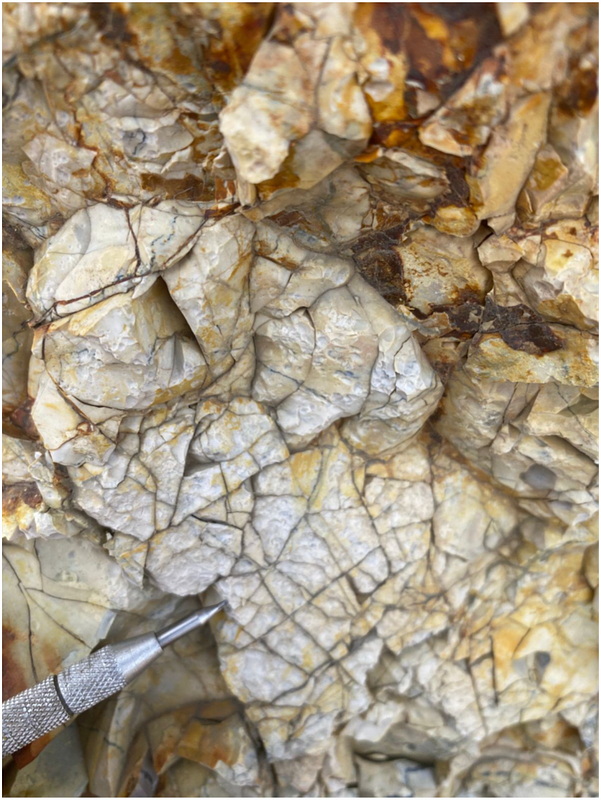
Epithermal deposits are formed by large, hot-spring-like geothermal systems. As mineral-rich water rises towards the surface, changes in temperature and pressure cause precious metals like gold and silver to precipitate out of the solution. This process creates distinct zones. The very top of the system, at the paleo water table, often features extensive silica and clay alteration but is typically leached of precious metals. Almadex reports finding exactly this: replacement silicification, argillic alteration, and features interpreted as sinter deposits—the geological fingerprints of a fossilized hot spring surface.
"Finding this type of high-level alteration without significant surface gold is precisely what exploration models predict for a well-preserved system," noted an independent geologist familiar with epithermal deposits in the Great Basin. "It’s like finding the chimney on a house. You don’t expect to find the fire in the chimney itself, but it tells you exactly where to look for the furnace below." The real prize, the so-called 'boiling zone' where gold and silver drop out in high concentrations, is often located hundreds of meters deeper. Almadex's strategy is to use these surface clues as a map to guide future geophysical surveys and, ultimately, drill rigs to those deeper, high-potential targets.
A Calculated Play in a Reawakening District
Almadex's decision to stake ground in this specific corner of Idaho is far from random. The region is a storied precious metals district. The nearby DeLamar Mine, located just 27 kilometers away, was a powerhouse producer for over a century. Historical records, including modern technical reports, confirm the district yielded approximately 1.6 million ounces of gold and 100 million ounces of silver before its closure in 1998.
That history is not merely a relic. Today, the district is seeing a significant revival. Integra Resources is actively advancing the DeLamar project through federal permitting, armed with a 2025 feasibility study outlining a robust, large-scale mining operation. Roughly 58 kilometers away in Oregon, Paramount Gold Nevada's Grassy Mountain project—a similar epithermal deposit—received its federal Record of Decision in early 2026 and is on the cusp of becoming Oregon’s first modern gold mine.
This flurry of activity by other companies provides a powerful form of validation for Almadex's thesis. The successful advancement of neighboring projects de-risks the region geologically and demonstrates a viable path, however arduous, through the modern regulatory landscape. Almadex is not pioneering in a completely unknown territory; it is strategically positioning itself in a reawakening district where the geological potential for large-scale deposits has been repeatedly proven.
The Prospect Generator Model in Action
This acquisition perfectly illustrates Almadex’s core operational strategy. As a prospect generator, the company's business model is not to operate mines, but to discover and advance mineral properties to a stage where they can be sold or joint-ventured with a larger mining company. This requires a disciplined approach to capital and a focus on cost-effective exploration.
The initial acquisition of Fountain Ridge via staking is a prime example, costing a fraction of what an outright purchase of an established property would. Furthermore, Almadex highlights a key piece of operational innovation in its corporate DNA: it owns and operates its own portable diamond drill rigs. This allows the company to conduct first-pass drilling in-house, significantly reducing the cost and logistical complexity of the most expensive phase of early-stage exploration. By controlling this critical function, the company can test more targets for the same budget, increasing the statistical probability of a discovery.
"We are pleased to further expand our exploration portfolio by acquiring the Fountain Ridge epithermal prospect," commented J Duane Poliquin, Chairman of Almadex, in the company's release. This portfolio approach, which includes numerous projects and royalty interests in Canada, the U.S., and Mexico, diversifies risk and provides multiple avenues for value creation. Fountain Ridge is not a single 'bet the company' project, but another carefully selected asset in a broader strategic portfolio.
The Long Road from Prospect to Production
Despite the compelling geological story and sound strategy, the journey for Fountain Ridge is just beginning, and the path is fraught with challenges. The next steps outlined by Almadex—detailed mapping and induced polarisation (IP) geophysical surveys—are designed to build a 3D model of the subsurface and pinpoint drill targets. This work will require time and capital.
Even with positive results, the regulatory hurdles are formidable. Mineral development in the western U.S. involves a multi-year gauntlet of permits from federal agencies like the Bureau of Land Management (BLM) and state bodies such as the Idaho Department of Environmental Quality (IDEQ). The nearly decade-long permitting journey for the Grassy Mountain project serves as a stark reminder of the timelines and complexities involved. Environmental reviews, public comment periods, and potential legal challenges can delay or even derail projects with sound economics.
For now, investors will watch for the results of the upcoming fieldwork. Positive geophysical anomalies would provide the next critical piece of evidence that the 'furnace' exists beneath the surface 'chimney' Almadex has identified. The Fountain Ridge story is a testament to the long-game of mineral exploration, where success is built on a foundation of scientific rigor, operational efficiency, and a great deal of patience.