
- $200M Investment: Alaska Airlines opens a 660,000-square-foot Global Training Center, a $200 million project.
- $1B Profit Target: The 'Alaska Accelerate' plan aims for $1 billion in incremental profit by 2027.
- $500M Synergies: Projected merger synergies from Hawaiian Airlines integration have doubled to $500 million.
Experts would likely conclude that this investment underscores Alaska Airlines' aggressive expansion strategy, emphasizing standardization, global growth, and workforce development as critical to its success.
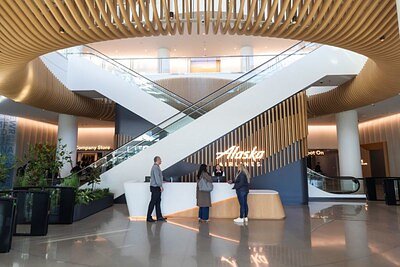
Alaska Airlines Unveils $200M Hub to Fuel Global Ambitions
RENTON, WA – January 30, 2026 – In a major strategic move solidifying its global aspirations, Alaska Airlines today officially opened its new Global Training Center, a sprawling 660,000-square-foot campus built with a staggering $200 million investment. The state-of-the-art facility will serve as the central nervous system for training thousands of employees from both Alaska Airlines and the recently acquired Hawaiian Airlines, bringing pilots, flight attendants, and customer service agents under one roof for the first time in the airline's history.
This colossal investment is more than just a new building; it is the physical embodiment of the airline's aggressive growth strategy. Situated just five miles from its corporate headquarters, the center is poised to play a pivotal role in the seamless integration of Hawaiian Airlines and the expansion of the combined carrier's international network.
A Strategic Hub for a New Era
The opening of the Global Training Center is a cornerstone of the "Alaska Accelerate" plan, a strategy designed to propel the Alaska Air Group into the top tier of global carriers. The plan, which targets $1 billion in incremental profit by 2027, hinges on the successful integration of Hawaiian Airlines and a significant expansion of its international routes. The training center is critical to achieving these goals, particularly the projected $500 million in synergies from the merger, a figure that has doubled from initial forecasts.
With a single operating certificate for both airlines secured in late 2025, the focus has shifted to standardizing procedures and cultivating a unified service culture. The Renton facility is engineered to do just that. It will be instrumental in preparing crews for an expanding global footprint, which already includes new routes to Tokyo and Seoul launched in 2025 and planned transatlantic services to London, Reykjavik, and Rome slated for 2026. This investment is part of a broader capital expenditure plan for 2026 projected to be between $1.4 billion and $1.5 billion, signaling the airline's deep commitment to its long-term vision.
Inside the 'University of the Skies'
Dubbed a 'University of the Skies' by some observers, the facility's advanced technology places it on par with, and in some aspects ahead of, training centers operated by global giants like Delta and United. The campus boasts an impressive array of sophisticated training tools, including ten full-motion flight simulators. Among these are nine simulators for the Boeing 737, the workhorse of Alaska's fleet, and a crucial new simulator for the Boeing 787 Dreamliner, the widebody aircraft essential for its long-haul international routes.
Beyond the cockpit, the center offers an immersive training environment for in-flight and ground crews. Five expansive mock aircraft bays allow flight attendants to practice emergency scenarios in a highly realistic setting. A fully functional aircraft galley is used for honing service procedures, while a mock airport lobby and gate area, complete with four aircraft door trainers, provide customer service agents with hands-on practice for normal and emergency situations. Furthermore, the airline is embracing next-generation learning tools with three dedicated virtual reality (VR) training rooms, allowing for even more dynamic and effective skills development.
This comprehensive approach is designed to elevate safety and service consistency across the entire network. By centralizing training, the airline aims to ensure that every employee, whether from Alaska or Hawaiian, is aligned on the highest standards of safety, performance, and customer care.
Investing in People and Culture
In a competitive labor market where skilled pilots and cabin crew are in high demand, the Global Training Center is also a powerful tool for recruitment and retention. The massive investment sends a clear message to current and prospective employees: the airline is committed to their professional development and well-being.
"The Global Training Center is spectacular and worthy of our amazing frontline employees," said Jason Berry, chief operating officer at Alaska Airlines. "This is the first time in our nearly 95-year history that employees across frontline workgroups will train under the same roof. I'm looking forward to this space being used by thousands of employees to build on our culture of safety, performance and care."
The facility's design and amenities reflect this people-first philosophy. The interior takes inspiration from the Pacific Northwest, with natural wood elements and a color palette representing mountains and oceans. To foster collaboration and well-being, the campus includes a full-service cafeteria, a café and bar modeled after the airline's popular airport lounges, an auditorium for graduations, and a modern fitness center. A one-mile walking trail, bike storage, and a repair room encourage a healthy work-life balance for the 550 permanent staff and the thousands of employees who will cycle through for training each year.
Revitalizing Renton's Aviation Legacy
The project also represents a significant investment in the local community and a continuation of Renton's deep-rooted aviation history. The building, formerly owned by Boeing, was purposefully constructed as an aviation training facility. Alaska Airlines acquired the 19-acre property from Unico Properties in 2024 for $85.75 million, investing over $100 million more in its renovation.
This revitalization of a key industrial site is part of the broader redevelopment of the Longacres campus into a modern, mixed-use community. During the remodel, the airline prioritized sustainability by reusing a significant number of existing materials, thereby limiting landfill waste. By transforming this historic site into a forward-looking hub, Alaska Airlines is not only securing its own future but also contributing to the economic vitality and enduring aviation heritage of the Puget Sound region.
Topics & Related
Digital Transformation
Revenue
Related Company Pulse