
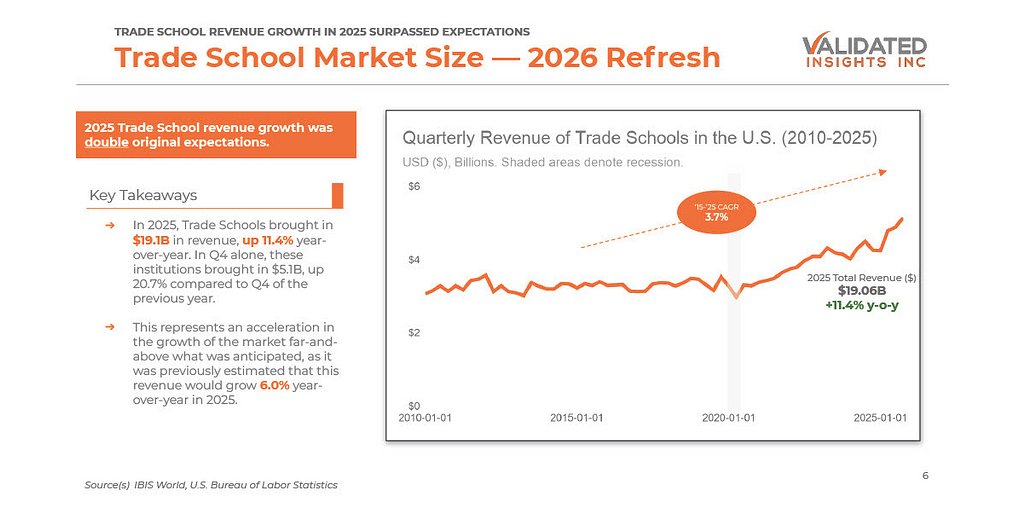
- Trade school revenue surged 11.4% YoY in 2025, reaching $19.1 billion
- Demand for skilled trades roles skyrocketed by 113% since 2022
- Gen Z trade school enrollment increased by 1,421% over eight years
Experts would likely conclude that AI-driven demand is reshaping the workforce, creating unprecedented growth in blue-collar sectors while exposing critical gaps in vocational education capacity.
AI's Unseen Engine: The Blue-Collar Boom Reshaping America's Workforce
CHICAGO, IL – June 29, 2026 – For years, the prevailing narrative has been one of digital disruption, where software and automation would render countless jobs obsolete. We were told to code or be coded over. But as we peel back the hype, a more complex and far more interesting reality emerges. A new report from research firm Validated Insights confirms a tectonic shift that has been rumbling beneath the surface: the skilled trades and allied health sectors are not just growing, they are exploding, far outpacing even the most optimistic forecasts.
According to the firm’s latest data, 2025 revenue for trade schools surged 11.4% year-over-year, nearly doubling the original 6.0% forecast. This places the trade education market at a formidable $19.1 billion. “We’re seeing some pretty fast, amazing, and strong numbers,” noted Brady Colby, Head of Market Research at Validated Insights, adding that the metrics appear “stable, structural, even conservative.” This isn't a fleeting trend; it's a fundamental realignment of our economy and our definition of a valuable career.
The AI Paradox: More Wires, Fewer Coders?
The most compelling driver of this blue-collar renaissance is, paradoxically, the very technology meant to replace physical labor: artificial intelligence. The report succinctly captures this irony: “AI turned skilled trades into the bottleneck. The capital that follows is the response.”
AI doesn't exist in an ethereal cloud. It lives in colossal, power-hungry data centers that require armies of skilled professionals to build, wire, cool, and maintain. The demand for robotics technicians, HVAC engineers, and industrial automation roles has skyrocketed by as much as 113% since 2022, according to an analysis by Randstad USA. The pressure is so intense that the average time-to-hire for a skilled trades professional has stretched to 56 days, eclipsing the time it takes to fill many desk-based roles.
Tech giants are voting with their wallets. Meta has launched a $115 million training initiative, America’s Workforce Academy, to cultivate the talent needed for its data center construction sites. Meanwhile, BlackRock, Google, and Lowe's have collectively pledged over $600 million to bolster the skilled trades workforce. This isn't corporate charity; it's a strategic necessity. One executive at a major AI firm recently remarked that their planned infrastructure projects alone would require an estimated 20% of the entire nation's existing skilled trades workforce.
This frantic demand for hands-on expertise creates a fascinating counter-narrative to the tech boom of the last decade. While enrollment in computer and information science programs has begun to decline across all institution types, according to the National Student Clearinghouse, applications for commercial electrical apprenticeships have jumped over 70% in the last two years. The future, it seems, will be built by hand as much as it is by code.
A Structural Shift in Education
This vocational resurgence is happening alongside a quiet but powerful crisis of confidence in traditional higher education. With total student debt cresting $1.7 trillion and studies showing that 40% of master's degree programs have a negative return on investment, families and students are rightfully questioning the 'college-for-all' mantra.
The data reflects a pragmatic pivot toward more direct and affordable career pathways. While bachelor's degree enrollment inches up by less than 1%, enrollment in undergraduate certificate programs has soared by over 28% in the past four years, primarily at community colleges. The value proposition is clear: shorter programs, lower debt, and a direct line to a high-demand job.
Gen Z, a generation often characterized by its digital fluency, is leading this charge. Trade school enrollment among this cohort has increased by a staggering 1,421% over the past eight years. They are seeing friends with four-year degrees struggle with underemployment while electricians and medical assistants walk into stable careers with strong earning potential. For-profit vocational giants like Universal Technical Institute and Lincoln Tech, once viewed with skepticism, are reporting revenue growth of 14% and 20% respectively, blowing past forecasts. It's a market-driven correction to an education system that has become misaligned with economic reality.
The Real Bottleneck: A Crisis of Capacity
While the demand for skilled workers is booming, our ability to produce them is sputtering. The Validated Insights report uncovers the most critical challenge ahead: a “massive, persistent gap” between student interest and the educational system's capacity.
In health fields alone, an estimated 7.7 million potential students expressed intent to enroll in a program, yet only 571,000 did. This isn't a lack of ambition; it's a lack of seats. Aspiring students are hitting waitlists as vocational schools, hobbled by decades of underfunding and a lingering social stigma, struggle to keep up. Outdated equipment, a shortage of qualified instructors, and a lack of program availability in many regions create a formidable barrier to entry.
This is where the opportunity for innovation lies. The market is signaling an urgent, unmet need. As Colby from Validated Insights observed, the sector is “growing, investment is coming in, returns are going out, and it’s still deeply underserved.” The race is no longer just about building the next great algorithm. It is about building the classrooms, apprenticeships, and career pathways needed to train the people who will construct the physical infrastructure of our digital future.