
- Europe's data center capacity is on track to surpass 10 gigawatts by the end of 2026, yet still insufficient for AI demand.
- Next-generation AI clusters push rack power densities beyond 100 kilowatts, a tenfold increase over traditional server racks.
- Ampace's PU200 battery system reduces thermal runaway gas by 58% compared to conventional lithium-ion batteries.
Experts agree that advanced battery technology is critical for managing AI's volatile power demands and ensuring data center resilience.
AI's Power Problem: A New Battery Blueprint for Data Center Resilience
CANNES, France – June 02, 2026
The French Riviera is playing host to the architects of our digital future this week, but behind the optimistic facade of the Datacloud Global Congress lies a looming crisis. The artificial intelligence revolution, for all its promise, runs on an increasingly unsustainable diet of raw electrical power. As data centers strain to keep pace, the foundational systems that guarantee uptime—the Uninterruptible Power Supplies (UPS)—are themselves becoming a critical point of failure. It is here, in the unglamorous world of power infrastructure, that a new battle for the future of AI is being waged, and companies like Ampace are positioning themselves on the front lines with a re-engineered approach to the humble battery.
The AI Power Paradox
For investors and operators, the numbers paint a stark picture. Europe's data center capacity is on track to surpass a record 10 gigawatts by the end of 2026, yet industry analysis confirms this is still woefully insufficient to meet the tsunami of demand driven by AI. The core of the issue isn't just the total power consumed, but the nature of that consumption.
Next-generation AI clusters, powered by thousands of GPUs, are pushing rack power densities beyond 100 kilowatts—a tenfold increase over traditional server racks. This intense concentration of power creates immense heat and operational challenges. More critically, AI workloads are notoriously volatile. They introduce millisecond-level load fluctuations, creating a spiky, unpredictable demand profile that conventional UPS infrastructure, designed for relatively stable loads, was never built to handle. These rapid power swings threaten to destabilize power quality, risking data corruption and costly downtime.
"The legacy model of UPS as a simple, passive backup is obsolete in the AI era," noted one power systems architect observing the conference. "You're asking a system designed for a predictable power outage to manage a constant, chaotic barrage of micro-demands. It’s like using a dam to stop a thousand fast-moving streams instead of a single river."
A Safer Chemistry for Critical Infrastructure
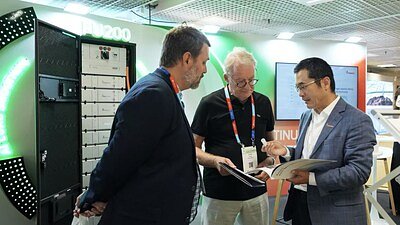
Addressing this challenge head-on, Ampace is showcasing its flagship PU200 UPS battery system in Cannes. The company, a 2021 spin-off with deep lineage from battery giants CATL and ATL, is betting that advanced battery chemistry is the answer. The PU200 is built on a proprietary semi-solid-state cell architecture, a technological bridge between today's liquid-electrolyte lithium-ion batteries and the all-solid-state batteries of the future.
The key innovation lies in safety and stability. By using a semi-solid electrolyte, the system dramatically reduces the risk of thermal runaway—a dangerous and self-sustaining fire event that is a primary concern for all data center operators. Ampace claims its architecture reduces the generation of flammable thermal runaway gas by 58% compared to conventional lithium-ion batteries. For a data center operator packing millions of dollars of IT equipment into ever-denser racks, this single metric represents a significant de-risking of their investment.
This technology moves far beyond the bulky, short-lived lead-acid batteries of the past. Compared to even standard lithium-ion solutions offered by established competitors like Eaton or Schneider Electric, Ampace's focus on a semi-solid-state chemistry is a specific, strategic wager on safety as a primary market differentiator in the high-stakes AI arena.
Redefining the Battery's Role
The industry is rapidly moving toward a consensus that batteries must evolve from a passive insurance policy to an active, intelligent component of the data center ecosystem. Ampace's broader PU Series reflects this shift, with solutions designed for applications ranging from sub-90-second high-power backup to multi-hour energy storage.
This expanded capability allows the UPS battery to do far more than just wait for a power failure. It can actively participate in managing the facility's power, smoothing out the volatile peaks and valleys of AI workloads to present a more stable load to the grid. This load balancing not only enhances infrastructure resilience but also improves the efficiency of the entire UPS ecosystem. Furthermore, these intelligent energy storage systems can provide grid services, allowing data centers to participate in demand response programs, shave peak demand, and better integrate with renewable energy sources. This transforms the battery from a sunk cost into a potential revenue-generating asset that also bolsters sustainability credentials—a critical factor in the heavily regulated European market.
The Looming AC vs. DC Debate
The strategic importance of this energy foundation is highlighted by a panel discussion scheduled for later in the congress. James Li, General Manager of UPS, Datacenter and Telecom Business at Ampace, will address the question: "Is AC or DC power better suited for tomorrow's high-density computing needs?"
This is not merely an academic debate. The traditional data center power chain is notoriously inefficient, converting power from AC to DC and back again multiple times before it reaches the server's processors. Each conversion wastes energy as heat. A shift to a high-voltage DC architecture, which is gaining traction in hyperscale and AI-specific designs, could eliminate several of these conversion steps, potentially improving power delivery efficiency by 10-30%. Since batteries are inherently DC, a direct DC-to-chip power path is the most efficient design possible.
Ampace's explicit focus on "UPS DC-side energy storage systems" signals that the company is not just building components for today's data centers, but is architecting solutions for the more efficient, DC-powered facilities of tomorrow. Overcoming the hurdles of standardization and legacy equipment will be challenging, but for the extreme power demands of AI, the efficiency gains may soon become impossible to ignore. The intelligent energy foundation being built by companies like Ampace may prove just as crucial to the AI revolution as the algorithms themselves.