
- 100% increase in patients receiving endovascular thrombectomy (EVT) at hospitals using the Brainomix AI platform.
- 64-minute reduction in 'door-in-door-out' times at primary stroke centers.
- Near doubling in the likelihood of patients receiving intravenous thrombolysis (IVT) with AI assistance.
Experts conclude that AI-driven platforms like Brainomix 360 Stroke significantly enhance stroke treatment rates and patient outcomes, offering a scalable and strategic solution for national health systems to improve care delivery and equity.
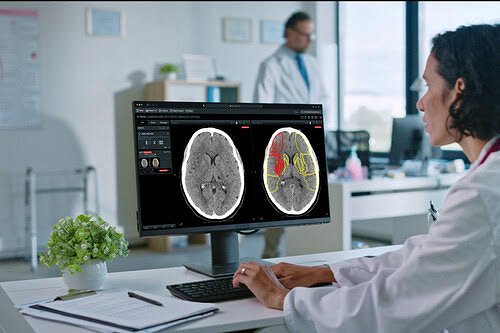
AI's Lifesaving Impact: Brainomix Doubles Stroke Treatment Rates in NHS
OXFORD, England – December 03, 2025
In a significant validation of artificial intelligence's role in frontline medicine, a landmark study published in The Lancet Digital Health has revealed that an AI platform from Brainomix dramatically improved outcomes for stroke patients across England’s National Health Service (NHS). The real-world evaluation, the largest of its kind, found that deploying the Brainomix 360 Stroke platform was associated with a 100% increase in patients receiving a life-saving surgical procedure, a strategic leap forward that is reshaping acute stroke care and offering a blueprint for digital transformation in public health.
The study represents a pivotal moment for both Brainomix, an AI pioneer spun out of the University of Oxford, and the NHS, which has strategically invested in digital tools to modernize care. By providing robust evidence of improved patient outcomes at an unprecedented scale, the findings cement AI's place not as a futuristic concept, but as a critical, present-day tool for enhancing clinical decisions and saving lives.
Quantifying a Revolution in Stroke Care
The prospective study analyzed data from over 450,000 patients admitted to 107 NHS England hospitals over a five-year period. Within this group, 26 hospitals deployed the Brainomix 360 Stroke platform, allowing for a direct pre- and post-implementation comparison. The results were striking.
Hospitals using the AI software saw a 100% increase in rates of endovascular thrombectomy (EVT), a minimally invasive procedure to remove blood clots from the brain. This far outpaced the 63% increase seen at non-evaluation sites over the same period. For individual patients, the use of the AI software made them significantly more likely to receive EVT, a treatment that can drastically reduce death and long-term disability. The platform was also associated with a near doubling in the likelihood of patients receiving intravenous thrombolysis (IVT), a clot-busting drug treatment.
"The significant increase in mechanical thrombectomy and intravenous thrombolysis with an associated improvement in clinical outcomes validates what we have seen in other studies, but at an unprecedented scale," said Dr. George Harston, Chief Medical and Innovation Officer at Brainomix and a co-author of the study. The data confirmed that these increased treatment rates led to better patient outcomes, with individuals showing less severe disability at the time of their discharge from the hospital.
Critically, the study highlighted the technology's power to democratize access to elite care. The most profound impact was observed in primary stroke centers—general hospitals that are often the first point of contact for stroke patients but lack on-site specialist teams. In these settings, the AI platform not only boosted treatment rates but also slashed 'door-in-door-out' times by an average of 64 minutes, drastically reducing delays in transferring patients to comprehensive centers for specialized surgery.
A Blueprint for National Health Systems
This success story is more than a technological victory; it is a strategic one, offering a compelling case study for integrating AI into national health systems. The UK government and the NHS have made digital innovation a cornerstone of the NHS Long Term Plan, which explicitly targets a tenfold increase in thrombectomy rates. The Brainomix deployment, supported by the government's AI in Health and Care Award, demonstrates a tangible pathway to achieving that goal.
Dr. David Hargroves, NHS National Clinical Director for Stroke and a study co-author, confirmed the strategic alignment, stating, "This landmark study confirms what stroke physicians have been witnessing on their wards every day – that this AI technology is changing lives... This publication is the result of a strategic investment by the UK government into AI research and its integration into the NHS."
The platform's ability to elevate the capabilities of non-specialist hospitals is perhaps its most significant strategic contribution. By providing fast, reliable interpretations of brain scans, the AI empowers clinicians everywhere to make confident, rapid decisions, effectively closing the gap between primary and comprehensive stroke centers. This creates a more equitable and resilient healthcare network, ensuring a patient’s odds of a good recovery are less dependent on which hospital they arrive at first.
"This is an AI solution that is meeting a clear need and delivering impact and benefit for patients across the NHS," said Professor Gary Ford, Chief Executive of Health Innovation Oxford and Thames Valley, which evaluated the rollout. He emphasized the technology's impact on improving access, "particularly for patients who initially present to hospitals without the capability to deliver thrombectomy."
Empowering Clinicians and Redefining Workflows
At the heart of this transformation is the Brainomix 360 Stroke platform's ability to augment, not replace, clinical expertise. In acute stroke care, where the mantra is "time is brain," every minute saved has a profound impact on a patient's future. The AI platform automates the analysis of complex CT and MRI scans, delivering clear, actionable insights to clinicians' devices in minutes. This allows for near-instantaneous sharing of images and data across a hospital network, enabling specialists to consult remotely and guide treatment decisions from anywhere.
This capability has fundamentally altered clinical practice. According to one consultant neuroradiologist familiar with the system, the technology has revolutionized service management by providing fast and accurate image analysis that builds confidence and accelerates the entire decision-making pathway. Instead of waiting for an on-site specialist to interpret a scan, frontline teams receive AI-powered guidance that helps them quickly identify patients eligible for EVT or IVT, initiating transfers or treatments far sooner.
This streamlined workflow not only improves patient outcomes but also helps alleviate pressure on an already strained healthcare workforce. By automating a time-consuming analytical task, the AI frees up clinicians to focus on direct patient care and complex decision-making, potentially reducing burnout and improving job satisfaction. The successful rollout across all 107 stroke centers in England, facilitated by dedicated NHS procurement frameworks, underscores the system's scalability and ease of integration.
A Strategic Victory in a Competitive Market
The publication of this study in a prestigious, peer-reviewed journal provides Brainomix with a powerful competitive advantage in the burgeoning medical AI market. The global market for AI in acute stroke triage is projected to grow exponentially, reaching an estimated $3.83 billion by 2029. In this dynamic landscape, where companies like Viz.ai and RapidAI also compete, robust, large-scale, real-world evidence is the ultimate differentiator.
While competitors have also shown positive results, the sheer scale and real-world setting of the NHS study set a new benchmark for validation. It moves the conversation beyond performance in controlled trials to proven impact across an entire national health system. For investors and healthcare providers, this level of evidence de-risks adoption and provides a clear return on investment, measured not just in dollars but in lives improved.
This strategic validation positions Brainomix for accelerated global growth. The company, already operating in over 20 countries, can now leverage this unparalleled evidence base to drive adoption in other health systems looking to replicate the NHS's success. The study's findings directly support clinical guidelines from major bodies like the American Heart Association/American Stroke Association, further smoothing the path for international expansion. For Brainomix, this is not just a clinical success but a major business milestone that solidifies its standing as a global leader in AI-powered diagnostics and a key player in the future of medicine.