
- 74% of frontline white-collar employees now identify as regular AI users, a 23-point year-over-year jump.
- 66% of employees report little to no guidance on how to use reclaimed AI time, leading to lost productivity.
- 25 percentage points increase in business impact when organizations have a clear AI strategy and workflow redesign.
Experts agree that while AI adoption is accelerating, the lack of strategic integration and workforce redesign is creating inefficiencies and missed opportunities for both productivity and employee satisfaction.
AI's 'Joy Paradox': Why Strategy, Not Tools, Will Define the Future of Work
BOSTON, MA – June 03, 2026 – A fundamental disconnect is cleaving the modern workplace. On one side, artificial intelligence is being adopted by frontline workers at a blistering pace, automating tasks and reshaping job descriptions. On the other, the corporate structures and strategies needed to harness this revolution are lagging dangerously behind. This growing chasm, detailed in Boston Consulting Group’s (BCG) fourth annual “AI at Work” report, is creating a perplexing “joy paradox” for employees and leaving trillions in potential value on the table for businesses.
The report, surveying nearly 12,000 workers globally, confirms what many feel intuitively: AI is making work both better and harder. While two-thirds of regular users report higher job satisfaction, a significant 41% also feel an increased cognitive load. This isn't just a growing pain; it's a symptom of a much larger organizational failure to move beyond mere tool deployment and engage in the difficult work of strategic transformation.
The Productivity Paradox Reimagined
The scale of AI adoption is no longer in question. BCG’s data shows a surge among frontline white-collar employees, with 74% now identifying as regular users—a 23-point jump year-over-year. This aligns with broader market trends, as firms like McKinsey report that overall enterprise AI adoption has climbed to 72%. The era of experimentation is over; AI is now a deeply embedded operational reality.
This reality is profoundly altering the nature of work itself. Nearly three-quarters (72%) of employees say AI has already changed skill expectations, and almost half (47%) now spend more time managing and directing AI than doing the work it once handled. This shift from task execution to systems supervision is the primary driver of the joy paradox. While employees are freed from mundane work—a source of satisfaction—they are now tasked with the mentally taxing job of hyper-verification, monitoring AI outputs, and managing an accelerated pace of work that often leads to what experts call “technostress.”
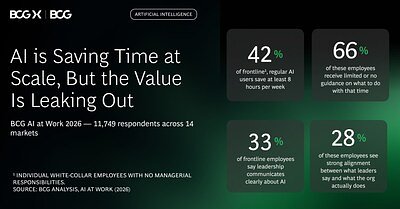
The economic cost of this paradox is staggering. While 42% of regular frontline users report saving an entire workday or more per week through AI, a stunning 66% say they receive little to no guidance on what to do with that reclaimed time. This isn't just a missed opportunity; it's a massive productivity dividend leaking out of organizations that have provided the tools but not the vision. Without a strategic framework to redirect this saved time toward higher-value activities, the efficiency gains simply evaporate.
Strategy, Not Tools: The Reshape/Invent Dividend
The central, and most critical, message from the data is that technology is not the bottleneck. Strategy is. BCG’s analysis reveals that having a clear AI strategy and a plan for workflow redesign lifts measurable business impact by an incredible 25 percentage points. In stark contrast, simply providing employees with better AI tools moves the needle by a mere 5 points.
This is the “reshape/invent dividend.” As one BCG report coauthor, Sylvain Duranton, puts it, the initial “AI honeymoon” of novelty quickly fades without strategic clarity. The organizations capturing the most value are not those with the fanciest tools, but those that fundamentally redesign how work gets done. Research from institutions like MIT Sloan corroborates this, arguing that AI’s true power is unlocked not by automating discrete tasks, but by re-architecting entire workflows, or “task chains,” to optimize the handoffs between human and machine intelligence.
Companies that embrace this approach are seeing profound benefits. According to the BCG survey, organizations actively pursuing workflow redesign are 24 percentage points more likely to see measurable business improvement and 20 points more likely to report increased job satisfaction. It proves that business value and employee well-being are not a trade-off; they are dual outcomes of a coherent strategy that augments human capabilities rather than simply automating them.
The New Managerial Frontier: Orchestrating AI Agents
Looming just over the horizon is an even more disruptive force: the rise of autonomous AI agents. These are not just tools but goal-oriented systems capable of executing complex, multi-step tasks with minimal human intervention. The report finds that 30% of organizations have already integrated agents into their workflows, more than double the figure from a year ago.
The implications for leadership are seismic. BCG’s Vinciane Beauchene calls it a “true managerial revolution,” noting that 65% of managers believe agents will take over at least half of their current job within three years. The manager’s role is rapidly shifting from directing people to orchestrating a hybrid workforce of human teams and AI systems. Success will depend less on task supervision and more on defining goals, setting guardrails, and exercising judgment.
This shift, however, exposes a critical governance vacuum. As agents gain the autonomy to interact with enterprise systems, access sensitive data, and execute tasks, the risks of error and misuse multiply. Yet over half of employees still have a limited understanding of what agents even are. A new paradigm of governance is required—one built on treating agents as distinct digital identities, implementing robust human-in-the-loop oversight for high-stakes decisions, and embedding policy-as-code to ensure accountability.
A Tale of Two Adoptions: The Global North-South Divide
Zooming out reveals a fascinating geopolitical dimension to the AI story. Frontline AI adoption is not uniform; markets in the Global South—notably India, the Middle East, Brazil, and South Africa—are leading the race, with usage rates well above the global average and their counterparts in the US, France, and Italy.
This trend reflects a “leapfrogging” mentality, where emerging economies are leveraging AI to solve pressing local challenges and bypass legacy infrastructure. However, this frontline enthusiasm masks a deeper, more troubling “AI divide.” Core investment in AI research, infrastructure, and talent remains overwhelmingly concentrated in the Global North. While workers in Mumbai or São Paulo may be avid users of AI tools, the companies and capital that build and control these systems are largely based in Silicon Valley and other Northern tech hubs.
This dynamic creates a complex interplay of opportunity and dependency. The Global South is becoming a vital laboratory for AI's real-world application, but it risks becoming a region of “rule-takers” in a global system where the economic benefits and governance standards are dictated by the North. The challenge for investors and policymakers is to foster a more equitable ecosystem that ensures the immense value generated by AI is shared more broadly. For companies, the imperative is clear: the future of work is arriving faster than planned, and those without a strategy to manage it will be left behind.