
- 9% revenue leakage: Poor contract obligation management leads to an estimated 9% annual revenue loss for the average company. - 71% of businesses: Up to 71% of businesses struggle to locate at least 10% of their own contracts, hindering proactive management.
Experts agree that AI-driven contract lifecycle management (CLM) solutions are transforming static contracts into dynamic, actionable assets, significantly reducing revenue leakage and operational inefficiencies.
AI Turns Contracts into Cash: Stopping the 9% Revenue Leak
REDWOOD CITY, CA – December 08, 2025 – For most organizations, contracts represent both the foundation of their business relationships and a significant source of hidden risk. Buried within pages of dense legal text are critical commitments: deadlines, service-level agreements, payment schedules, and compliance requirements. When managed poorly, these post-signature obligations become a primary driver of what industry analysts call “contract value leakage”—a problem that quietly siphons off an estimated 9% of annual revenue for the average company.
This isn't just about clerical errors; it's a systemic failure with staggering financial consequences. Forgotten renewal dates lead to lost customers or unfavorable auto-renewals. Missed deliverables result in financial penalties and damaged partner relationships. Overlooked compliance duties can trigger multi-million dollar fines under regulations like GDPR. For years, the only solution was a brute-force approach: armies of legal and procurement staff manually combing through documents, tracking dates in spreadsheets, and hoping nothing fell through the cracks. Now, a new generation of artificial intelligence is promising to transform these static, high-risk documents into dynamic, intelligent assets, and the latest move from contract lifecycle management (CLM) provider Agiloft highlights this profound shift.
The High Cost of Forgotten Promises
The financial drain from poor obligation management is well-documented and extends far beyond a single industry. Research from World Commerce & Contracting (WCC) corroborates the 9% leakage figure, noting that even best-in-class organizations lose over 6% of a contract's value after it's signed. The causes are as numerous as they are common: disagreements over scope, failure to enforce pricing terms, and a simple lack of visibility into who is responsible for what.
In a healthcare context, the stakes are even higher. A missed obligation in a medical device supply contract could disrupt patient care. Failure to adhere to data privacy clauses in a vendor agreement could lead to a catastrophic breach of patient information and severe regulatory penalties. The operational cost is equally burdensome. Studies have shown that up to 71% of businesses cannot locate at least 10% of their own contracts, making proactive management a near impossibility. This reactive, chaotic approach creates operational bottlenecks, strains inter-departmental relationships, and forces highly skilled legal and compliance teams to spend their time on low-value administrative work instead of strategic initiatives.
From Static Text to Actionable Intelligence
Addressing this pervasive challenge is the core objective of Agiloft's newly launched AI-driven Obligation Management solution. The platform aims to move beyond simple document storage and fundamentally change how organizations interact with their contractual commitments. By embedding AI directly into its no-code CLM platform, the company is enabling enterprises to automatically extract, track, and act on their obligations at scale.
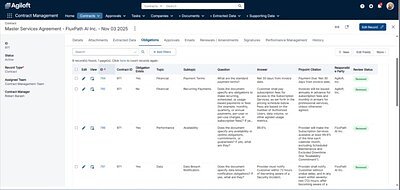
At the heart of the new offering is a capability that allows users to analyze any contract document with a single click. The system’s AI engine reads the document and automatically identifies key obligations—such as payment terms, service levels, and regulatory duties—and structures them as actionable data points. To accelerate adoption, Agiloft has included a library of pre-built obligation categories designed by legal experts, covering common areas like finance, delivery, and data security. This gives teams an immediate, standards-based framework for analysis.
Once extracted, these obligations are no longer passive entries in a document. The system transforms them into tasks that can be assigned to specific individuals or teams, complete with deadlines and automated reminders. New dashboards provide a consolidated view of all commitments across the enterprise, flagging upcoming deadlines, overdue items, and high-risk gaps. This transforms the contract from a legal artifact stored in a silo into a living, cross-functional playbook for the entire organization, from procurement and finance to sales and operations.
"Enterprises today manage thousands of contracts, and the cost of missed obligations – whether penalties, compliance failures, or missed revenue – is staggering," said Andy Wishart, Chief Product Officer at Agiloft, in the company's announcement. "With our new Obligation Management capabilities, we are giving enterprises data-rich tools for modern business transformation."
A Crowded Field and the Agentic AI Future
Agiloft is not alone in recognizing the urgency of this problem. The AI-powered CLM market has become a hotbed of innovation, with major players like Icertis, Conga, and SirionLabs all rolling out sophisticated AI features to tackle post-signature management. Competitors are leveraging generative AI for similar extraction tasks and are also promoting a vision of more intelligent, automated contract workflows. This intense competition underscores the magnitude of the market opportunity and signals a definitive industry-wide pivot toward AI-native solutions.
In this crowded landscape, Agiloft is seeking to differentiate itself through its platform's architecture and its philosophy on AI governance. Its emphasis on a “data-first” approach, combined with a highly configurable no-code platform, allows organizations to tailor AI workflows to their specific needs without extensive IT resources. Furthermore, the company is addressing one of the biggest enterprise concerns around AI: trust. By offering what it calls "white box AI," the platform provides transparency into its reasoning, showing users the exact contract language that informed an AI-generated insight. Crucially, Agiloft also guarantees that customer data is never used to train its general AI models, a critical security and privacy assurance for organizations in highly regulated fields like healthcare.
This launch is framed as a key step in what Wishart calls an “agentic AI journey”—a move toward a future where AI can “actively collaborate, reason, and take meaningful actions.” This vision pushes beyond simple automation, envisioning a system that can proactively identify risks, suggest strategic actions, and even initiate workflows autonomously based on the evolving context of a business relationship. While true agentic AI is still on the horizon, the ability to turn unstructured contractual text into structured, actionable intelligence is a foundational building block for that future, shifting CLM from a passive system of record to a proactive system of intelligence.