
- Cardiovascular disease is a leading cause of global mortality, highlighting the need for earlier detection.
- T-Mode™ Heart is the 10th AI module in the Clarius Intelligence suite, designed to simplify cardiac ultrasound interpretation.
- The technology is available globally on Clarius HD3 scanners via a software update, with access requiring a Clarius Membership or One Time License.
Experts view T-Mode™ Heart as a significant advancement in democratizing cardiac ultrasound training, enabling primary care physicians to confidently identify key heart structures and improve diagnostic capabilities in real time.
AI Tool Aims to Give Family Doctors a Specialist's Eye for Ultrasound
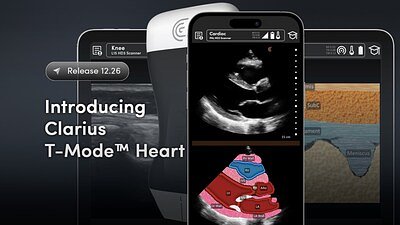
VANCOUVER, BC – March 23, 2026 – In a move aimed at arming frontline clinicians with powerful new diagnostic capabilities, Clarius Mobile Health today unveiled T-Mode™ Heart, an artificial intelligence-driven training technology for its handheld ultrasound scanners. The new tool is designed to dramatically lower the steep learning curve traditionally associated with cardiac ultrasound, empowering primary care physicians (PCPs), medical students, and emergency staff to confidently identify key heart structures in real time.
With cardiovascular disease persistently ranking as a leading cause of global mortality, the push for earlier and more accessible detection methods has intensified. Clarius, a leader in the AI-powered portable ultrasound space, is betting that the solution lies in making complex medical imaging simpler. By integrating AI directly into the learning process, the company seeks to transform its portable scanners from mere imaging devices into interactive educational platforms, potentially changing the landscape of primary care diagnostics.
A Digital Mentor for Complex Anatomy
The core innovation of T-Mode™ is its ability to act as a real-time translator for what can be a bewildering array of grayscale shadows on a typical ultrasound screen. With a single tap during a live scan, the Clarius app activates a synchronized split-screen view. On one side, the clinician sees the standard black-and-white ultrasound image. On the other, an AI model instantly generates a corresponding color-coded, clearly labeled diagram, akin to a page from a medical textbook. This feature, the 10th AI module in the Clarius Intelligence suite, demystifies the view by explicitly identifying structures like the left ventricle, right atrium, and key valves.
This instant anatomical reference is designed to bridge the gap between theoretical knowledge and practical application, a common stumbling block for novice users. It removes the uncertainty and guesswork, allowing learners to build confidence and competence simultaneously.
“The imaging really pops for learners,” says Dr. Brian Johnson, an emergency physician and ultrasound educator who was part of the initial testing group for the new technology. “When teaching, I often point to the left ventricle, right ventricle, left atrium, etc. and learners sort of nod their heads, but I can see they are not sure if they are truly seeing what I want them to see. With the T-Mode they can learn in real time. Plus, when they're not sure what they are seeing, T-Mode is a great support and refresher.”
Overcoming the POCUS Training Barrier
For years, the primary obstacle to the widespread adoption of point-of-care ultrasound (POCUS) in general practice has not been the cost or availability of hardware, but the extensive training required to use it effectively. Interpreting ultrasound images, especially for dynamic organs like the heart, is a skill that traditionally takes months or years to master. This has largely confined its use to specialists like cardiologists and radiologists.
Clinical research, however, underscores the immense potential of placing this technology in the hands of PCPs. A study highlighted in the Journal of Primary Care in August 2025 noted that family physicians trained in cardiac POCUS can accurately diagnose serious heart conditions, including heart failure. The challenge has always been delivering that training at scale.
Clarius's new technology aims to be the catalyst for that change. “The data shows that POCUS use by primary care physicians supports preventive medicine by helping clinicians screen for cardiac disease in patients presenting with fatigue or chest discomfort but the challenge has always been the necessary training,” says Sarah Leverett, Clarius Vice President of Marketing. “T-Mode Heart provides the missing link for clinicians to quickly integrate point-of-care ultrasound into everyday patient care. By removing the uncertainty of image interpretation and thereby accelerating ultrasound training, we are enabling clinicians to improve triage and treatment decisions when every minute counts.”
From Cardiac Care to Common Knee Pain
Building on the same AI foundation, Clarius is simultaneously launching T-Mode™ Knee. This module addresses one of the most frequent complaints seen in primary care offices: knee pain. Using the same split-screen, color-coded approach, the tool helps clinicians master scanning the knee's complex anatomy across all planes—anterior, posterior, lateral, and medial.
By helping practitioners identify POCUS markers for common injuries and pathologies, T-Mode™ Knee empowers them to perform more accurate in-office assessments. This capability can streamline patient care pathways significantly, allowing for more efficient and informed referrals to physical therapy or orthopedic surgery, and in many cases, providing immediate answers that can alleviate patient anxiety and avoid unnecessary specialist visits.
Navigating a Competitive and Evolving Market
The launch positions Clarius distinctly within the competitive handheld POCUS market, which includes major players like Butterfly Network, Philips Lumify, and GE Vscan Air. While competitors also leverage AI for image optimization and workflow improvements, Clarius's explicit focus on creating a real-time, overlay-based training tool is a key differentiator. It directly tackles the educational barrier that has long hindered market expansion into primary care.
The technology is available globally on the company's Clarius HD3 scanners through a new software update. Access to the T-Mode features requires either an ongoing Clarius Membership or a One Time License for the Clarius Intelligence suite. This subscription-based model, common in the software industry, makes the advanced technology more accessible by lowering the upfront financial barrier for smaller clinics and individual practitioners, who can pay a recurring fee for access to the latest AI advancements.
The regulatory pathway for such tools is also a crucial part of the strategy. By positioning T-Mode as an educational and training feature, rather than a direct diagnostic AI, Clarius can potentially accelerate the rollout of new modules for different body parts. The underlying HD3 scanners already possess the necessary regulatory approvals, such as the CE Mark in Europe, allowing the company to build upon a certified and trusted hardware platform. This approach enables a rapid expansion of capabilities, empowering clinicians on the front lines and moving healthcare closer to a future where advanced diagnostic insights are available to every medical professional, right in their pocket.