
- 100 USVs per month: Thunder Tiger aims to scale production to meet demand from large-scale government contracts.
- 6-week integration: Shield AI demonstrated Hivemind's rapid adaptability by integrating it onto a U.S. USV in under six weeks.
- 600 kg payload: Thunder Tiger's Seashark 600 Stealth USV can carry payloads of up to 600 kg.
Experts view this partnership as a critical step in enhancing Taiwan's asymmetric defense capabilities, particularly in deterring potential adversaries through advanced AI-driven autonomous systems.
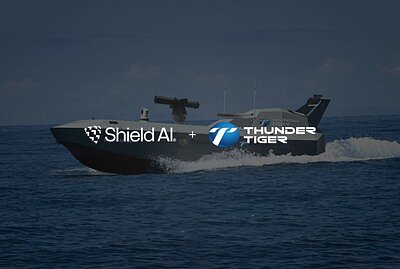
AI Swarms for Taiwan: Shield AI & Thunder Tiger Forge Defense Pact
TAIPEI, Taiwan – May 12, 2026 – In a significant move to bolster Taiwan's defensive capabilities, U.S. defense-tech firm Shield AI and leading Taiwanese manufacturer Thunder Tiger Corp. have announced a partnership to integrate advanced artificial intelligence into Taiwan's unmanned naval fleet. The collaboration will equip Thunder Tiger's unmanned surface vessels (USVs) with Shield AI's "Hivemind" autonomy software, designed to enable swarms of autonomous boats to operate as a coordinated team, even without human control.
This agreement, formalized through a memorandum of understanding, marks a critical step in Taiwan's pursuit of an asymmetric defense strategy. The initial phase will culminate in a live demonstration this summer, where a Hivemind-powered USV will showcase its ability to navigate and execute missions at sea, offering a glimpse into the future of naval warfare in the Indo-Pacific.
A New Edge for Taiwan's 'Porcupine' Defense
The partnership directly addresses Taiwan's long-standing military doctrine, often called the "porcupine strategy," which focuses on making a potential invasion prohibitively costly for an adversary. Faced with the numerically superior forces of the People's Liberation Army, Taiwan's Ministry of National Defense (MND) has increasingly pivoted towards innovative, cost-effective technologies like unmanned systems and AI.
This strategic shift is underscored by the establishment of Taiwan's own Defense Innovation Unit (DIU), modeled after its U.S. counterpart, to fast-track the adoption of cutting-edge commercial technology for military use. The MND has allocated substantial budgets for drone procurement, viewing autonomous platforms as a "destabilizing technology" that can provide a crucial asymmetric advantage. The integration of a sophisticated AI pilot like Hivemind is seen as the key to unlocking the full potential of these unmanned fleets, transforming them from remotely piloted vehicles into intelligent, autonomous assets.
"Our partnership with Thunder Tiger is about getting Taiwan MND the asymmetric capabilities needed to deter conflict and is part of a broader strategy to support Taiwan," said Brandon Tseng, co-founder of Shield AI and a former U.S. Navy SEAL, in the announcement. This collaboration aims to enhance Taiwan's self-reliance by strengthening its indigenous defense industrial base through technology transfer and local development.
The 'Hivemind' Behind the Autonomous Fleet
At the heart of this technological leap is Shield AI's Hivemind, an AI-powered software that acts as an intelligent pilot. It enables unmanned systems to sense their environment, make decisions, and act on them without constant human input. This is particularly vital in a contested battlespace where communications and GPS signals could be jammed or spoofed.
Hivemind's most significant advantage is its ability to facilitate "multi-agent teaming." This allows individual unmanned platforms—whether on the sea, in the air, or on land—to communicate and collaborate, forming a cohesive, intelligent swarm. A group of Hivemind-equipped USVs could, for example, collectively decide how to best conduct a surveillance mission, track a target, or respond to a threat, all while dynamically adapting to changing conditions.
While its application on Taiwanese USVs is new, Hivemind has a proven track record. The software has been integrated and tested across dozens of platforms, including fighter jets like the F-16 and advanced drones like the MQ-20 Avenger. Just recently, Shield AI demonstrated Hivemind's rapid adaptability by integrating it onto an HII-built USV in the United States in under six weeks, proving its modular, platform-agnostic design. This partnership with Thunder Tiger represents the software's continued expansion into the critical maritime domain.
A Taiwanese Tiger with Global Reach
The collaboration pairs Shield AI's cutting-edge software with the robust hardware of Thunder Tiger Corp., one of Taiwan's most prominent unmanned systems manufacturers. The company has developed an extensive portfolio of platforms designed for real-world operational conditions, from coastal defense to disaster response.
Thunder Tiger's USV lineup, which will be the first to receive the Hivemind integration, includes the versatile Seashark series. Models like the 6-meter Seashark 600 Stealth are designed for high-speed missions, capable of carrying payloads of up to 600 kg and switching between reconnaissance and attack roles. The company currently has the capacity to produce dozens of USVs per month, with plans to scale to 100 to meet demand from expected large-scale government contracts.
Crucially, Thunder Tiger has already established itself as a trusted partner within the Western defense ecosystem. Its "Overkill" FPV drone recently gained approval under the U.S. Department of Defense's stringent Blue UAS program. This certification validates the drone's cybersecurity, supply chain integrity, and non-PRC sourcing, making it a pre-approved platform for U.S. and allied government procurement.
"Integrating Hivemind gives our platforms the autonomous decision-making capability to execute complex missions independently and operate as part of a coordinated team," stated Gene Su, board director and general manager of Thunder Tiger Corp. "We see this partnership as an opportunity to advance Taiwan's defense industrial base and deliver more capable, autonomous systems to forces."
Navigating Tense Geopolitical Tides
This deepening of U.S.-Taiwan defense-industrial ties is certain to be watched closely from Beijing, which has consistently condemned U.S. arms sales and military support for the island it claims as its own territory. Chinese officials frequently describe such cooperation as a crossing of a "red line."
However, from the perspective of Taipei and Washington, these collaborations are essential for maintaining regional stability by strengthening deterrence. The partnership is a clear signal of the U.S. commitment to helping Taiwan defend itself. Shield AI has backed this commitment by establishing a permanent office in Taipei's iconic Taipei 101 tower, signaling a long-term investment in the island's security and industrial base.
The phased approach for the integration—starting with simulation and moving to live-vehicle testing—is designed to systematically validate the performance of these new autonomous teams. The upcoming summer demonstration will be more than just a technical trial; it will be a strategic showcase of a new, AI-driven capability that could redefine maritime security in the Taiwan Strait and beyond. As these intelligent swarms prepare to take to the water, they represent a powerful new component in the delicate balance of power in the Indo-Pacific.