
- 85% of enterprises will use AI SRE tooling by 2029 (up from <5% in 2025) - AI can reduce MTTR by up to 43% and MTTD by 35% - AIOps market valued at over USD 1.5 billion
Experts agree that while AI offers significant operational efficiencies in SRE, its success depends on proper implementation, financial oversight, and addressing underlying system issues rather than relying on it as a standalone solution.
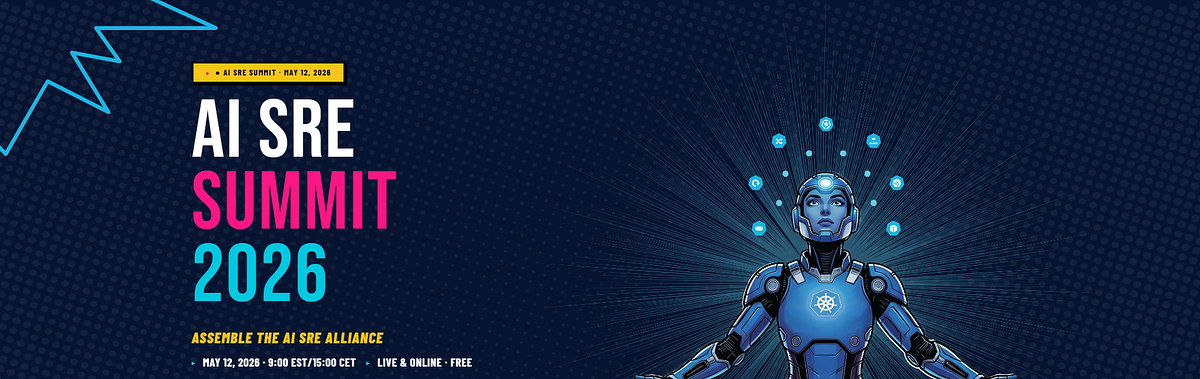
AI SRE Summit to Tackle Hype vs. Reality in Cloud Operations
TEL AVIV, Israel and SAN FRANCISCO – April 22, 2026 – As engineering teams grapple with the escalating complexity of cloud-native systems, Komodor, an autonomous AI SRE company, has announced a virtual summit aimed at cutting through the noise surrounding artificial intelligence in production operations. The AI SRE Summit 2026, a free online event scheduled for May 12, will bring together a formidable lineup of engineering leaders from companies including AWS, Salesforce, Honeycomb, and Man Group to deliver a crucial reality check on AI's role in Site Reliability Engineering (SRE).
The event arrives at a pivotal moment for the tech industry. Enterprises are facing immense pressure to maintain system uptime and accelerate release cycles, all while managing colossal volumes of telemetry data from labyrinthine microservice architectures. The promise of AI is to automate, predict, and self-heal these systems, but a chasm often exists between vendor promises and production reality. This summit aims to bridge that gap by focusing on practical insights and real-world lessons, moving the conversation beyond marketing hype to tangible results.
Beyond the Buzz: A Grounded View of AI in the Trenches
The central theme of the AI SRE Summit is to separate demonstrable value from speculative hype. The agenda is purpose-built for the practitioners on the front lines—SREs, platform engineers, and DevOps leaders—who are tasked with applying AI safely and effectively. A headline panel, titled “AI in SRE: Hype vs. Reality in 2026,” features luminaries such as Stefana Muller, VP of Infrastructure and Operations at Salesforce, and Charity Majors, CTO of Honeycomb, who will dissect where AI is creating measurable value and where it still falls short.
Industry data underscores the urgency of this conversation. Gartner predicts that by 2029, a staggering 85% of enterprises will utilize AI SRE tooling, a monumental leap from less than 5% in 2025. This rapid adoption is fueled by AI's proven ability to be a “force multiplier” for overstretched teams. Studies have shown that AIOps implementations can slash Mean Time to Detect (MTTD) by 35% and Mean Time to Resolution (MTTR) by up to 43%, transforming incident response from a chaotic, multi-hour scramble into a more controlled, minutes-long process.
However, the summit's agenda also reflects a healthy skepticism. Brittany Woods, Head of Systems Engineering at Man Group, will present a session titled “You Can’t AI Your Way Out of a Broken Platform.” This talk promises to explore the counterproductive nature of layering AI onto fragmented or poorly designed internal platforms, a scenario that can amplify complexity rather than reduce it. This nuanced perspective is critical, acknowledging that AI is a powerful tool, not a magical fix for underlying architectural or cultural issues.
The Economic Imperative: Taming Cloud Costs and Operational Chaos
Beyond technical elegance, the push towards AI-driven SRE is fundamentally an economic one. The explosion of cloud-native architectures has led to a parallel explosion in operational costs and complexity, often leaving organizations struggling with runaway cloud bills and inefficient resource utilization. The summit directly confronts this challenge, examining the crucial link between AI, reliability, and financial governance.
Corey Quinn, the renowned Chief Cloud Economist at Duckbill, is slated to discuss “Your AI Doesn’t Know What Things Cost,” a session poised to scrutinize the operational and financial realities of scaling AI systems in production. This reflects a growing concern in the industry: while AI can optimize systems, the AI models themselves can be expensive to run and require careful financial oversight. Komodor, the event's host, claims its own platform can save millions in Kubernetes compute costs, highlighting the intense focus on demonstrating tangible return on investment.
The AIOps market, currently valued at over USD 1.5 billion and growing at a steady clip, is a testament to this economic imperative. Organizations are investing heavily in solutions that can automate away toil—the repetitive, manual tasks that consume valuable engineering time—and provide predictive insights into resource needs. By automating tasks like log analysis and alert correlation, which can reduce alert noise by as much as 80%, AI frees up engineers to focus on high-value work like improving system resilience and designing future-proof architecture.
The Human Element: Redefining the Engineer's Role in an Autonomous Future
Perhaps the most profound impact of AI in SRE is the fundamental shift it forces in the role of the human engineer. As AI agents become more capable of autonomous diagnosis and remediation, the responsibilities of SRE and platform teams are evolving. The summit's agenda is rich with sessions exploring this human-AI collaboration, such as “If AI Writes the Code, Who Owns Production?” and “Your AI Agent Has No SRO.”
These discussions point to a future where engineers transition from being manual problem-solvers to becoming the architects and supervisors of autonomous systems. The focus shifts from reactive firefighting to proactive governance. This requires a new skill set, including what Asaf Savich of Komodor calls “Context Engineering”—the practice of providing AI agents with the right information and guardrails to make safe, effective decisions. Trust and explainability become paramount; engineers must be able to understand and audit every AI-driven action.
This evolution is not about replacing engineers but augmenting them. With AI handling the immense data correlation and initial triage, human experts can apply their deep system knowledge to more complex, strategic challenges. The engineer’s role becomes less about manually piloting the aircraft through turbulence and more about designing the autopilot, monitoring its performance, and taking control when it encounters a situation beyond its programming. The insights shared at the AI SRE Summit will be instrumental in helping organizations and individuals navigate this transition, ensuring that as systems become more autonomous, they also become more reliable and resilient.
Topics & Related
Software & SaaS
AI & Machine Learning
Cloud & Infrastructure
Artificial Intelligence
Generative AI
Machine Learning
ChatGPT
Revenue
EBITDA
Related Company Pulse