
- 4 million submissions: BusyBee AI grading assistant processed over 4 million student submissions across 600+ school domains.
- 4,200 hours saved weekly: The tool reduces grading time by an estimated 4,200 hours per week for teachers.
- 80% time reduction: eLearning Academy reported an 80% reduction in grading time, cutting feedback delivery from days to under 24 hours.
Experts agree that AI grading tools like BusyBee are significantly reducing teacher workload and improving student feedback timeliness, marking a pivotal shift in educational technology adoption.
AI Reveals the Hidden Work of Grading with 4 Million Submissions
OREM, Utah – April 13, 2026 – A significant milestone in educational technology was announced today, revealing the sheer scale at which artificial intelligence is beginning to reshape K-12 classrooms. Agilix Labs confirmed that its AI grading assistant, BusyBee, has now processed more than four million student submissions across over 600 school domains. The achievement not only highlights a remarkable level of adoption but also sheds light on the often-invisible burdens of teaching, offering a glimpse into a future where technology shoulders administrative tasks, freeing educators to focus on their students.
The tool, built on Amazon Bedrock from Amazon Web Services (AWS), is at the forefront of a movement aiming to solve one of the most persistent challenges in education: the overwhelming and time-consuming nature of grading. By automating key parts of the assessment process, the platform is demonstrating tangible results at a production scale, significantly altering the daily workflow for thousands of teachers.
The AI Assistant in the Digital Classroom
For educators, the challenge of grading extends far beyond the sheer volume of papers. As Curt Allen, CEO of Agilix Labs, explained, the real drain is the constant mental gear-shifting. "The problem teachers described wasn't volume. It was starting over mentally, forty times in a single grading session," Allen stated. A teacher might move from a fifth-grade history essay to a ninth-grade biology report, each with its own rubric, vocabulary, and academic expectations. This cognitive load is a major contributor to teacher burnout, a problem that industry research confirms is exacerbated by administrative tasks that consume between eight and twelve hours of a teacher's week.
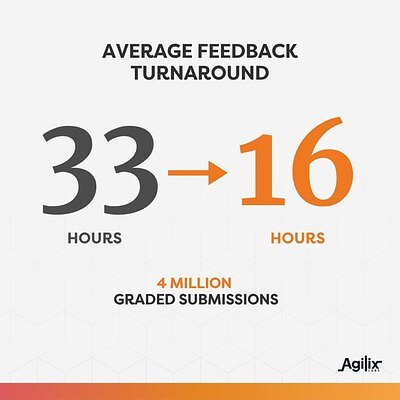
BusyBee is designed to tackle this specific pain point. The AI automatically adjusts its assessment framework to each student's grade level and the specific assignment's rubric. This allows it to provide a consistent first pass of feedback, which the teacher then reviews, modifies, and approves. The impact has been dramatic. Across its user base, the average turnaround time for student feedback has been more than halved, dropping from 33 hours to just 16. Agilix estimates this translates to a collective savings of 4,200 hours of grading time each week for teachers on the platform.
At institutions like eLearning Academy, the results are even more pronounced. The academy reported an 80 percent reduction in time spent on grading, allowing them to return feedback to students in under 24 hours, a significant improvement from the previous two-to-three-day wait. "Instead of mentally shifting gears for each grade, teachers get accurate, consistent feedback that adapts to the level they're assessing," said Celeste Robichaux of eLearning Academy.
Scaling Smart: The Technology Behind the Milestone
Processing millions of student submissions while providing nuanced, grade-appropriate feedback requires immense computational power and a sophisticated, secure infrastructure. This is where the collaboration with Amazon Web Services becomes critical. By building BusyBee on Amazon Bedrock, Agilix has been able to deploy its AI models at scale while navigating the stringent security and privacy requirements of the K-12 sector.
"Four million graded submissions on Amazon Bedrock means real teachers are relying on this daily," noted Alec Chalmers, Director of EdTech and GovTech for AWS Public Sector. "Agilix Labs has shown that responsible AI in K-12 can work at scale while keeping teachers in control."
This concept of "responsible AI" is crucial. AWS Bedrock is designed with features essential for handling sensitive student data, including robust data encryption and a zero-persistence policy, meaning customer data is not logged or used to train the foundational models. While AWS provides the secure cloud infrastructure, under a shared responsibility model, it is up to companies like Agilix to build applications that are compliant with regulations like FERPA (Family Educational Rights and Privacy Act). The platform’s architecture provides the necessary tools to achieve this compliance, a critical factor for gaining trust from school districts. This trust appears to be growing; internal data from Agilix shows that the rate of teachers accepting AI-suggested grades without any edits has climbed from 48% at launch to 63% today, indicating increasing confidence in the tool's accuracy and reliability.
Beyond Speed: Reshaping Student Feedback
The most profound impact of AI grading may not be on teacher schedules, but on student learning itself. Educational research has long established that timely, specific feedback is one of the most powerful drivers of academic improvement. When students receive comments on an assignment days after they have moved on to a new topic, the opportunity for learning is diminished. By cutting feedback loops from days to hours, tools like BusyBee ensure that guidance is delivered when it is most relevant.
Furthermore, AI introduces a level of consistency that is difficult for humans to maintain across hundreds of assignments. The technology applies rubrics identically to every submission, helping to mitigate the unconscious bias and variability that can sometimes creep into manual grading. This not only ensures a fairer evaluation for all students but also provides teachers with a wealth of data. The system can identify common misconceptions across a classroom in real-time, allowing an educator to adjust their lesson plan for the next day to address a specific learning gap that might have otherwise gone unnoticed.
A Crowded Field in a Growing Market
Agilix's success with BusyBee is a significant indicator of a much broader trend. The company operates within a fiercely competitive and rapidly expanding EdTech landscape. The global K-12 Learning Management System (LMS) market, valued at over $5 billion in 2024, is projected to swell to over $33 billion by 2034. Within that, the niche for AI in K-12 education is exploding, expected to grow from approximately $390 million to nearly $8 billion in the next decade.
Numerous companies are vying to offer solutions. Competitors range from comprehensive platforms like MagicSchool AI to specialized tools like Gradescope by Turnitin, which handles complex assignment types, and Formative, an AI-first assessment platform. Each aims to carve out a piece of the market by automating administrative tasks and providing data-driven insights.
What the four-million-submission milestone for BusyBee demonstrates is that AI is no longer a theoretical or experimental tool in education. It is a production-scale utility being used daily to manage core educational workflows. As these systems become more integrated, they promise to continue transforming the roles of both teachers and students, marking a definitive shift in the landscape of modern education.