
- 78 gigawatts: Projected data center power demand on the ERCOT grid by 2030, up from 30 gigawatts in 2024.
- 438-acre site: The size of the Texas Critical Data Centers (TCDC) campus in Odessa, TX.
- 30+ years: Lifespan of the CO2 Battery Plus technology with no performance degradation.
Experts view this partnership as a critical innovation in addressing the energy demands of AI, offering a scalable, efficient, and lower-emission solution to grid constraints.
AI Power Crisis Spurs Novel CO2 Battery Solution in West Texas
ODESSA, TX – April 02, 2026 – In a landmark move to address the voracious energy appetite of artificial intelligence, developer New Era Energy & Digital, Inc. (NUAI) is partnering with technology firm Energy Dome to deploy a first-of-its-kind energy storage solution for a massive new data center campus in West Texas. The collaboration will see Energy Dome’s innovative CO2 Battery Plus technology integrated with on-site gas power generation to provide the reliable, round-the-clock electricity required by NUAI’s planned 1-gigawatt-plus Texas Critical Data Centers (TCDC) facility in Odessa.
This partnership represents a critical new strategy in the race to power the AI revolution. As data centers become larger and more power-intensive, they are placing unprecedented strain on public electrical grids. By creating a self-contained, behind-the-meter power ecosystem, the TCDC project aims to decouple from grid constraints, ensuring the constant uptime essential for AI workloads while pioneering a model for more efficient, lower-emission digital infrastructure.
ERCOT Under Siege: The Energy Demands of the AI Boom
The backdrop for this project is the escalating energy crisis within the Texas electricity market. The Electric Reliability Council of Texas (ERCOT), which manages the state's independent grid, is facing a tidal wave of demand driven almost entirely by the proliferation of AI and hyperscale data centers. Projections show data center power demand on the ERCOT grid could skyrocket from roughly 30 gigawatts in 2024 to nearly 78 gigawatts by 2030, an increase equivalent to the power needs of millions of homes.
This surge is not just about total consumption; it is also about the nature of the demand. AI workloads create “very fast, very large ramps” in power usage, creating volatility that is difficult for grid operators to manage. Because Texas operates an “islanded” grid with limited connections to the rest of the country, it is particularly vulnerable to these sudden demand spikes, which threaten overall grid reliability. The challenge has become so acute that interconnection requests for new large-scale power users have overwhelmed the system, highlighting the urgent need for alternative power solutions.
“AI is redefining energy systems and accelerating the need for reliable, always-available power for data centers and the grid,” said Claudio Spadacini, Founder and CEO of Energy Dome, in a statement. “This collaboration further confirms Energy Dome’s unique positioning as a leading technology platform for the deployment of firm capacity and true 24/7 clean energy solutions, purpose-built for next-generation AI infrastructure.”
Beyond Batteries: How CO2 and Waste Heat Will Power the Future
At the heart of the Odessa project is Energy Dome’s CO2 Battery Plus technology, a long-duration energy storage system that functions on a novel thermodynamic principle. Unlike conventional lithium-ion batteries, this system stores energy by using electricity—often from low-demand periods or excess renewables—to compress ubiquitous carbon dioxide gas until it turns into a liquid. This liquid CO2 is then stored in standard, pressurized steel tanks.
When power is needed, the process is reversed. The liquid CO2 is evaporated and heated, causing it to expand dramatically and drive a turbine to generate electricity. The CO2 remains within a closed-loop system, meaning it is continuously recycled and not released into the atmosphere during operation. The system is built with readily available, off-the-shelf components like steel and water, boasts a 30+ year lifespan, and experiences no performance degradation over time.
The “Plus” configuration being deployed in Texas takes this a step further by integrating with on-site Open Cycle Gas Turbines (OCGTs). Instead of storing the heat generated during compression, the system captures waste heat from the gas turbines' exhaust. This captured heat is then used to expand the CO2 during the discharge phase, dramatically boosting efficiency and power output. The system offers three distinct operational modes:
- Charge Mode: Stores energy by liquefying CO2 during periods of low power demand.
- SuperBoost Mode: During peak demand, it uses turbine waste heat to more than double the power plant's output, effectively adding the power of an additional turbine without burning more fuel.
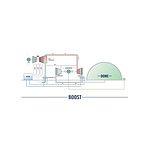
- Boost Mode: The compressor and turbine run simultaneously in a closed cycle, increasing the net power output of the gas plant by up to 25%.
A New Model for Digital Infrastructure in the Texas Plains
The developer, NUAI, is master-planning the TCDC campus on a 438-acre site as a vertically integrated hub for AI and high-performance computing. The strategy is to build the power infrastructure directly alongside the data centers it serves, ensuring a reliable and cost-effective energy supply that is not subject to the bottlenecks and volatility of the public grid.
This behind-the-meter approach is becoming increasingly attractive for mission-critical facilities that cannot tolerate power interruptions. For NUAI, the Energy Dome partnership is a cornerstone of this strategy.
“As we continue to scale our behind-the-meter power infrastructure at TCDC, Energy Dome’s CO2 Battery Plus technology addresses three key areas: lowering delivered energy costs, helping manage the inherent variability between data center load profiles and our on-site generation fleet, and reducing the carbon intensity of our power generation,” noted Charlie Nelson, President and Chief Operating Officer of NUAI. “The ability to capture waste heat and flexibly dispatch stored energy provides additional operational flexibility for AI workloads.”
Energy Dome has already proven its technology with a commercial demonstration plant in Sardinia, Italy, and is developing its first U.S. project in Wisconsin. The TCDC deployment in Texas, however, represents a significant scaling of the technology, specifically tailored for the extreme demands of the AI industry and setting a potential blueprint for future projects worldwide.