
- 1.5 million: Osteoporosis-related fractures occur annually in the U.S.
- 80%: Patients with fragility fractures do not receive guideline-based bone health care
- 25%: One-year mortality rate for hip fracture patients
Experts agree that the AI-powered bone health navigator represents a critical advancement in addressing the gap in post-fracture osteoporosis care, particularly under the new CMS payment model, by integrating evidence-based practices into clinical workflows to improve patient outcomes and streamline financial accountability.
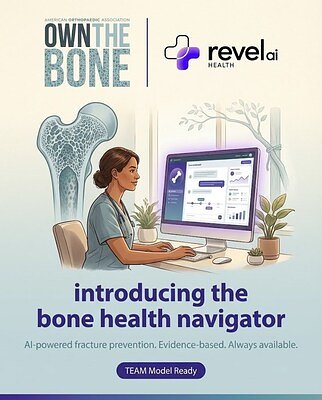
AI Navigator to Tackle Bone Fractures Under New CMS Payment Model
DURHAM, N.C. and ROSEMONT, Ill. – January 14, 2026 – A new partnership is set to deploy artificial intelligence on the front lines of a silent public health crisis: untreated osteoporosis following a bone fracture. The American Orthopaedic Association's (AOA) renowned Own the Bone® program is collaborating with tech firm RevelAi Health to launch an AI-powered “bone health navigator.” The tool is designed to embed evidence-based care directly into clinical workflows, aiming to dramatically improve patient outcomes while helping hospitals navigate the complex financial landscape of a new, mandatory government payment model.
This collaboration arrives at a critical juncture for orthopedic care. Fragility fractures, which are breaks that occur from a fall at standing height or less, represent a massive and growing problem. In the United States alone, an estimated 1.5 million osteoporosis-related fractures occur each year. The consequences are severe, particularly for the 300,000 annual hip fracture patients, who face a one-year mortality rate as high as 25% and a substantial loss of independence. Despite the availability of effective treatments, a staggering 80% of these patients never receive guideline-based bone health care, leaving them vulnerable to debilitating secondary fractures.
The TEAM Model: A New Era of Accountability
The urgency for a solution is being amplified by a major policy shift from the Centers for Medicare & Medicaid Services (CMS). Beginning in 2026, the mandatory Transforming Episode Accountability Model (TEAM) will hold selected hospitals financially accountable for the cost and quality of care for several high-cost procedures, including surgical hip and femur fracture treatment (SHFFT).
Under TEAM, hundreds of hospitals across the country will no longer be paid on a simple fee-for-service basis for these episodes. Instead, they will be measured against a predetermined target price for the entire episode of care, which begins with the initial surgery and extends 30 days after hospital discharge. This period covers all associated Medicare Parts A and B services, from post-acute care and physical therapy to follow-up diagnostics and readmissions. Hospitals that deliver high-quality care below this target price stand to earn financial bonuses. Those whose costs exceed the target, or who fail to meet quality benchmarks, will face financial penalties.
This two-sided risk model fundamentally changes the incentives for orthopedic departments. It puts immense pressure on care teams to streamline processes, improve coordination, prevent costly complications like infections or readmissions, and meticulously document quality metrics. The TEAM model is the first to formally require the collection of Patient-Reported Outcome Measures (PROMs), adding another layer of data-gathering complexity. It is precisely this high-stakes environment of cost control and quality reporting that the new AI navigator is built to address.
Closing the Care Gap with an AI Co-Pilot
The Own the Bone-RevelAi Health partnership aims to provide more than just a static checklist. It promises an active, intelligent assistant designed to alleviate the administrative burden on clinicians while ensuring patients don’t fall through the cracks.
The AI navigator will be delivered through RevelAi's agentic AI platform, which was built by orthopedic surgeons and AI experts. It is designed to integrate into a care team's daily operations, offering several key functions. Clinicians will have access to a conversational interface that can answer questions about Own the Bone's evidence-based practices in real time, providing decision support at the point of care. The tool will also assist in operational tasks, such as designing fracture liaison service (FLS) workflows, generating documentation for prior authorizations, and ensuring proper coding for billing.
"Own the Bone has been the backbone of post-fracture osteoporosis care in the United States for more than a decade," said Christian Pean, MD, MS, an orthopaedic trauma surgeon at Duke University School of Medicine and CEO of RevelAi Health. "As hip fractures move into a mandatory episode-based model, teams need more than static toolkits—they need an AI navigator that can sit inside their workflow, answer bone health questions in real time, support registry and TEAM reporting, and help ensure high-risk patients actually get treated."
Furthermore, the platform will integrate with automated care pathways that can track patient follow-up, monitor osteoporosis treatment status, and manage tasks related to registry or TEAM reporting over time. It will also provide consistent, high-quality patient education materials, empowering teams to effectively counsel patients and their families about the importance of bone health.
Merging Proven Guidance with Modern Technology
For over a decade, the AOA's Own the Bone program has been a leading quality improvement initiative, helping hundreds of medical centers establish FLS programs to identify, evaluate, and treat at-risk patients. Sites participating in the program have already demonstrated measurable improvements in osteoporosis treatment rates. However, challenges related to resources, manual data entry, and fragmented communication persist.
The collaboration with RevelAi Health represents a significant technological leap forward. By embedding Own the Bone's proven curriculum into an AI-driven workflow, the partnership aims to scale best practices and reduce the operational friction that has historically limited the reach of FLS programs.
"Pairing Own the Bone with RevelAi's technology creates a practical way to deliver consistent, high-quality bone health management while reducing operational burden," said Kevin Kirk, DO, FAOA, chair of the Own the Bone Steering Committee. "By building Own the Bone expertise into an AI navigator, we can give our teams real-time support that helps them follow proven evidence-based guidance and best practices, ultimately improving patient outcomes."
AOA President Kyle Jeray, MD, FAOA, echoed this sentiment, calling the collaboration "an exciting step forward for secondary fracture prevention and bone heath care for orthopaedic patients."
The partners plan to begin deploying the navigator at select Own the Bone sites in 2026, targeting large health systems and high-volume private practices for an early access program. Following this initial phase, the tool is expected to become more broadly available, offered both as part of RevelAi's comprehensive care coordination platform and as a standalone product. This strategic rollout aims to refine the technology in real-world settings as the pressures of the TEAM model begin to mount for hospitals nationwide.