
- 87% of organizations use AI in their customer education programs
- 42.5% have no designated owner for their AI strategy
- 45% cite content quality and accuracy as their top worry
Experts emphasize the need for structured AI governance, clear ownership, and quality guardrails to mitigate risks and maximize ROI in customer education.
AI in Customer Training: High Adoption and Low Oversight Create Risks
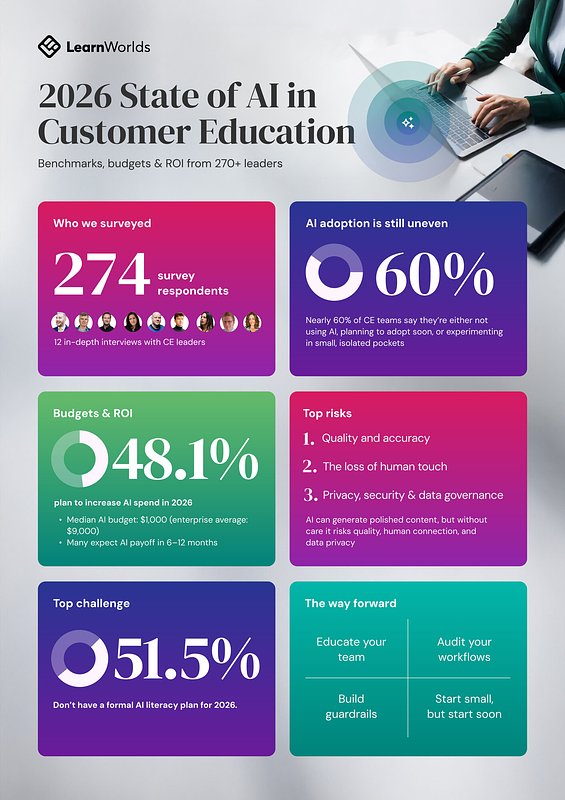
LIMASSOL, Cyprus – March 03, 2026 – A striking paradox is unfolding in the world of corporate training: while an overwhelming majority of companies are rapidly deploying artificial intelligence tools, a significant number are doing so without a map, a driver, or a clear destination. A landmark report released today reveals that while 87% of organizations use AI in their customer education programs, a staggering 42.5% have no designated owner for their AI strategy, creating a high-risk environment that threatens content quality, data security, and the return on investment that AI promises.
The findings, published in the “2026 State of AI in Customer Education” report by learning management system provider LearnWorlds, paint a picture of a sector in a state of enthusiastic but chaotic adoption. Based on data from 274 professionals and 12 executive interviews, the report highlights a deep maturity divide. While about 37% of teams have successfully embedded AI into their core operations, a majority—nearly 60%—are still in the nascent stages of experimentation and planning, operating in a virtual “wild west” of unmanaged AI implementation.
The Governance Gap: From Novelty to Infrastructure
The central challenge identified by the report is a critical gap between grassroots adoption and strategic governance. This isn't a problem unique to customer education; it mirrors a broader trend across enterprises where the rush to deploy AI outpaces the creation of frameworks to manage it. This “AI sprawl” leads to duplicated tools, increased compliance risks, and a failure to capture a true return on investment.
Panos Siozos, PhD, Co-founder and CEO at LearnWorlds, argues that structure, not budget, is the key differentiator for success. "A less widely known B2B company can outperform a global enterprise in AI-powered learning not because of budget, but because of structure," Siozos stated in the report. "The teams pulling ahead treat AI as infrastructure with clear ownership, documented workflows, and quality guardrails. The teams falling behind are still treating it as a novelty."
This lack of oversight is breeding significant concerns among practitioners. Nearly half (45%) cite content quality and accuracy as their top worry, a fear echoed by Dave Derington, former Sr. Manager of Learning Solutions & Programs at Atlassian. "The risk we're seeing relates to business leaders who over-index on using AI to create learning experiences without understanding that AI doesn't fix bad systems—it amplifies them," Derington warned. "Quality still lives and dies with human taste. Creation time goes down with AI, but review time goes up." Beyond quality, 30% worry about losing the human touch, and 32.5% flag the serious risks of data privacy and compliance.
Budgets, Blockers, and the Skills Deficit
Despite the strategic vacuum, financial optimism is high. While the median annual AI budget is a modest $1,000—skewed by enterprise outliers spending far more—nearly half (48.1%) of organizations plan to increase their AI spending in 2026. This investment comes with bold expectations: 58.4% anticipate a positive ROI within a year, and over a third expect a return in under six months.
However, this optimism runs headlong into significant operational hurdles. The report reveals a profound skills crisis, with 51.5% of organizations admitting they have no formal plan to improve AI literacy among their teams. This deficit is a primary blocker to adoption for 44.2% of respondents, alongside budget constraints (46.7%) and the technical headache of tool integration (44.5%).
Alisa Dubik, Customer Education Manager at Gorgias, captured the frustration of a fragmented toolset. "Reporting is a nightmare," she said. "I've been without my main dashboard for over a month because of switching LMS vendors. You have to wait for the data, understand the schema, transform it, combine it. And in the meantime, you're flying blind. That's the price of working with so many tools."
The tool landscape is currently dominated by a few major players, with ChatGPT’s 82% adoption rate suggesting that many teams are using readily available, consumer-grade tools rather than strategically procured, enterprise-level solutions.
From Busywork to Breakthroughs
Currently, AI's application in customer education is focused on efficiency gains for low-level tasks. Text generation (62.4%) and creating course outlines (52.2%) are the most common uses. While these applications provide value, the more transformative capabilities of AI—such as adaptive learning paths and personalized AI agents—remain largely untapped, with adoption rates below 15%.
The danger lies in using AI to simply do the wrong things faster. The true value emerges when AI is applied to solve complex, high-impact problems that were previously intractable. Danielle Evans, Director of Customer Education at Sendoso, provided a powerful example of this strategic application. "We had over 50 product training videos and 15-30 product releases per year," Evans explained. "Updating them manually would basically be a full-time job. We are now using an AI tool which actually tags to the code behind the product. When something changes, we just rerender it and the video updates everywhere. That's a huge time and cost saver."
This high-impact approach is key to realizing the exponential gains AI can offer. As Eric Mistry, AI & Automation Transformation Lead at Zapier, noted, the long-term view is critical. "We tend to overestimate what AI can do in a month and underestimate what it can do in a year," Mistry said. "Once people build the muscle, the payoff is exponential. If every employee in a 500-person company saves just ten minutes a day with AI, that's a massive gain."
The Future is Contextual and Just-in-Time
Looking ahead, the report identifies a fundamental shift away from traditional, lengthy courses housed in a learning management system. The future of customer education is contextual, personalized, and delivered at the precise moment of need. Two-thirds of professionals expressed interest in AI-powered analytics that can identify user behavior within a product and trigger an immediate, relevant educational intervention.
"The future isn't long certification paths," said Antony Leeming, Head of Customer Education at BeyondNow. "With AI and point-of-need learning, what learners really need is a 20-second contextual video or a well-timed tooltip, not a three-hour course."
To navigate this evolution from chaotic experimentation to a future of intelligent, just-in-time learning, the report suggests a clear path forward. Experts advise leaders to move decisively by assigning clear ownership of AI strategy, systematically building AI literacy across teams, establishing firm quality and privacy guardrails, and proving value through focused, high-impact pilot projects. By closing the governance gap, organizations can begin to harness the true transformative power of AI, moving it from a risky novelty to the core infrastructure of modern learning.