
- $1.2 trillion: The U.S. needs this amount over the next two decades to maintain and upgrade its drinking water and wastewater systems (EPA).
- 99% accuracy: SewerAI's AutoCode™ AI engine identifies and classifies faults with this level of precision, six times faster than human reviewers.
- $6-9 billion: The City of Houston's estimated cost for wastewater system upgrades under an EPA Consent Decree.
Experts agree that AI-driven solutions like SewerAI's platform represent a critical advancement in managing America's aging sewer infrastructure, offering unprecedented efficiency, accuracy, and cost-effectiveness in inspection and maintenance.
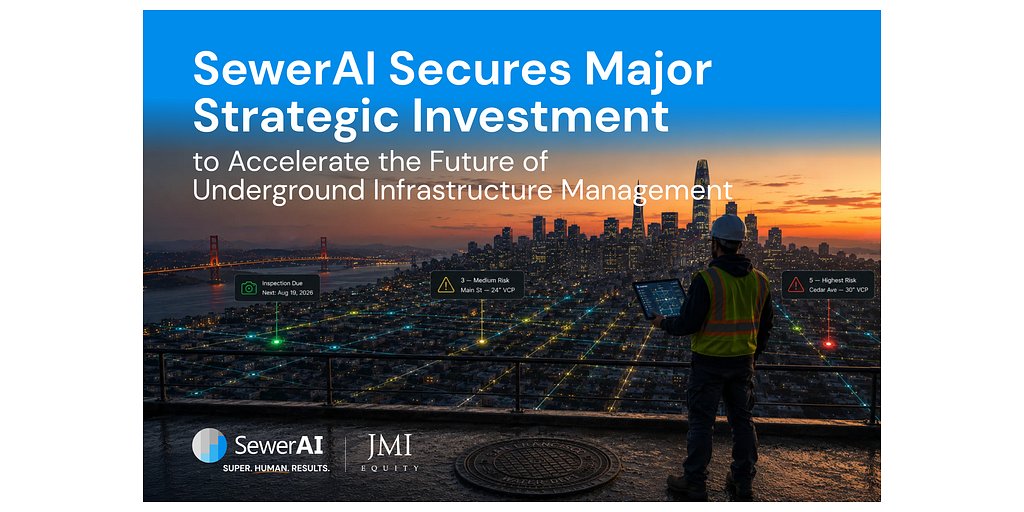
AI Goes Underground: Smart Money Bets on Fixing America's Sewer Crisis
WALNUT CREEK, CA – June 02, 2026
A silent crisis is unfolding beneath America's cities. An aging, labyrinthine network of water and sewer pipes—the circulatory system of modern life—is failing. For decades, the response has been a slow, costly, and often reactive cycle of dig-and-repair. But a major strategic investment in a California-based tech firm signals a fundamental shift in this battle. SewerAI, a company arming municipalities with artificial intelligence, just secured a significant funding round led by JMI Equity, a top-tier growth equity investor. This infusion of capital isn't just a vote of confidence in one company; it's a declaration that the era of managing critical infrastructure with clipboards and guesswork is over. The digital revolution is finally going underground.
A Crisis Measured in Trillions
The scale of the problem is staggering. According to the U.S. Environmental Protection Agency (EPA), the nation needs to invest over $1.2 trillion in the next two decades to maintain and upgrade its drinking water and wastewater systems. The 2022 Clean Watersheds Needs Survey alone identified a $630 billion requirement for wastewater and stormwater infrastructure. These are not abstract figures; they translate into tangible risks. The EPA records between 23,000 and 75,000 sanitary sewer overflows annually, spewing raw sewage into communities and waterways. The National League of Cities' latest report confirms a grim trend: water and sewer infrastructure is experiencing the steepest decline in condition of any major asset category since 2022. While federal initiatives like the Bipartisan Infrastructure Law have allocated billions, the sheer magnitude of the decay dwarfs public funding alone. This gap creates a critical opening for innovation that can do more with less, stretching every dollar and maximizing the lifespan of existing assets.
The Digital Shift from Shovel to Software
For years, the primary tool for inspecting this subterranean world has been a camera on a crawler, with human operators manually watching thousands of hours of grainy footage to spot cracks, blockages, and intrusions. This process is notoriously slow, expensive, and prone to subjective error. SewerAI is systematically dismantling this archaic workflow. The company’s PIONEER™ platform acts as a central nervous system for a utility's underground assets. It ingests inspection data from any standard CCTV crawler and applies its AutoCode™ AI engine. This proprietary AI automates the tedious NASSCO defect coding process, analyzing video to identify and classify faults with over 99% accuracy at six times the speed of a human reviewer. What once took teams of technicians months can now be done in weeks, with greater consistency. The platform doesn't stop at diagnosis. Its Risk & Rehab™ module uses this AI-generated data to create system-wide risk models. It calculates the likelihood and consequence of failure for each pipe segment, allowing utilities to move from a reactive "fix-the-worst-break" model to a proactive, data-driven strategy. This gives public works departments what co-founder and co-CEO Matt Rosenthal calls "superhuman" capabilities, helping them "work faster, make better decisions, and reduce risk and the total cost of infrastructure."
Smart Money Bets on GovTech's New Frontier
The decision by a heavyweight investor like JMI Equity to lead this funding round is a powerful market signal. JMI, known for its disciplined bets on high-growth software companies, doesn't invest lightly. Their move validates the burgeoning "GovTech" sector, particularly in the unglamorous but essential world of critical infrastructure. "SewerAI sits at the intersection of several powerful tailwinds: aging pipeline infrastructure, labor constraints, and the rapid adoption of AI-powered automation," noted Chase Thomet, a Partner at JMI Equity. This investment thesis highlights a new reality for private equity: the massive, historically underserved government and utility market is ripe for technological disruption. With a portfolio representing over $90 billion in aggregate enterprise value, JMI’s backing provides SewerAI not just with capital, but with a strategic partner experienced in scaling category-defining software businesses. This partnership aims to accelerate SewerAI’s mission, as co-founder and co-CEO Billy Gilmartin declared, to end the "era of neglected infrastructure."
From Data to Decisions: The Impact on the Ground
The theoretical promise of AI-driven efficiency is already a reality for some of the nation's largest utilities. The City of Houston, facing a massive EPA Consent Decree requiring an estimated $6 billion to $9 billion in wastewater system upgrades, turned to SewerAI to manage the colossal task. The platform was instrumental in helping the city complete a full-system inspection in just 18 months—a project that was originally projected to take five years with traditional methods. This radical acceleration is crucial for meeting stringent regulatory deadlines and avoiding further penalties. Similarly, the City of Phoenix, which manages one of the country's largest sewer programs, is leveraging the technology to scale its operations without a proportional increase in resources. "SewerAI helps us inspect, prioritize, and report at a scale that wasn’t possible before," said Patrick R. Womack II, SDSSR Program Manager at the City of Phoenix Water Services Department. "It puts our data in one place, making it easier to thoroughly explain inspections and make projections for future capital improvements." This ability to create transparent, defensible capital plans is key to unlocking state and federal funding, turning raw data into approved budgets.
With this new strategic investment, SewerAI plans to push its technology even further. The near-term roadmap focuses on extending its AI capabilities from inspection and assessment into the full lifecycle of rehabilitation planning and program management. This includes enhancing the accuracy of AutoCode™, expanding Risk & Rehab™ to cover manholes, and deepening integrations with industry-standard systems like Esri ArcGIS and OpenGov. The goal is to create a seamless digital thread from the field crawler to the city's master plan. Challenges certainly remain. The inertia of entrenched municipal processes, persistent funding gaps, and a constrained labor market will not disappear overnight. However, the convergence of a clear and present crisis with powerful, scalable technology and sophisticated capital creates a tipping point. By providing cities with the tools to see, understand, and predict the health of their hidden networks, companies like SewerAI are proving that the next great leap in American infrastructure may not be built with concrete and steel, but with algorithms and data.