
- 800 kW of solar panels integrated with a 200 kWh battery storage system deployed at a Japanese chemical plant.
- AI-driven Energy Management System (EnMS) makes thousands of micro-decisions per minute to optimize energy use.
- thingnario's AI software reportedly boosts energy yields by 12-20% in renewable energy systems.
Experts agree that AI-driven smart energy systems are becoming essential for industrial resilience, combining sustainability with operational reliability to mitigate risks from grid instability and extreme weather.
AI Fortifies Industry: Smart Energy Becomes a Strategic Shield
TOKYO, JAPAN – December 08, 2025 – In a move that speaks volumes about the evolving priorities of heavy industry, a Japanese chemical plant has quietly implemented a sophisticated on-site energy system that does more than just lower its carbon footprint. The recent deployment of nearly 800 kW of solar panels integrated with a 200 kWh battery storage system is, on its surface, another step toward corporate environmental, social, and governance (ESG) goals. Yet, the intelligence powering it reveals a more urgent strategy: building a fortress of energy resilience.
By partnering with EPC contractor LINET Corporation and Taiwanese AI specialist thingnario Co. Ltd., the facility is pioneering a model where sustainability and robust business continuity are inextricably linked. The project highlights a critical shift in thinking for sectors where operational failure is not an option. For chemical plants, manufacturers, and data centers, the risk of grid instability—whether from extreme weather, geopolitical tensions, or aging infrastructure—poses an existential threat. This initiative demonstrates that the solution may not just be a bigger backup generator, but a smarter, self-sufficient energy ecosystem.
The Challenge of Integrating Unstable Power
For an energy-intensive facility like a chemical plant, the decision to embrace renewable energy is fraught with complexity. Unlike the predictable, constant flow from a traditional power grid, solar output is inherently volatile, fluctuating with every passing cloud. This intermittency creates significant challenges for an industry where a momentary power disruption can compromise safety protocols, spoil entire batches of product, and trigger cascading system failures.
The core of the problem lies in balancing supply and demand in real-time. Without an intelligent management layer, a facility with large-scale solar faces two undesirable outcomes: either curtailing solar production during peak sun hours to avoid overwhelming its systems (wasting clean energy) or drawing expensive, carbon-intensive power from the grid when the sun isn't shining. The deployment of a 100 kW / 200 kWh battery energy storage system (BESS) is the physical solution, but making it work effectively requires a sophisticated digital brain.
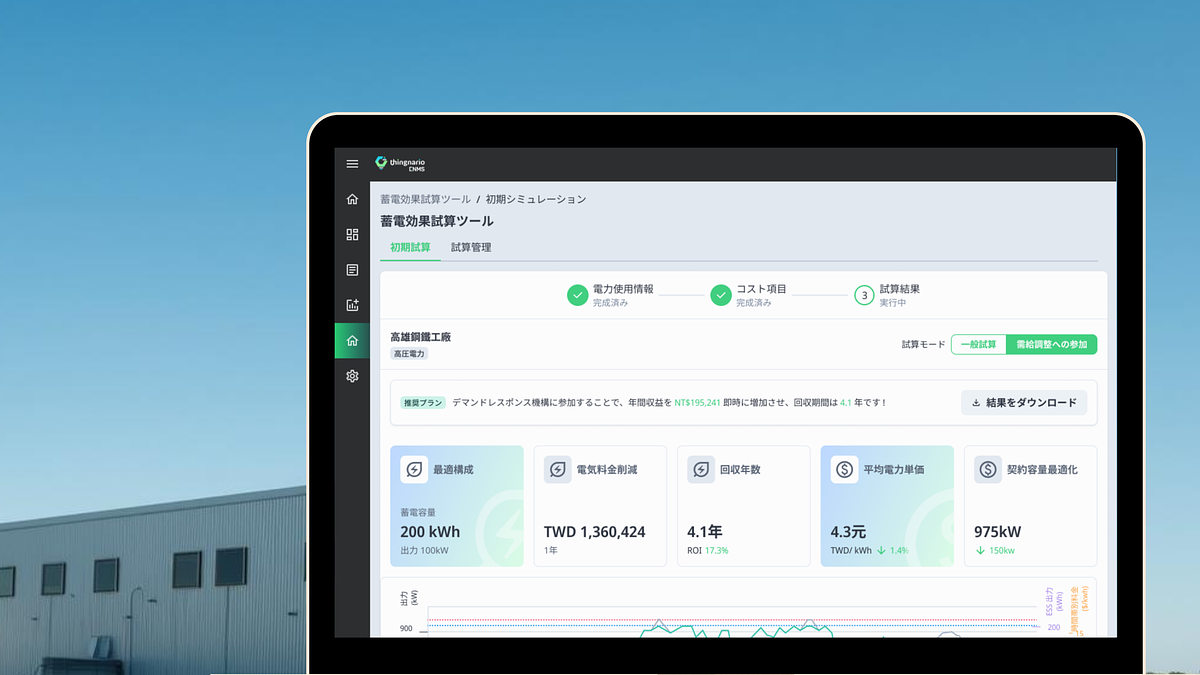
This is where thingnario's Energy Management System (EnMS) comes into play. The system addresses the core technical hurdles by using AI-driven algorithms to make thousands of micro-decisions every minute. It determines precisely when to store surplus solar energy in the battery, when to discharge that energy to power the plant's load, and when to draw from or feed back to the grid, all while respecting the operational constraints and safety imperatives of the chemical manufacturing process.
From Optimization to Disaster-Proofing
What sets this project apart is its explicit focus on resilience, a feature embodied in the system's 'disaster-response mode'. This function elevates the BESS from a tool for economic optimization to a critical component of the plant's Business Continuity Plan (BCP)—a high-priority concern in disaster-prone Japan. With a single click or an automated trigger, the system can island the facility from a failing external grid, using the stored battery power and solar generation to keep critical equipment online.
This AI-managed approach offers significant advantages over traditional diesel generators. The response is nearly instantaneous, preventing the power flicker that can disrupt sensitive machinery. It operates silently and without emissions, and its duration can be extended by ongoing solar generation, a key advantage during prolonged outages where fuel resupply may be uncertain. For a chemical plant, this ensures that safety and containment systems remain powered, mitigating environmental and financial risks.
thingnario's credibility in this space is underpinned by a significant track record. The company, founded in 2017, has rapidly become a dominant force in Taiwan's renewable energy software market, managing over 5 GW of capacity across more than 100,000 IoT devices. Its flagship PHOTON solar monitoring software, which holds the highest market share in Taiwan, uses AI to predict and diagnose production issues, reportedly boosting energy yields by 12-20%. This deep expertise in optimizing renewable assets is now being applied to ensure their reliability in the most demanding industrial settings.
A Blueprint for Industrial Energy Autonomy
This project serves as a powerful blueprint for the future of industrial energy. As global supply chains remain fragile and energy markets volatile, the concept of on-site generation and storage—often called a 'behind-the-meter' microgrid—is gaining traction as a strategic imperative. It represents a move away from passive energy consumption toward active energy management and greater operational autonomy.
In Japan, this trend is accelerated by national policy and economic reality. The country's commitment to achieving carbon neutrality by 2050, coupled with rising electricity prices and regulatory pressure on large energy users, creates a powerful incentive for industries to invest in such systems. The ability of an AI-driven EnMS to provide clear ROI calculations, through modules like thingnario's 'Investment Evaluation Module', helps build the business case for what has traditionally been a high-capital investment.
By accurately modeling energy savings, peak shaving benefits, and avoided downtime costs, these AI platforms transform a BESS from a pure cost center for insurance into a productive asset that pays for itself through daily optimization. This dual-use capability is what makes the technology so compelling for CFOs and operations managers alike, aligning the goals of sustainability and profitability.
Cross-Border Innovation Meets Market Demand
The collaboration between the Japanese plant, LINET Corporation, and Taiwan's thingnario also highlights a significant trend in regional technology partnerships. As Japanese industries accelerate their green and digital transitions, they are increasingly looking to specialized technology leaders from neighboring countries to provide cutting-edge solutions. thingnario's success is a testament to Taiwan's growing prowess in AI and IoT software.
The company's expertise is not limited to individual facilities; it extends to the grid itself. thingnario played a leading role in designing the software for the Taiwan Power Company's (Taipower) ambitious DREAMS project, a system for managing distributed energy resources across the national grid. This experience in utility-scale control and data management demonstrates a level of sophistication that is crucial for ensuring that on-site industrial systems can operate harmoniously with the broader energy network.
For investors and market watchers, this project is a clear indicator of a burgeoning market. The fusion of AI, renewable energy, and energy storage is creating a new class of solutions essential for 21st-century industry. Companies that can successfully navigate the complexities of real-time energy optimization and deliver tangible benefits in both efficiency and resilience are poised for significant growth as industries worldwide race to decarbonize their operations while simultaneously shielding them from an increasingly unpredictable world.