
- 300 million people worldwide live with a rare disease
- 3,000 rare disease summaries will be created in both clinician-focused and patient-friendly formats
- 40% of U.S. physicians already use OpenEvidence for clinical decision-making
Experts agree that this AI-human collaboration represents a breakthrough in rare disease information management, offering a trusted, comprehensive, and up-to-date resource that can significantly shorten diagnostic odysseys and improve care for patients and clinicians alike.
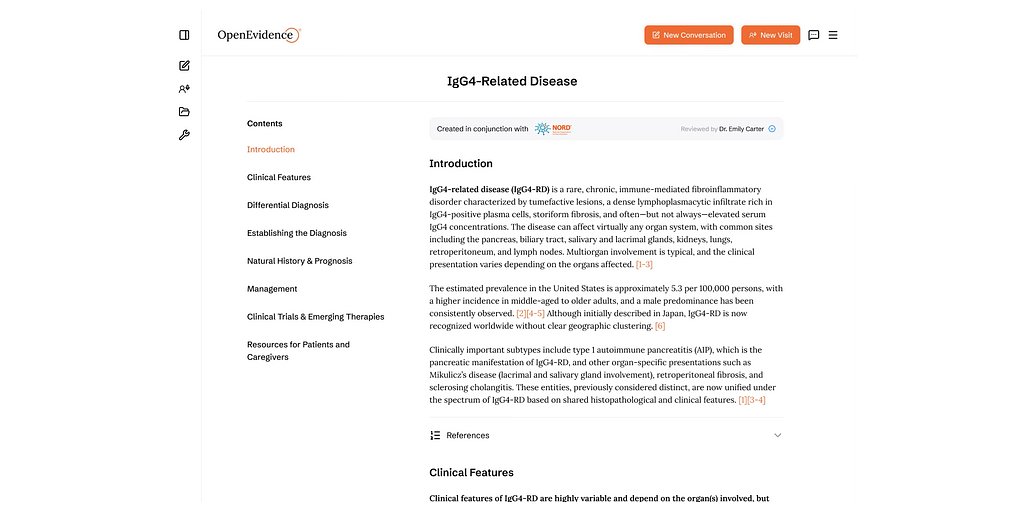
AI and NORD Unite to Tackle the Rare Disease Information Crisis
NORWELL, Mass. & MIAMI – March 12, 2026 – A landmark partnership is set to revolutionize the way medical information is managed for the more than 300 million people worldwide living with a rare disease. The National Organization for Rare Disorders (NORD) and the medical AI platform OpenEvidence have joined forces to create a vast, continuously updated library of expert-vetted rare disease information, aiming to shorten the arduous path to diagnosis and empower both clinicians and patients.
The collaboration will leverage OpenEvidence's advanced AI to synthesize the latest biomedical research, which will then be rigorously reviewed by specialists from NORD’s esteemed network, including its Rare Disease Centers of Excellence. The result will be a library of over 3,000 rare disease summaries, available in both clinician-focused and patient-friendly formats, designed to close a critical information gap that has long plagued one of medicine’s most vulnerable communities.
The Diagnostic Odyssey: A Crisis of Knowledge
For the more than 30 million Americans affected by a rare disease, the journey to a correct diagnosis is often a grueling and isolating "diagnostic odyssey" that can span years and involve numerous specialists. The core of the problem lies not in a lack of effort, but in a crisis of knowledge management. The medical literature across more than 7,000 rare conditions is vast, fragmented, and evolves at a pace that no single human clinician can master.
This information chasm leaves general practitioners, and even some specialists, struggling to connect disparate symptoms to a rare condition. Meanwhile, patients and their families are left to navigate a confusing and often contradictory sea of online information, desperate for reliable answers. This partnership directly targets this systemic failure, aiming to create a single, trustworthy source that is both comprehensive and current.
A New Synthesis: AI Meets Human Expertise
At the heart of the initiative is a powerful synergy between artificial intelligence and human intellect. OpenEvidence, a platform already used by over 40% of U.S. physicians for clinical decision-making, is not a general-purpose chatbot. Its AI is specifically trained on a curated corpus of trusted medical literature, including peer-reviewed journals like The New England Journal of Medicine, major clinical guidelines, and systematic reviews. It employs a sophisticated Retrieval-Augmented Generation (RAG) model, which grounds every piece of information in cited, verifiable sources, a critical feature that has helped it achieve a near-perfect score on the United States Medical Licensing Examination (USMLE).
"Rare disease is exactly the kind of problem AI should be helping to solve: a vast, fragmented literature that no single clinician can master on their own,” said Travis Zack, MD, PhD, Chief Medical Officer of OpenEvidence. “By combining the scale and synthesis capabilities of AI with review from NORD experts, we can build resources that are comprehensive, current, and trustworthy."
This "human in the loop" model is what sets the partnership apart. While the AI can synthesize thousands of studies in minutes, every summary intended for clinicians will be reviewed by leading experts recommended by NORD. These specialists will ensure clinical accuracy, real-world relevance, and alignment with the latest care practices, providing a layer of validation that builds trust and ensures safety.
“People living with rare diseases and the families who support them deserve access to information they can trust, and clinicians need reliable resources they can use in real time,” stated Pamela Gavin, MBA, Chief Executive Officer of NORD. “Our partnership with OpenEvidence will help bring more expert-reviewed rare disease information into the world in formats designed for both clinical care and patient understanding.”
Bridging the Gap Between Clinic and Home
The project's impact is designed to be twofold, addressing the needs of both healthcare providers and the families they serve. For clinicians, the rare disease summaries will be integrated directly into the OpenEvidence platform, which already facilitates over 16.5 million clinical consultations each month. The system is designed to surface relevant rare disease information automatically when a clinician's query suggests it might be a possibility, potentially flagging conditions that might otherwise be missed. This provides a powerful decision-support tool at the point of care, helping to accelerate diagnosis and inform treatment plans with the latest evidence.
Simultaneously, NORD will spearhead the development of patient-friendly versions of these summaries. These resources will translate complex medical terminology into accessible, understandable language, empowering patients and caregivers to become more active partners in their own care. These summaries will be disseminated globally through NORD's own highly respected Rare Disease Database, extending the reach of trusted education far beyond the clinic walls and fostering more informed conversations between doctors and patients.
Navigating the Future of AI in Medicine
This collaboration arrives as the medical community grapples with both the promise and the perils of artificial intelligence. While platforms like the NIH’s GARD Information Center and Europe’s Orphanet have long served as vital repositories, the NORD/OpenEvidence model represents a new paradigm by actively synthesizing and updating information at scale.
The initiative's architecture directly addresses key ethical concerns surrounding AI in healthcare. By training its AI exclusively on vetted sources, OpenEvidence minimizes the risk of "hallucinations" or misinformation that can plague general AI models. Furthermore, the mandatory human expert review process aligns with principles for responsible AI development championed by regulatory bodies like the U.S. Food and Drug Administration (FDA) and the European Medicines Agency (EMA). These agencies have stressed the importance of human-centric design and maintaining a "human in the loop" to ensure safety, accountability, and trust.
By embedding expert oversight into its core workflow, the partnership aims to create a resource that is not only technologically advanced but also fundamentally reliable. It serves as a potential blueprint for how AI can be responsibly harnessed to solve some of healthcare's most intractable problems, strengthening the connection between emerging knowledge, informed clinical care, and the empowered patients at the center of it all.
Topics & Related
Diagnostics
Software & SaaS
Artificial Intelligence
Generative AI
ESG
Related Company Pulse