
- 51%: Potential increase in intra-African passenger traffic with full SAATM implementation
- 35%: Projected reduction in airfares under SAATM
- $4B+: Annual GDP boost expected from SAATM
Experts agree that SAATM represents a transformative opportunity for Africa's economic growth, but its success hinges on overcoming political protectionism and infrastructure challenges through concrete action at the Lomé convention.
Africa's 'Single Sky' Dream Faces Critical Test in Lomé
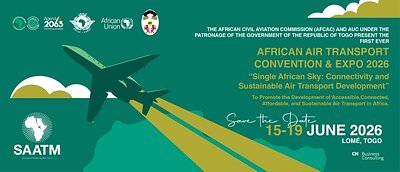
LOMÉ, Togo – March 18, 2026 – The long-held ambition of a borderless African sky is set to face a pivotal test this June as leaders from across the continent converge on Lomé. The Togolese capital will host the first-ever African Air Transport Convention and Exhibition, a high-stakes gathering aimed at breathing new life into the Single African Air Transport Market (SAATM), the continent's ambitious open-skies initiative.
From June 15 to 19, under the theme "Single African Sky: Connectivity and Sustainable Development of Air Transport," Heads of State, government ministers, and aviation industry titans will meet to tackle the formidable barriers that have kept Africa's aviation market fragmented and expensive. Hosted by the African Civil Aviation Commission (AFCAC), the event is being framed as a make-or-break moment to accelerate a project deemed critical for unlocking Africa’s vast economic potential.
The Billion-Dollar Promise of Open Skies
The economic case for SAATM is staggering. Proponents argue that fully liberalizing the continent's air routes could fundamentally reshape its economic landscape. The initiative, a flagship project of the African Union's Agenda 2063, aims to create a single, unified air transport market, removing restrictions on market access, ownership, and capacity that have long stifled intra-African travel and trade.
According to studies by international aviation bodies, a fully implemented SAATM could increase intra-African passenger traffic by over 51% and lead to fare reductions of up to 35%. For the continent's travelers, who often face the absurdity of connecting through Europe to travel between neighboring African countries, this would be a revolutionary change. The economic ripple effects are projected to be immense, with various analyses forecasting the creation of between 155,000 and 600,000 direct jobs and an injection of over $4 billion into the continent's GDP annually.
More strategically, SAATM is seen as the vital circulatory system for the African Continental Free Trade Area (AfCFTA). Without efficient, affordable air connectivity for both passengers and cargo, the grand vision of a seamless continental free trade zone remains severely hampered. Enhanced air service is expected to facilitate trade, attract investment, and stimulate a tourism sector that could see an additional 3.95 million visitors per year.
A Legacy of Turbulence and Stalled Progress
Despite the clear benefits, the vision of a unified African sky is not new, and its history is fraught with turbulence. The foundation for SAATM was laid more than two decades ago with the Yamoussoukro Decision of 1999. This landmark agreement, which became legally binding in 2002, committed signatory nations to the full liberalization of their air transport markets.
However, its implementation has been painfully slow. For years, the decision remained largely an agreement on paper, undermined by a potent mix of protectionist policies, a lack of political will, and deep-seated fears over the viability of national flag carriers. Many governments, protective of their often state-subsidized airlines, have been reluctant to open their markets to competition. Consequently, restrictive Bilateral Air Service Agreements (BASAs) have continued to govern air travel. A continental study revealed that as of 2020, a staggering 61% of the 607 BASAs reviewed were not compliant with the Yamoussoukro Decision's principles.
The official launch of SAATM in 2018, with AFCAC as its executing agency, was intended to provide a fresh impetus. While 37 countries, representing over 80% of Africa's aviation market, have signed the solemn commitment, the gap between commitment and concrete action on the ground remains the initiative's greatest challenge.
The Lomé Convention: A New Catalyst for Change?
This is the context into which the Lomé convention arrives. Organizers are positioning the event as a practical platform to move beyond rhetoric and forge actionable solutions. By bringing together not just transport ministers but also heads of finance, trade, and tourism, alongside private investors and development banks, the convention aims to create a holistic ecosystem for progress.
"The African Air Transport Convention & Expo 2026 will serve as a practical platform to accelerate SAATM implementation and strengthen intra-African connectivity," said Ms. Adefunke Adeyemi, Secretary General of AFCAC, in a statement. "By convening governments and industry leaders, we are reinforcing our collective commitment to a more integrated and competitive African aviation market."
The event's agenda reflects this pragmatic approach. Planned sessions include a Route Development Marketplace to forge new city pairings, a Cargo & Logistics Corridor Lab to streamline trade, and an Infrastructure, ATM & Finance Hall to tackle the continent's significant infrastructure deficits. The goal is to address the known impediments head-on, from harmonizing regulations to securing funding for airport modernization.
Navigating the Headwinds Ahead
No one attending the convention will be under the illusion that the path forward is easy. The headwinds are strong and well-documented. Beyond political protectionism, African airlines face some of the highest operating costs in the world, driven by prohibitive taxes, high fuel prices, and steep airport charges. Many airports lack the modern infrastructure to handle a significant increase in traffic, and the continent's air navigation systems require substantial investment and harmonization.
Furthermore, the lack of a robust dispute settlement mechanism with real teeth has allowed some nations to backtrack on their commitments without consequence. Ensuring that the rules of the single market are not only agreed upon but also consistently enforced will be a critical topic of discussion in Lomé.
The success of the convention will not be measured in the grandeur of its opening ceremony, but in the concrete commitments that emerge from its forums and bilateral meetings. It represents a crucial opportunity for Africa's leaders to align their actions with their long-stated ambitions. The question hanging over the conference halls in Lomé will be whether the collective political will has finally reached a tipping point, ready to transform the dream of a Single African Sky from a distant vision into an economic reality that benefits all Africans.