
- Global data center electricity consumption could double by 2030, with AI as the primary driver.
- Cooling can account for up to 55% of a data center's energy use.
- bedra’s Powerway alloys exceed pure copper strength by over 30% post-brazing.
Experts agree that advanced copper alloys are critical for managing the thermal and power demands of AI infrastructure, ensuring efficiency and reliability in data centers and electrical grids.
Advanced Copper: The Unseen Hero Fueling the AI Boom
CHICAGO, IL – April 29, 2026 – As artificial intelligence reshapes industries and daily life, a silent but monumental challenge is growing within the world's digital infrastructure: an insatiable demand for power and an unprecedented need to manage heat. The global AI expansion is pushing data centers and electrical grids to their limits, creating a critical need for innovation not in algorithms, but in the fundamental materials that make computation possible.
At the recent IEEE PES T&D 2026 conference, global precision alloy manufacturer bedra showcased a suite of high-performance copper materials designed to meet this challenge head-on. These advanced alloys, presented by the company's Vietnam-based subsidiary, are emerging as the unsung heroes of the AI era, providing the essential foundation for both cooling the powerful processors in data centers and reinforcing the power grids that feed them.
Cooling the Compute: A Thermal Arms Race in AI Data Centers
The computational density required for training and running advanced AI models generates immense thermal loads. Rack-level power density in AI data centers is soaring, making traditional air cooling increasingly inadequate. Industry analysis projects that global data center electricity consumption could double by 2030, with AI being the primary driver of this surge. Cooling alone can account for up to 55% of a data center's energy use, making thermal management a critical frontier for efficiency and reliability.
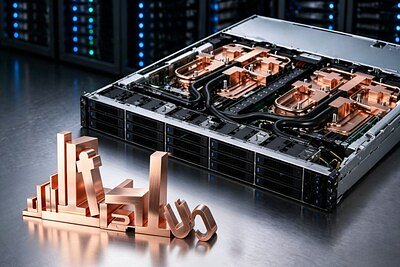
This thermal arms race has accelerated the adoption of liquid cooling, where fluids are used to dissipate heat directly from hotspots like GPUs and CPUs. This is where the intrinsic properties of copper become indispensable. bedra’s high-purity copper materials are engineered to serve as critical components in liquid cooling plates. With exceptional thermal conductivity, these materials efficiently draw heat away from processors, preventing performance throttling and hardware failure.
Furthermore, the company's Powerway high-performance alloys address a key manufacturing challenge. These materials exhibit exceptional resistance to high-temperature softening, boasting a post-brazing strength that exceeds pure copper by over 30%. This structural integrity allows for the miniaturization of next-generation liquid cooling components, a crucial factor in designing ever-denser and more powerful computing systems.
Beyond cooling, efficient power delivery within the data center itself is paramount. Energy loss, even if minimal at each connection, accumulates into significant waste and excess heat under the high-current conditions of AI workloads. bedra’s oxygen-free copper alloys, with electrical conductivity reaching up to 101% of the International Annealed Copper Standard (IACS), minimize voltage drop and energy loss. Their excellent formability and tight dimensional tolerances for rack-level busbars also ensure compatibility with Open Compute Project (OCP) standards, facilitating their integration into the efficient, open-source hardware designs favored by hyperscalers.
Powering the Grid: The Backbone of the AI Expansion
The impact of AI extends far beyond the walls of the data center. The projected growth in electricity demand is placing immense pressure on national and regional power transmission and distribution systems. Some estimates suggest that by 2030, AI-related power demand in the United States alone could account for nearly half of the nation's growth in electricity consumption. This requires a power infrastructure that is not only larger but significantly more robust and reliable.
Medium- and high-voltage systems, which form the backbone of the electrical grid, operate under extreme electrical and thermal stress. Material failure in a single component, such as a contact or interrupter, can lead to widespread outages. Recognizing this, bedra has engineered a range of copper alloys specifically for these demanding environments.
Materials like bedra18200, a copper-chromium (Cu-Cr) precipitation-strengthened alloy, offer a powerful combination of properties. While retaining about 75% of pure copper's conductivity, it possesses significantly higher strength, hardness, and resistance to softening at high temperatures. This makes it ideal for stationary contacts, contact stems, and other current-carrying structural members that must withstand immense mechanical and thermal stress over decades of service.
For even more demanding high-voltage environments, the company offers bedra18150, a copper-chromium-zirconium (Cu-Cr-Zr) alloy. This material provides upgraded performance with improved creep resistance, ensuring long-term stability and minimal deformation under sustained high-temperature loads. Meanwhile, its oxygen-free electronic copper, bedra10100, is crucial for high-reliability parts in high-voltage vacuum interrupters, where its purity helps minimize energy losses and enhance dielectric performance, preventing electrical arcing.
Vietnam's Strategic Role in the Global AI Supply Chain
As the world races to build out AI infrastructure, the resilience of the underlying supply chain has become a paramount concern. Geopolitical tensions and a push for diversification have led many global firms to adopt a "China plus one" strategy, and Vietnam has emerged as a primary beneficiary. The country is rapidly becoming a global manufacturing hub for high-tech and electronics production, offering a combination of cost efficiency, political stability, and a favorable business environment.
bedra’s strategic investment in a modern, large-scale production facility in Vietnam places it at the center of this global shift. With an annual production capacity of 50,000 tons and a portfolio of over 400 alloy grades, the facility is a cornerstone of the company's global supply chain. Its certifications, including ISO9001 for quality, ISO14001 for environmental management, and IATF16949 for the automotive industry, signal a commitment to meeting the rigorous standards of critical industries.
This manufacturing footprint provides a crucial advantage: a reliable, scalable source of essential materials for a world increasingly dependent on AI. By locating significant production in Southeast Asia, the company mitigates supply chain risks and positions itself to serve the burgeoning tech ecosystems across the globe.
The Sustainable Foundation for a Digital Future
With the massive energy footprint of AI becoming a major point of public and regulatory concern, sustainability is no longer an optional add-on but an integral part of responsible manufacturing. bedra's efforts in this area have been recognized with an EcoVadis Bronze Medal, placing it in the top 35% of companies assessed for its corporate social responsibility practices, and a CDP Grade B for its environmental management and transparency.
These ratings reflect a structured approach to sustainability that includes a commitment to a diversified, low-carbon energy mix for its production processes. The focus on high-efficiency alloys also contributes to broader sustainability goals. By reducing energy loss in both data centers and power grids, these materials directly lower the operational carbon footprint of digital infrastructure.
Moreover, copper itself is an inherently sustainable material, capable of being recycled infinitely without any loss of its essential properties. As the world builds the physical foundation for the AI revolution, the use of durable, efficient, and recyclable materials is essential for ensuring that this technological leap forward is also an environmentally responsible one. This focus on the elemental building blocks ensures that the digital future, powered by artificial intelligence, is built on a foundation that is both powerful and resilient.