
- 35–44% annual OpEx savings and 8–17% five-year TCO savings with Accelsius’s two-phase cooling vs. single-phase systems
- Up to 90% reduction in cooling energy consumption and elimination of millions of gallons of annual water use compared to traditional air cooling
- Market growth projection: Direct-to-chip liquid cooling expected to expand from $2.2B in 2025 to $14.4B by 2035
Experts agree that Accelsius’s two-phase liquid cooling technology offers a sustainable and cost-effective solution for AI data centers, addressing critical energy and water consumption challenges while supporting rapid deployment.
Accelsius Tackles AI's Energy Crisis with New Cooling Technology
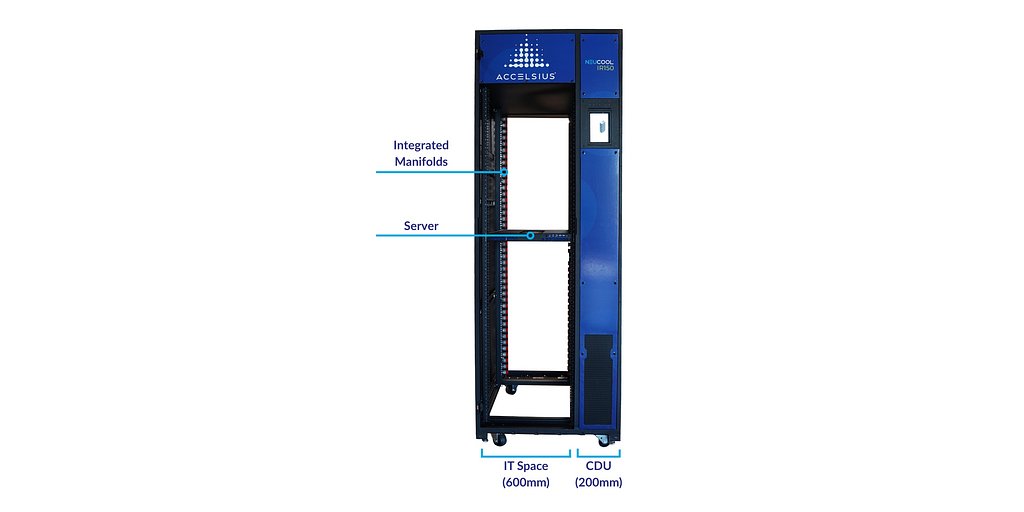
WASHINGTON, D.C. – April 20, 2026 – As the artificial intelligence boom places unprecedented demands on data center infrastructure, Accelsius today unveiled a new solution aimed at tackling the industry's escalating power and water consumption challenges. At the Data Center World 2026 conference, the company announced the general availability of its NeuCool® IR150, an all-in-one, rack-level liquid cooling system, alongside a new program designed to accelerate its adoption by the world's largest cloud providers.
The announcement comes at a critical juncture. Hyperscale and "neocloud" operators are in a race to build out gigawatt-scale AI facilities, but this rapid expansion has drawn intense scrutiny from communities and regulators concerned about the strain on local power grids and water supplies. Accelsius argues that its two-phase, direct-to-chip cooling technology offers a path forward, enabling rapid growth without the associated environmental toll.
The AI Dilemma: Balancing Speed and Sustainability
The race to deploy AI has created a significant dilemma for data center operators. The powerful GPUs that train and run AI models generate immense heat, pushing traditional air-cooling methods to their limits and beyond. While the industry has turned to liquid cooling, the urgency to build has sometimes overshadowed long-term sustainability planning. Billions of dollars in data center projects have already faced delays or outright cancellations due to concerns over their environmental footprint.
Accelsius CEO Josh Claman, speaking at the conference, addressed this tension directly. “Hyperscalers and neoclouds are under enormous pressure to deliver AI capacity faster than ever, and that urgency is understandable,” he stated. “Our message at Data Center World is simple: moving fast and planning responsibly are not mutually exclusive.”
The company's strategy is to provide a solution that not only meets the extreme thermal demands of modern AI hardware but also aligns with growing corporate and social responsibility goals. The goal is to prevent a future where AI's progress is throttled by its own resource consumption.
Beyond Hyperscale: The NeuCool IR150 Advantage
At the heart of the announcement is the NeuCool IR150, which Accelsius bills as the industry’s first fully integrated rack-level cooling solution. The system packs a two-phase Coolant Distribution Unit (CDU), 42U of IT rack space, and all necessary manifolds into a single, standard 800mm-wide enclosure. Capable of dissipating up to 150kW of heat, the unit is designed as a true "plug-and-play" system.
This integrated design is a significant departure from more complex, bespoke liquid cooling implementations. By arriving pre-tested and ready for deployment, the IR150 aims to dramatically simplify and shorten installation times. More importantly, it makes advanced two-phase liquid cooling accessible to a much broader market. While hyperscalers are a primary target, the system's form factor is also ideal for enterprise data centers and burgeoning edge computing deployments, which will power smaller, localized AI models.
“With the general availability of the IR150... we’re giving operators a practical path to bring two-phase, direct-to-chip cooling into their reference designs today,” Claman added. The aim is to help AI factories “avoid the mistake of scaling without considering their host communities’ water and energy supplies.”
The Two-Phase Technical Edge
Accelsius is a strong proponent of two-phase cooling, arguing that the industry’s earlier bets on single-phase liquid cooling were a misstep. Single-phase systems typically circulate treated water directly to the chip, which introduces risks of leaks, corrosion, and the need for constant water quality maintenance.
In contrast, Accelsius’s two-phase technology utilizes a non-conductive dielectric refrigerant that boils at the chip's surface, turning to vapor. This vapor travels to a condenser where it cools, turns back into a liquid, and circulates back to the chip in a passive, closed loop. This process is significantly more efficient at transferring heat than single-phase liquid systems.
The benefits are substantial. Because the refrigerant is non-conductive and no water enters the IT rack, the risk to expensive server electronics from a potential leak is minimal. Independent analysis by Jacobs Engineering validates the economic and environmental claims, showing that Accelsius’s two-phase solutions can deliver 35–44 percent annual OpEx savings and 8–17 percent five-year total cost of ownership (TCO) savings compared to single-phase direct-to-chip systems. Furthermore, industry studies suggest these systems can slash cooling energy consumption by up to 90 percent and eliminate millions of gallons of annual water use when compared to traditional air cooling.
Accelerating Adoption with the HyperStart Program
Recognizing that transitioning to a new cooling architecture can be a significant undertaking, especially for massive-scale operators, Accelsius also launched the NeuCool HyperStart program. This initiative provides a structured pathway for hyperscalers, neocloud providers, and key partners to validate and integrate two-phase cooling into their data center roadmaps.
Participants in the program receive dedicated engineering support, deployment planning assistance, and technical validation services. The goal is to de-risk the adoption process and build confidence in the technology's performance and reliability for high-density, large-scale AI deployments. According to the company, several hyperscale AI cloud providers are already engaged with the program as they map out their cooling strategies for next-generation infrastructure, which includes platforms like NVIDIA's upcoming liquid-cooled Vera Rubin GPU.
This collaborative approach is critical in a market where direct-to-chip liquid cooling is projected to grow from $2.2 billion in 2025 to $14.4 billion by 2035. While the market features strong competitors like Vertiv, CoolIT Systems, and ZutaCore, Accelsius is betting that its focus on a fully integrated, easy-to-deploy two-phase system will give it a decisive edge. The IR150 joins the company's existing NeuCool product family, which includes the larger row-based MR250 CDU and a thermal simulation rack, offering a suite of solutions that scale from initial evaluation to full data center build-outs. To further cement its position as a thought leader, company executives are scheduled for several panels at Data Center World, discussing everything from investor ROI in cooling to balancing AI's growth with community impact.