
- Median overall survival for glioblastoma patients: 12–18 months
- Five-year survival rate for glioblastoma: less than 7%
- BPM31510 Phase I trial showed PET-confirmed reversal of the Warburg effect in tumor metabolism
Experts view BPM31510's metabolic reprogramming approach as a promising and novel strategy to target glioblastoma's mitochondrial vulnerability, potentially offering a meaningful survival benefit when combined with standard therapies.
A New Hope for Glioblastoma: Targeting Cancer's Energy Engine
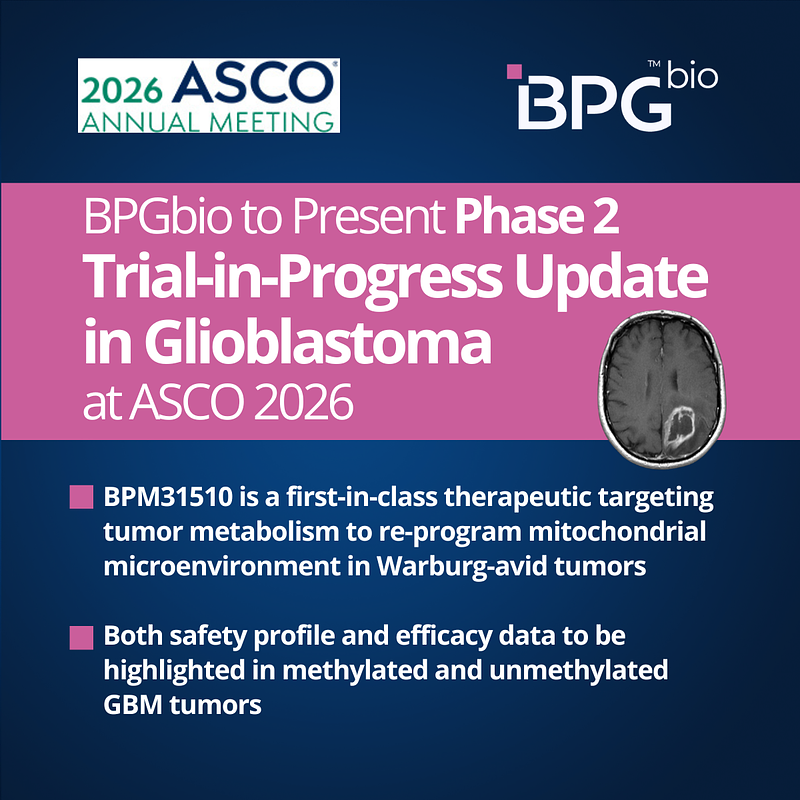
BOSTON, MA – May 28, 2026 – In the relentless fight against glioblastoma multiforme (GBM), one of the most aggressive and lethal forms of cancer, a new strategy is emerging that targets the tumor's fundamental power source. BPGbio, a clinical-stage biopharmaceutical company, has announced it will present a crucial trial-in-progress update on its Phase 2 study of BPM31510 for newly diagnosed GBM at the upcoming American Society of Clinical Oncology (ASCO) Annual Meeting. The presentation is poised to offer a significant glimpse into a novel therapeutic designed to reprogram the very metabolism that fuels this devastating disease.
For patients and clinicians, the news represents a potential breakthrough in a field starved for progress. The ASCO update, to be presented by Dr. Seema Nagpal of Stanford Medicine, will detail the ongoing evaluation of BPM31510 in combination with the current standard of care, offering the first look at safety and efficacy data from this critical frontline study.
A Landscape of Unmet Need
Glioblastoma is notoriously difficult to treat, earning it a grim reputation as a “graveyard” for drug development. Despite decades of research, the standard treatment protocol—maximal surgical resection followed by radiation and temozolomide chemotherapy—has only incrementally moved the needle on survival. The median overall survival for patients remains stubbornly low, hovering between 12 and 18 months, with a five-year survival rate of less than 7%.
The challenges are immense. The protective blood-brain barrier prevents many drugs from reaching the tumor, while the cancer's profound genetic and cellular diversity allows it to resist therapies and fuel inevitable recurrence. High-profile failures of promising drugs in late-stage trials, from immunotherapies like Opdivo to advanced gene therapies, have left the neuro-oncology community searching for entirely new vulnerabilities to exploit. It is within this challenging context that targeting the unique metabolic profile of glioblastoma has gained significant traction as a promising new frontier.
Rewiring the Tumor's Engine
At the heart of BPGbio's approach is a direct assault on the 'Warburg effect,' a metabolic hallmark of many aggressive cancers first observed nearly a century ago. Cancer cells, including those in GBM, often rewire their energy production, shunning the more efficient mitochondrial process of oxidative phosphorylation (OXPHOS) in favor of rapid, but less efficient, glycolysis. This metabolic shift provides the building blocks for rapid cell proliferation and creates an acidic, immunosuppressive microenvironment that helps the tumor thrive.
BPM31510, a lipid nanodispersion of oxidized Coenzyme Q10 (CoQ10), is designed to force a reversal of this process. By delivering supraphysiologic levels of CoQ10, the drug aims to reboot the mitochondria and push cancer cells back towards oxidative phosphorylation. This metabolic reprogramming is a double-edged sword for the tumor. It not only disrupts its preferred energy pathway but also generates a surge of reactive oxygen species (ROS), a form of oxidative stress that can trigger programmed cell death, or apoptosis, in cancer cells while largely sparing healthy tissue.
“The BPM31510 phase I trial delivered pharmacodynamic proof, PET-confirmed reversal of the Warburg effect, shifting tumor metabolism from glycolysis to oxidative phosphorylation at supraphysiologic CoQ10 concentrations,” said Dr. Vivek Subbiah of the Stanford Cancer Institute. “That metabolic reprogramming drives a ROS-mediated, BCL-2–dependent apoptotic cascade that may finally unlock glioblastoma's mitochondrial vulnerability. For patients with GBM...the ongoing front-line study is a test of whether this science can translate into a meaningful survival benefit.”
Enhancing the Standard of Care
Rather than replacing existing treatments, BPM31510 is being developed to make them more effective. The ongoing Phase 2 trial evaluates the drug in combination with standard-of-care radiation and temozolomide. The scientific rationale is that by inducing metabolic stress and targeting the BCL-2 protein family—key regulators of cell death—BPM31510 can act as a potent sensitizer, lowering the threshold for radiation and chemotherapy to kill cancer cells.
This combination strategy is critical. By weakening the tumor's defenses and making it more vulnerable to established therapies, BPM31510 could potentially amplify their effectiveness, particularly in patient populations that typically have a poor prognosis. The trial is specifically examining outcomes in both methylated and unmethylated GBM tumors, the latter being notoriously resistant to temozolomide, representing a group with a particularly high unmet medical need.
“Glioblastoma remains one of the most devastating cancers, with limited therapeutic advances for patients in recent decades,” said Niven R. Narain, Ph.D, President and CEO of BPGbio. “We believe mitochondrial targeting represent an important and underexplored therapeutic frontier in GBM in oncology. BPM31510 is designed to target the mitochondrial metabolism that cancer cells depend upon...The emerging data in this study is encouraging, and we look forward to sharing updates with the community at ASCO.”
A Platform-Driven Approach to a Formidable Foe
BPGbio’s pursuit of BPM31510 is part of a broader corporate strategy focused on mitochondrial dysfunction, which plays a role in numerous diseases beyond cancer. The company utilizes a proprietary AI-driven platform, Interrogative Biology®, to analyze complex biological data from patients, identifying novel therapeutic targets and guiding clinical development. This biology-first approach led them to identify mitochondrial metabolism as a key vulnerability in GBM and other aggressive tumors.
The potential of this approach has been recognized by regulators, with the U.S. Food and Drug Administration granting BPM31510 Orphan Drug Designation for glioblastoma. This status is reserved for therapies addressing rare diseases and provides incentives for development. While BPGbio’s approach is novel, it joins a competitive pipeline of investigational therapies for GBM that includes immunotherapies, targeted molecular agents, and advanced drug delivery systems. However, its unique mechanism of metabolic reprogramming sets it apart, offering a complementary, rather than competing, strategy to many other treatments in development.
As the oncology world prepares to convene for ASCO, all eyes will be on the data from BPGbio. The upcoming trial-in-progress report will provide the first substantial evidence of whether this innovative metabolic attack can make a meaningful difference for patients battling one of medicine’s most intractable cancers. For a community long accustomed to disappointment, the prospect of a new, viable therapeutic avenue offers a profound sense of anticipation and long-awaited anticipation.