
- 160% to 300% increase in U.S. power interruptions since 2010.
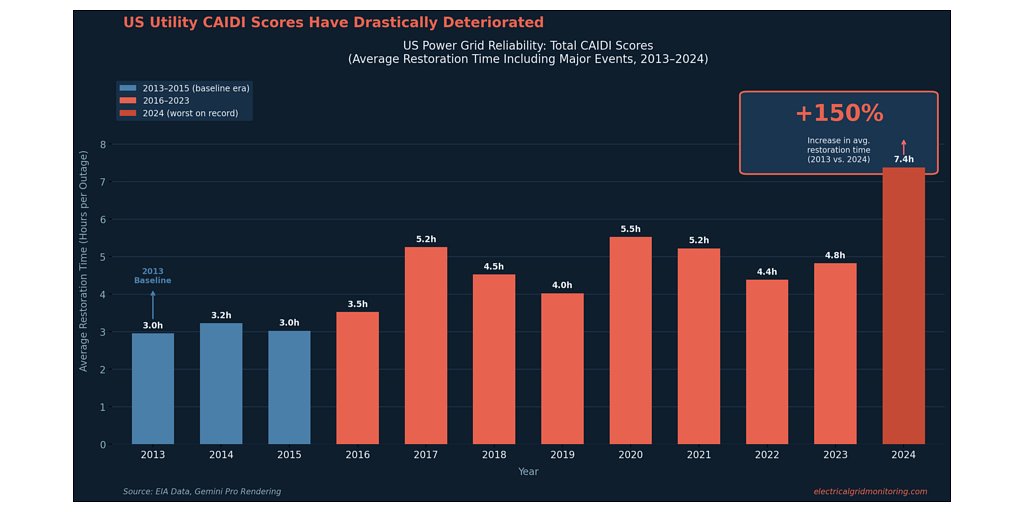
- 7.4 hours: Average outage restoration time in 2024.
- $7 billion annually: Estimated utility crew-time costs from fault location.
Experts would likely conclude that EGM's AFLD technology represents a significant step forward in grid reliability, offering precise fault detection that could dramatically reduce outage times and costs, though widespread adoption will depend on further validation and scalability.
A Digital Fix for America's Ailing Grid: The Race to Keep the Lights On
HOUSTON, TX – June 11, 2026
The American electrical grid, an engineering marvel of the 20th century, is showing its age. Strained by soaring demand from AI and data centers, battered by increasingly extreme weather, and burdened by decades-old infrastructure, its reliability is faltering. U.S. power reliability metrics have worsened dramatically, with key indexes showing interruptions have grown by 160% to 300% since 2010. For consumers and businesses, this translates to a frustrating reality: the lights are going out more often, and for longer than ever.
Against this backdrop of systemic stress, a Houston-based company, Electrical Grid Monitoring (EGM), has announced a technological breakthrough that promises not just to patch the cracks, but to fundamentally change how utilities manage grid failures. Its new Accurate Fault Location and Detection™ (AFLD) solution, recently validated in a blind study by the U.S. Department of Energy’s National Laboratory of the Rockies (NLR), claims it can pinpoint the location of a power line fault to within a single pole span. This leap in precision could slash outage times and costs, offering a much-needed lifeline to an industry at a critical inflection point.
A Precision Strike Against Power Outages
For utility line crews, the most time-consuming part of restoring power isn’t the repair itself, but the hunt for the problem. “Utility crews typically spend two-thirds of their time locating faults and one-third repairing them,” explained Alex Levran, Ph.D., CEO of Electrical Grid Monitoring. A fallen tree branch, a failed insulator, or an animal on a remote power line can force crews to patrol miles of infrastructure, a process that is inefficient, costly, and extends outage durations for customers.
EGM’s technology aims to eliminate this costly guesswork. By deploying clusters of advanced sensors at strategic points, the AFLD system captures comprehensive electrical, mechanical, and environmental data. When a fault occurs, patented algorithms triangulate the data in real-time to identify the precise location. The potential impact is staggering. EGM projects the technology could reduce typical 3-5 hour outages to approximately one hour and slash the associated utility crew-time costs—currently estimated at $7 billion annually—by up to 80%.
The company’s claims are bolstered by independent testing at NLR, which subjected the AFLD solution to 26 blind test scenarios. While the lab’s involvement does not constitute a formal endorsement, its analysis of the data confirmed the technology’s promise in accurately locating faults. “Our AFLD technology marks a significant advancement in grid-reliability innovation,” Levran stated, emphasizing its ability to make outage resolution faster and more affordable.
The High Stakes of an Overburdened Grid
The urgency for such innovation cannot be overstated. The U.S. grid is facing a perfect storm of challenges. The DOE’s 2025 Pathways to Commercial Liftoff Report forecasts a 15-20% surge in electricity demand over the next decade, doubling by 2050. This growth is fueled by the voracious energy appetite of AI and data centers, coupled with a national push to onshore manufacturing.
Simultaneously, the grid’s performance is deteriorating. The System Average Interruption Duration Index (SAIDI) has risen alarmingly, and the average outage restoration time hit a record 7.4 hours in 2024. The DOE itself sounded a stark warning in its 2025 report on grid reliability, projecting that without significant intervention, customer outages could increase by a factor of 100 in some regions by 2030. This isn't just an inconvenience; it's a threat to economic competitiveness and national security.
This reliability crisis is unfolding as electricity prices reach historic highs, squeezing consumers and businesses alike. In California, for example, consumers now pay 120% more per kilowatt than they did 15 years ago. The need for a more efficient, reliable, and affordable grid has become a central focus of national policy, driving initiatives like the DOE’s “Accelerating Speed to Power” program.
A New Playbook for Grid Modernization
For decades, the primary solution to grid strain was to build more—more power plants, more transmission lines. But this approach is slow, incredibly expensive, and often faces regulatory hurdles. EGM’s technology represents a different playbook, one focused on making the existing grid smarter, not just bigger.
This strategy has attracted sophisticated investors. Energy Growth Momentum, a London-based private equity firm, led EGM’s Series B round, bringing its total funding to over $40 million. “We invest in highly scalable digital solutions that can have an outsized impact on the power grid,” said Chris Holcroft, an investor and board director at the firm. “Digital solutions can deliver reliability, efficiency, and affordability at scale, but at a fraction of the cost of building new infrastructure.”
Holcroft noted the immense potential in the U.S. market, where the annual cost-savings from better fault location could range from $7 billion to $20 billion. EGM’s business model, which avoids the impracticality of placing sensors on every utility pole and promises a return on investment in under a year, makes this advanced capability accessible to a wide range of utilities, not just the largest players.
Beyond Faults: The Future of Grid Intelligence
What makes EGM’s platform particularly compelling is that its value extends far beyond locating faults. The sensors are a rich source of data, monitoring everything from voltage and cable temperature to humidity and wind speed. This data powers a suite of applications that enable proactive grid management.
In wildfire-prone regions, the system can provide early warnings by detecting line disturbances caused by high winds or falling trees. It can enable dynamic line ratings, allowing utilities to safely push more power through existing lines during periods of high demand. This holistic view transforms grid management from a reactive, break-fix model to a predictive, data-driven one.
Led by Levran, who previously built and sold a billion-dollar solar inverter company, EGM is positioning itself as a key partner in the future of energy. The company is currently deploying its technology with the Israel Electric Corporation and several U.S. utilities. By moving its manufacturing to the United States, EGM is also aligning with national priorities to reduce supply chain risks and bolster domestic industry. In an era of profound energy transition, deploying intelligence across the grid may prove to be the most powerful tool for keeping the lights on.