
- 6.3 million verified human users: Meta Earth's milestone after 730 days of mainnet operation.
- 400% growth in 10 months: From 1M to over 4M users between January and April 2026.
- $100M ecosystem fund: Allocated for developer grants and security initiatives.
Experts would likely conclude that Meta Earth's identity-centric approach demonstrates a viable model for bot-free Web3 ecosystems, though its long-term success will depend on sustained adoption and competition.
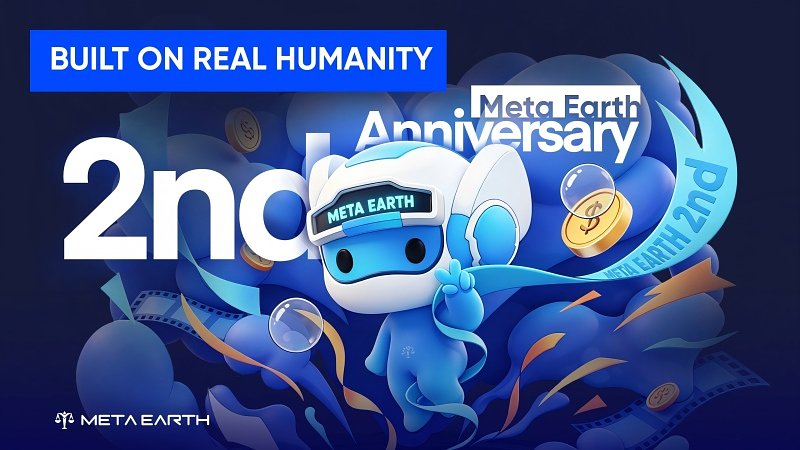
6.3 Million Verified Users: Is This the Blueprint for a Bot-Free Web3?
DUBAI, UAE – June 23, 2026 – In the often-opaque world of blockchain, user numbers can be a deceptive metric. Inflated by bots, airdrop hunters, and Sybil attacks, a network boasting millions of wallets can often be a digital ghost town. This is the challenge that Meta Earth, a modular blockchain network, claims to have solved as it celebrates the second anniversary of its mainnet with a milestone: surpassing 6.3 million verified human users.
As the network's ongoing 'ME 730' campaign—celebrating 730 days of mainnet operation—fills social media feeds, the Dubai-based project marks a critical transition from building foundational infrastructure to fostering large-scale application adoption. While many projects chase speculative hype, Meta Earth has been quietly constructing a digital ecosystem anchored by a simple yet radical premise: what if every user was a real, unique person? This identity-centric approach is now being put to the test, posing a fundamental question to the industry: Is a network built on proven humanity the definitive blueprint for the next generation of decentralized applications?
The 'Proof of Life' Protocol
At the heart of Meta Earth’s strategy is its native Decentralized Identity (DID) system, which functions as a 'proof of life' mechanism. For decentralized application (dApp) developers, one of the most significant hurdles has been the “cold start” problem—launching a product into an ecosystem of unknown authenticity. It's difficult to build a sustainable business when you can't distinguish a genuine customer from a script designed to drain resources.
Meta Earth addresses this by requiring users to complete a Know Your Customer (KYC) verification to participate fully in the ecosystem. While KYC is often viewed with suspicion by privacy advocates in the crypto space, this network has integrated it with privacy-preserving technologies. By leveraging Zero-Knowledge Proofs (ZKP), the system can confirm a user's unique identity without revealing the underlying personal data to the public or even to the dApps themselves. Private data is encrypted and stored off-chain, with only a verification hash recorded on the blockchain, aligning with W3C standards for self-sovereign identity.
This creates a powerful value proposition. Developers building on the network gain immediate access to a user base that is guaranteed to be human. “Because the native DID system requires KYC verification while encrypting private data off-chain, developers building on Meta Earth gain immediate access to a community of strictly verified, real individuals,” the company stated in its recent announcement. This ensures that metrics like user engagement, transaction volume, and market demand are authentic, providing a stable foundation for innovation and growth that has long eluded other platforms.
From Infrastructure to Exponential Growth
The effectiveness of this identity-centric model is reflected in the network's striking user acquisition curve. After launching its ME Network 2.0 in May 2025 and reaching a modest 10,000 verified users by October 2024, the ecosystem began to show compounding results. The user base grew to 400,000 by March 2025 and hit 3 million by January 2026.
The growth then accelerated dramatically. The network onboarded its 4 millionth user on April 8, 2026, and crossed the 5 million mark just three weeks later on April 29. Now, less than two months after that, it stands at over 6.3 million. This trajectory suggests that the initial investment in building a robust, human-verified infrastructure is now paying dividends in network effects.
Fueling this expansion is a concerted push to attract builders. In April, the team hosted the "MetaEarth Devs" event in Hong Kong, where it officially open-sourced its developer SDK and announced a $100 million ecosystem fund. The fund is designed to provide developer grants and support a bug bounty program, signaling a strong commitment to cultivating a vibrant and secure third-party application layer. This technical architecture is built on a modular design that decouples the execution, settlement, and data availability layers, allowing sovereign Rollup chains to process transactions in parallel. For developers, this means lower gas costs and the flexibility of customizable virtual machine environments.
A New Digital Social Contract: UBI and AI Agents
Beyond solving for bots, Meta Earth is pursuing an ambitious vision for a more equitable and automated digital economy. This vision is built on two forward-thinking pillars: Unconditional Basic Income (UBI) and native support for Artificial Intelligence.
The network’s tokenomics are designed around a UBI concept. Verified users who join the network receive a native stake in the ecosystem through the MEC token. A portion of the total token supply is permanently staked and bound one-to-one with verified IDs, generating a passive income for all participants. This model is designed to create a closed value loop, where user growth directly translates into shared value, incentivizing long-term participation over short-term speculation.
Perhaps most forward-looking is the network's architecture built in anticipation of a future where autonomous AI agents are primary economic actors. The modular design allows these agents not only to hold their own native digital wallets but also to deploy their own custom Rollups. This capability facilitates seamless, on-chain contracts and smart execution between AIs, laying the groundwork for a truly autonomous digital economy where intelligent agents can transact, collaborate, and build without human intervention.
Charting a Course in a Crowded Sea
Meta Earth is not without competitors. The industry is rife with projects tackling modularity, decentralized identity, and AI integration. Projects like Worldcoin are also exploring 'proof of personhood,' while numerous Layer 2 solutions offer scalable environments for dApps.
However, Meta Earth's strategic advantage may lie in its synthesis of these disparate trends into a single, cohesive platform. It combines a regulatory-friendly, privacy-preserving identity layer with a sustainable economic model, a scalable modular architecture, and a clear roadmap for AI integration. As the 'ME 730' campaign continues to draw global attention, the project is no longer just a theoretical experiment. It is a live, rapidly growing ecosystem testing whether a blockchain anchored by real human identity can serve as the definitive blueprint for a more resilient, transparent, and innovative digital future.