
- 3 distinct tiers: Base ($799), Pro ($1,299), Creator Pack ($2,499)
- Intel 12th Gen Core processors with hybrid architecture
- 2 unlocked PCIe slots for hardware customization
Experts would likely conclude that the ZimaCube 2 represents a significant innovation in the NAS market by combining powerful local AI capabilities, open hardware expansion, and user-friendly software, offering a compelling alternative to both closed ecosystems and complex DIY solutions.
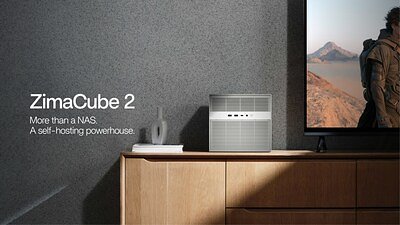
ZimaCube 2: The Self-Hosting Server Betting on Local AI and Open Hardware
SHANGHAI – April 29, 2026 – In a direct challenge to the established order of personal data storage, IceWhale Technology today launched the ZimaCube 2, a device that blurs the lines between a Network Attached Storage (NAS) unit and a powerful home server. The company is betting that the future of home data isn't just about passive storage, but about active computation, local artificial intelligence, and user-owned services, all without subscription fees.
The ZimaCube 2 arrives in a market where users are increasingly caught between two paradigms: the polished but restrictive walled gardens of major NAS brands and the complex, time-consuming world of building a Do-It-Yourself (DIY) server. IceWhale aims to carve a third path, offering a pre-built, compute-focused platform that champions hardware openness and software accessibility.
"The NAS industry is splitting into two paths: closed ecosystems that sell you subscriptions, or open platforms that let you own everything. We chose open," stated Lauren Pan, CEO of IceWhale, in the announcement. "ZimaCube 2 ships with unlocked PCIe slots, community-driven software, and enough compute to run local AI, because the next decade of NAS is about what your hardware can do, not just what it can store."
Beyond Storage: A Bet on Compute and Local AI
At the heart of the ZimaCube 2's design philosophy is a pivot from storage-first to compute-first. This strategy directly taps into the growing consumer and prosumer interest in edge computing and local AI. As users become more wary of sending personal data to the cloud for processing and fatigued by endless subscription models, the demand for capable local hardware is surging. The ability to run AI models for photo management, smart home automation, or security camera analysis on-device is becoming a key differentiator, driven by a desire for privacy, lower latency, and cost control.
To power these ambitions, the ZimaCube 2 line is equipped with Intel's 12th Generation Core processors. These chips feature a hybrid architecture, combining powerful Performance-cores for demanding tasks with power-sipping Efficiency-cores for always-on background services—an ideal setup for a home server. Paired with fast DDR5 memory expandable to 64 GB, the platform is designed for the multitasking workloads inherent in self-hosting.
The product is offered in three distinct tiers. The base ZimaCube 2 ($799) uses a Core i3-1215U and is positioned as a ready-to-go self-hosting stack. The Pro model ($1,299) upgrades to a 10-core Core i5-1235U and onboard 10GbE networking for more demanding users. Topping the range is the Creator Pack ($2,499), which includes a pre-installed NVIDIA RTX PRO 2000 GPU, transforming the cube into a turn-key media workstation and local AI development box right out of the gate.
The 'Open' Philosophy vs. Walled Gardens
IceWhale's most significant departure from traditional NAS vendors lies in its commitment to hardware openness. Where many competitors use proprietary components or lock down expansion capabilities to upsell their own branded accessories, the ZimaCube 2 features two unlocked PCIe slots (one PCIe 4.0 and one PCIe 3.0). This single feature fundamentally changes the long-term value proposition of the device.
This openness allows users to adapt the server to their evolving needs. A creator could install a high-end GPU for video transcoding or running larger AI models. A power user could add a 25GbE network interface card for lightning-fast file transfers. Someone needing more ultra-fast storage could install an NVMe expansion card. This level of customization is typically reserved for the DIY community and stands in stark contrast to the soldered-in, non-upgradable accelerators found in many off-the-shelf NAS units.
Furthering this theme of versatile connectivity are dual Thunderbolt 4 ports. This allows the ZimaCube 2 to function as a high-speed Direct-Attached Storage (DAS) device for a Mac or PC, offering blistering transfer speeds without any network configuration—a boon for video editors and other creative professionals who need to move massive files quickly.
ZimaOS: Lowering the Barrier to Self-Hosting
A powerful server is only as useful as its software is accessible. IceWhale addresses this with ZimaOS, a pre-installed, Docker-native operating system refined through a reported 4 million downloads across its platforms. The OS is designed to remove the "sysadmin tax"—the steep learning curve and constant maintenance often associated with running a home server.
ZimaOS presents users with a visual app store that enables one-click deployment for hundreds of popular self-hosted applications, including Plex for media, Nextcloud for personal cloud storage, Home Assistant for smart home control, and Immich for photo management. This approach abstracts away the complexities of Docker command-lines and configuration files, making powerful software accessible to a much broader audience.
For those with existing digital ecosystems, ZimaOS also features a unified file manager capable of mounting drives from other NAS devices, cloud storage services like Dropbox or Google Drive, and local USB disks. This allows for a gradual consolidation of data without forcing a massive, all-at-once migration. While ZimaOS is the default, the company reinforces its open-hardware ethos by officially supporting the installation of other popular server operating systems like TrueNAS, Proxmox, Unraid, or even a standard Linux distribution or Windows.
An Integrated Alternative to DIY and Traditional NAS
By blending performance, expandability, and user-friendly software, the ZimaCube 2 carves out a compelling niche. For the seasoned homelab enthusiast, it offers a well-integrated and power-efficient hardware base that eliminates the component sourcing and compatibility headaches of a full DIY build, while still providing the freedom to tinker. For the consumer graduating from a basic NAS, it represents a significant leap in capability, opening the door to a world of self-hosting and local AI that was previously out of reach.
The hybrid storage architecture, combining six 3.5-inch SATA bays for mass capacity with four M.2 NVMe slots for a high-speed cache or application storage, provides a flexible foundation for a wide range of use cases. It is this combination of thoughtful hardware integration, a commitment to open expansion, and software designed to empower rather than restrict, that defines the ZimaCube 2's ambitious attempt to redefine what a personal server can be.