
- 150 automotive executives from China and Europe gathered for the Electric Vehicle Forum and Exhibition in Paris.
- €1.5 billion investment by Stellantis in Chinese EV startup Leapmotor in late 2023.
- 32% year-on-year surge in DPCA’s overseas exports in the first half of 2024.
Experts would likely conclude that while Sino-French automotive cooperation faces significant trade tensions, strategic alliances and technological collaboration remain crucial for navigating the industry's transformation and global competition in the EV market.
Wuhan's EV Push in Paris: Forging Alliances Amid EU Trade Tensions
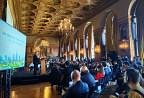
PARIS, France – April 14, 2026 – Against a complex backdrop of looming trade tariffs and intense global competition, the Maison internationale in Paris buzzed with a determined spirit of cooperation today. Over 150 automotive executives from China and Europe gathered for the Electric Vehicle Forum and Exhibition, a high-stakes summit aimed at charting a new course for collaboration in the electric and intelligent vehicle era.
While showcasing a fleet of advanced “Made-in-Wuhan” electric vehicles, the event’s true significance lay in the strategic discussions happening behind the scenes. As automakers grapple with supply chain disruptions and a rapid technological shift, the forum underscored a shared belief in mutual interdependence. Jean-Pierre Raffarin, former prime minister of France, captured the mood in his opening remarks, highlighting the long history of Sino-French automotive cooperation and the immense potential that lies in harnessing complementary strengths to navigate the industry's profound transformation.
A Partnership Recharged
The choice of Paris for this showcase was no coincidence. It represents a full-circle moment for the industrial ties between France and the Chinese city of Wuhan. The relationship is anchored by the Wuhan Economic and Technological Development Zone (WEDZ), a sprawling hub known as “China’s Auto Valley,” which was originally established to host the Sino-French joint venture Dongfeng Peugeot Citroën Automobile (DPCA).
“We have brought outstanding ‘Made-in-Wuhan’ products to Paris not only to showcase our latest achievements but more importantly to join hands with our European partners to move forward together,” said Liu Ziqing, a senior official representing Wuhan and WEDZ. For over three decades, the joint venture between Dongfeng Motor Corporation and France's PSA Group (now part of Stellantis) was a cornerstone of China's early automotive market, serving over 6.5 million customers.
However, like many legacy joint ventures, DPCA has faced immense pressure in recent years, with sales falling sharply from a peak of over 700,000 vehicles in 2015. Today, the conversation has shifted from survival to revival. “Stellantis is once again joining hands with Dongfeng Motor Corporation to explore a new model for Sino-French joint ventures with DPCA at its core,” Liu added, framing it as a “second entrepreneurship journey.” This renewed momentum follows a key visit to Wuhan just last month by Robert Peugeot, vice chairman of Stellantis, where a consensus was reached to deepen the group's presence and engineer a strong comeback for DPCA.
Stellantis's New China Blueprint
The renewed focus on DPCA is a critical piece of Stellantis’s broader, and radically different, strategy for China. The transatlantic automaker has been candid about its past struggles, which included the dissolution of its underperforming Jeep joint venture with GAC in 2022. In its place, Stellantis is pursuing a more flexible, “asset-light” approach that prioritizes collaboration with innovative Chinese firms.
The most significant move was its €1.5 billion investment in late 2023 for a 20% stake in Chinese EV startup Leapmotor. The deal gives Stellantis access to a cost-efficient EV platform and creates a new joint venture, Leapmotor International, which Stellantis will lead to export and sell Leapmotor vehicles globally, starting with Europe. This pivot acknowledges the competitive edge Chinese companies have developed in EV technology and cost structure.
Within this context, the plan to revitalize DPCA is not a return to the old model. Instead, it appears to be a hybrid strategy: leveraging an existing manufacturing footprint in Wuhan while pivoting towards a global export model and the new energy vehicle (NEV) market. The strategy is already showing early signs of success, with DPCA’s overseas exports reportedly surging 32% year-on-year in the first half of 2024. The venture is scheduled to mass-produce its first NEV model in 2025, marking a crucial step in its transformation.
A Global Gambit Amid Trade Headwinds
The Paris forum is the flagship event for the “Made-in-Wuhan, Global Journey,” a sweeping initiative designed to cement Wuhan’s status as a global automotive powerhouse. WEDZ is already a formidable force, with an annual production capacity of over one million vehicles and a rapidly growing NEV capacity of 1.46 million units, home to brands like Voyah, Lotus, and Xpeng. In 2025, the zone’s NEV production skyrocketed by 230%.
Yet, this ambitious global push comes at a precarious time. The European Commission has been conducting an anti-subsidy investigation into Chinese EV imports since late 2023, concluding that the value chain benefits from unfair state support. Provisional countervailing duties were imposed in mid-2024, adding tariffs of up to 35.3% for some manufacturers on top of the existing 10% import duty. France has been a key supporter of these protective measures.
This creates a complex duality: even as French officials like Raffarin champion cooperation, and French Finance Minister Bruno Le Maire invites Chinese EV giant BYD to build a factory in France, the threat of a trade war looms. The Paris event, therefore, serves as a crucial diplomatic and commercial channel, demonstrating a desire for partnership that transcends political friction.
Deals Done and Technologies Displayed
The forum was more than just talk. It served as a showroom for the latest from Wuhan's industrial base. On display were a range of compelling models, including the rugged M-Hero 917 electric off-roader, the luxurious Voyah Dream MPV, and the agile Nammi Box city car. Also drawing significant attention were the Lotus Eletre hyper-SUV and Emeya hyper-GT, which blend the British brand's performance heritage with Geely's Chinese ownership and EV prowess.
The deep industrial integration was further reinforced by a series of new agreements. WEDZ signed cooperation pacts with European automotive leaders Fiamm, Valeo, and ZF, covering components, R&D, and market expansion. This builds on long-standing relationships; French supplier Valeo, for example, established its first China factory in WEDZ in 1995 and now operates its largest global lighting R&D center there.
Furthermore, preliminary agreements were reached with major French automotive dealer groups, including Emil Frey Group and COSMOBILIS Group, paving the way for Wuhan-made vehicles to enter the European market. As this Paris event concludes, it marks not an end but a beginning. Wuhan plans to continue its “Global Journey” with a series of roadshows in key cities worldwide, determined to drive its automotive ambitions far beyond its domestic borders.