
- Average siding repairs range from $500 to $2,500, but severe cases can cost $5,000 to $15,000 due to underlying damage.
- Ideal Siding reported an 85% growth in franchise network and 223% increase in yearly revenue in the last year.
- Fiber cement siding is highlighted as a top performer in cold climates due to its resistance to moisture and freeze-thaw cycles.
Experts emphasize that winter siding failure is a growing financial and structural risk for homeowners, driven by climate change, and recommend investing in resilient materials and professional installation to mitigate long-term costs.
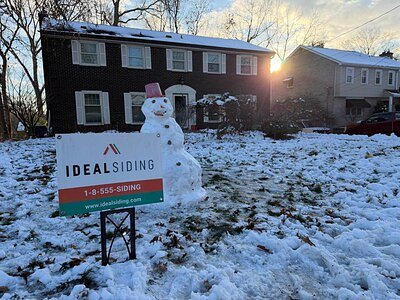
Winter's Hidden Cost: Siding Failure and Your Home's Bottom Line
VANCOUVER, BC – December 05, 2025 – As winter tightens its grip across North America, homeowners are bracing for the usual challenges of snow, ice, and plunging temperatures. Yet, beyond the obvious concerns lies a silent financial threat eroding the value of what is, for most, their largest asset: their home's exterior siding. The subtle creep of moisture and the stress of freeze-thaw cycles are creating a multi-billion dollar headache, turning minor neglect into major capital expenditure.
This isn't just a maintenance issue; it's an economic one. The integrity of a home's protective shell is directly tied to its energy efficiency, structural health, and market value. As weather patterns become more severe, the financial stakes for homeowners, investors, and the construction industry are escalating, fueling a demand for greater resilience and smarter investment in building materials.
The Freeze-Thaw Economy: Unpacking Winter's Financial Toll
The damage inflicted by winter is often insidious. Moisture from melting snow and ice finds its way behind siding panels through tiny gaps or failing caulking. When temperatures drop, this trapped water freezes and expands, exerting immense pressure that can crack, warp, or even detach siding from the structure. This relentless cycle is the primary culprit behind a cascade of costly problems.
The financial fallout can be substantial. According to industry data, average siding repairs run between $500 and $2,500. However, these figures can be misleadingly low. Minor issues, such as replacing a single cracked vinyl panel, might cost a few hundred dollars. But when moisture intrusion leads to underlying rot in the sheathing or structural framing, repair costs can quickly soar into the $5,000 to $15,000 range, often involving significant deconstruction and remediation. These figures don't even account for secondary damage like interior mold growth, which poses health risks and requires expensive, specialized removal.
"Every year, we see homeowners dealing with cracked siding, hidden water damage, or cold drafts coming from behind aging panels," noted Alex Filipuk, CEO of Ideal Siding, in a recent advisory. "Winter is one of the toughest seasons for a home's exterior, and small issues can escalate quickly if you don't know what to look for."
The economic impact extends to energy consumption. Compromised siding allows for air infiltration, creating cold drafts and forcing heating systems to work overtime. An unexpected spike in utility bills is often one of the first red flags that a home's thermal envelope has been breached, representing a direct and recurring drain on household finances.
A Market Reshaped by Resilience and Climate
The growing awareness of these risks is fundamentally reshaping the siding industry. The traditional calculus of choosing materials based on initial cost and aesthetics is giving way to a more sophisticated analysis centered on long-term performance and climate resilience. This shift is creating clear winners and losers in the building materials sector.
At the forefront of this trend are advanced composite materials. Fiber cement siding, a mixture of wood pulp, cement, sand, and water, has become a top performer in cold climates. Its resistance to moisture, rot, and extreme temperature fluctuations makes it exceptionally stable during freeze-thaw cycles. Similarly, engineered wood combines the look of traditional wood with resins and binders that protect it from moisture and decay, offering a durable alternative.
While still a market leader due to its affordability, traditional vinyl siding's vulnerability to becoming brittle and cracking in extreme cold is a known liability. In response, manufacturers have developed insulated vinyl siding, which includes a foam backing that not only improves energy efficiency but also adds rigidity and impact resistance. This product innovation is a direct reaction to market demands for more robust solutions in regions with harsh winters. This evolution highlights a key tenet of the new economy: climate change is no longer a distant threat but an active market force driving innovation and capital allocation in legacy industries.
The Specialist Model: Capitalizing on a Fragmented Market
Responding to this demand for expertise and reliability, new business models are emerging to disrupt the fragmented and often inconsistent home renovation market. One notable example is the rapid expansion of specialized franchise systems like Ideal Siding, which has leveraged technology and a centralized operational model to standardize quality.
The company's growth metrics are striking. With a reported 85% growth in its franchise network in the last year and a 223% increase in yearly revenue, it exemplifies a successful strategy of capitalizing on a clear market need. By combining digital marketing to generate leads, a centralized call center to manage customer inquiries, and a proprietary system for onboarding and training installation crews, the model aims to solve the classic homeowner dilemma of finding a trustworthy contractor.
This tech-enabled, systematic approach allows for a level of consistency that is difficult to achieve for independent local contractors. The company claims its efficiencies allow homeowners to pay significantly less while installation crews earn substantially more, a formula designed to attract both customers and skilled labor in a tight market. This strategy of professionalizing a trade through technology and scalable processes is a hallmark of how capital and innovation are reshaping service-based industries.
The Installation Imperative: Securing a Capital Investment
Ultimately, the performance of any siding material, regardless of its advanced properties, is contingent on one critical factor: the quality of its installation. A capital investment in premium fiber cement or engineered wood can be completely undermined by improper fastening, inadequate flashing, or incorrect caulking.
"Installation is everything," Filipuk emphasized. "Even the strongest siding materials fail in winter if they're installed without proper flashing, caulking, or spacing. A professional installation gives your home its best chance of staying protected all winter long."
This is not hyperbole. Siding manufacturers' warranties are almost universally voided if their specific, often stringent, installation guidelines are not followed to the letter. These requirements cover everything from the type of nails used to the precise gap left between panels to allow for thermal expansion and contraction. An amateur or rushed job can create the very vulnerabilities—gaps for moisture intrusion, stress points that lead to cracking—that the homeowner paid a premium to avoid.
For property owners, this means the choice of an installer is as important as the choice of material. Vetting contractors for factory certifications, experience with specific materials, and a deep understanding of local climate challenges is essential due to diligence. A professional installation is not an expense; it is the final and most crucial step in securing a multi-thousand-dollar investment and safeguarding the long-term structural integrity and value of the property. As homeowners increasingly view their properties through the lens of long-term asset management, the demand for this level of proven expertise will only continue to grow.