
- $2 Deals: Two Tuffy Tire & Auto Service properties sold in Toledo, Ohio, reflecting strong investor demand.
- 53-Day Close: One property sold to a REIT in just 53 days, highlighting institutional efficiency.
- 97% Asking Price: The second property sold at 97% of the asking price in an all-cash transaction.
Experts agree that automotive service real estate is a resilient and attractive investment due to its necessity-based demand, stable income, and significant tax advantages, making it a top choice for both institutional and private investors.
Why Auto Service Real Estate is a Hot Commodity for Investors
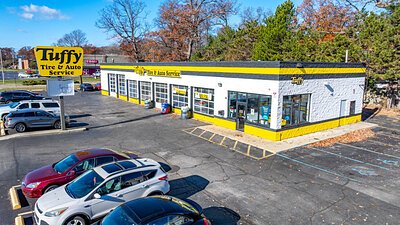
TOLEDO, OH – March 17, 2026 – A pair of recent real estate transactions in Toledo, Ohio, are shining a spotlight on one of the most resilient and sought-after sectors in commercial property: automotive service centers. CrownPoint Partners, a national brokerage firm, recently announced the successful sale of two Tuffy Tire & Auto Service properties, deals that underscore a powerful national trend of investors flocking to necessity-based, e-commerce-proof assets.
The sales, one to a publicly traded real estate investment trust (REIT) and the other to a private investor, illustrate the broad appeal of a sector fueled by stable income, long-term leases, and significant tax advantages.
An E-Commerce Proof Investment Engine
In an era where digital disruption has upended traditional retail, automotive service centers stand out as a remarkably durable asset class. The core reason is simple: you can't get an oil change or a tire rotation online. This necessity-based foundation makes the sector exceptionally resilient to economic downturns and shifts in consumer behavior. With the average age of vehicles on U.S. roads now exceeding 12 years, the demand for maintenance and repair services is not just stable; it's growing.
This inherent stability is a primary driver for investors. The two Toledo properties, both leased to Tuffy Tire & Auto Service, exemplify this. The tenant, a well-established national franchise, provides the kind of reliable operational history that investors crave. The Airport Highway location, for instance, is situated less than seven miles from Tuffy's corporate headquarters, reinforcing the brand's deep commitment to the Toledo market. The franchisee is a multi-unit operator, demonstrating an established footprint and a proven business model within the region.
"These transactions highlight the strong investor demand for essential automotive service real estate with long-term lease structures and experienced operators," noted Shannon Bona of CrownPoint Partners in a recent statement. "Automotive service properties continue to perform well in the net lease market due to their necessity-based use, durable tenant demand, and stable cash flow."
A Tale of Two Buyers Reveals Market Depth
The diversity of the buyers for the two Toledo properties speaks volumes about the sector's wide-ranging appeal. The first property, located on Airport Highway, was acquired by a publicly traded REIT. The transaction closed in a swift 53 days, showcasing the efficiency and decisiveness of institutional capital when the right asset comes to market. The property's Absolute Net Lease structure, with over seven years remaining, offers the REIT a completely passive, long-term income stream—a core objective for these large-scale investors.
In contrast, the second property on Monroe Street was purchased by a local, private buyer utilizing a 1031 exchange. This all-cash transaction, which closed at 97% of the asking price, highlights the robust demand from private capital seeking to defer taxes and reinvest in stable, income-producing assets. For this buyer, the deal offered an added layer of financial ingenuity: in addition to the Absolute Net Lease with Tuffy, the sale included a separate 20-year electronic billboard lease. This dual-income stream provides enhanced revenue stability and diversifies the investment's return profile, a feature highly attractive to sophisticated private investors.
This convergence of institutional and private capital on the same asset type in the same city demonstrates a market with deep, multi-layered demand. While REITs seek to add proven, passive assets to their large portfolios, private investors are leveraging powerful tax strategies to build wealth through reliable, hands-off commercial properties.
The Powerful Financial Levers: Leases and Tax Codes
Beyond the sector's fundamental stability, the financial structures underpinning these deals are a major part of the attraction. Both Toledo properties were sold with Absolute Net Leases, often considered the gold standard for passive real estate investors. Under this arrangement, the tenant is responsible for all operating expenses, including property taxes, insurance, and maintenance. This effectively insulates the owner from the day-to-day costs and responsibilities of property management, creating a predictable, bond-like income stream.
Even more compelling for many buyers are the significant tax advantages. The Monroe Street sale, facilitated by a 1031 exchange, is a prime example. This provision in the U.S. tax code allows investors to defer capital gains taxes on the sale of a property by reinvesting the proceeds into a "like-kind" replacement property. This creates a constant flow of motivated buyers in the market who need to place capital within strict deadlines, and net lease automotive properties are often a perfect fit.
Furthermore, the potential for accelerated depreciation adds another layer of financial incentive. As Julius Swolsky of CrownPoint Partners explained, these assets can offer substantial tax savings. "Fueling the demand in automotive service properties is the ability to depreciate these assets 100%, providing investors with possible substantial tax savings," Swolsky stated. This is often achieved through a cost segregation study, which allows investors to accelerate the depreciation of certain property components. Instead of depreciating the entire building over 39 years, portions can be depreciated over 5, 7, or 15 years. This front-loads tax deductions, significantly reducing an investor's tax liability in the early years of ownership and boosting overall cash flow.
This combination of passive income from net leases and powerful tax-shielding strategies makes automotive service real estate a uniquely attractive vehicle for wealth preservation and growth. The ability to generate stable income while simultaneously lowering tax burdens is a powerful one-two punch that continues to draw a flood of capital into the sector. These recent sales in Ohio are not isolated events but rather clear indicators of a market firing on all cylinders, driven by fundamental need and sophisticated financial engineering.