
- 1 in 25,000 live births: Achondroplasia affects approximately 1 in 25,000 live births.
- 1.57 cm annual growth: Children treated with VOXZOGO grew an average of 1.57 cm more per year than those who received a placebo.
- $900 million projected sales: Global sales of VOXZOGO are projected to exceed $900 million in 2025.
Experts view the approval of VOXZOGO as a transformative advancement in treating achondroplasia, offering the first targeted therapy to address the underlying genetic cause of the condition, though long-term benefits and equitable access remain key considerations.
VOXZOGO Approved in Canada, a New Era for Achondroplasia Treatment
MONTREAL, QC – February 11, 2026 – Health Canada has granted conditional approval for VOXZOGO (vosoritide), a groundbreaking therapy from BioMarin Pharmaceutical that marks the first time a drug targeting the underlying cause of achondroplasia will be available to Canadian children. The decision represents a pivotal moment for families and physicians who have long awaited a treatment for the most common form of dwarfism.
The medication is now authorized for children with achondroplasia aged four months and older whose epiphyses, or growth plates, are not yet closed. Achondroplasia is a genetic condition affecting approximately 1 in 25,000 live births, characterized by impaired bone growth.
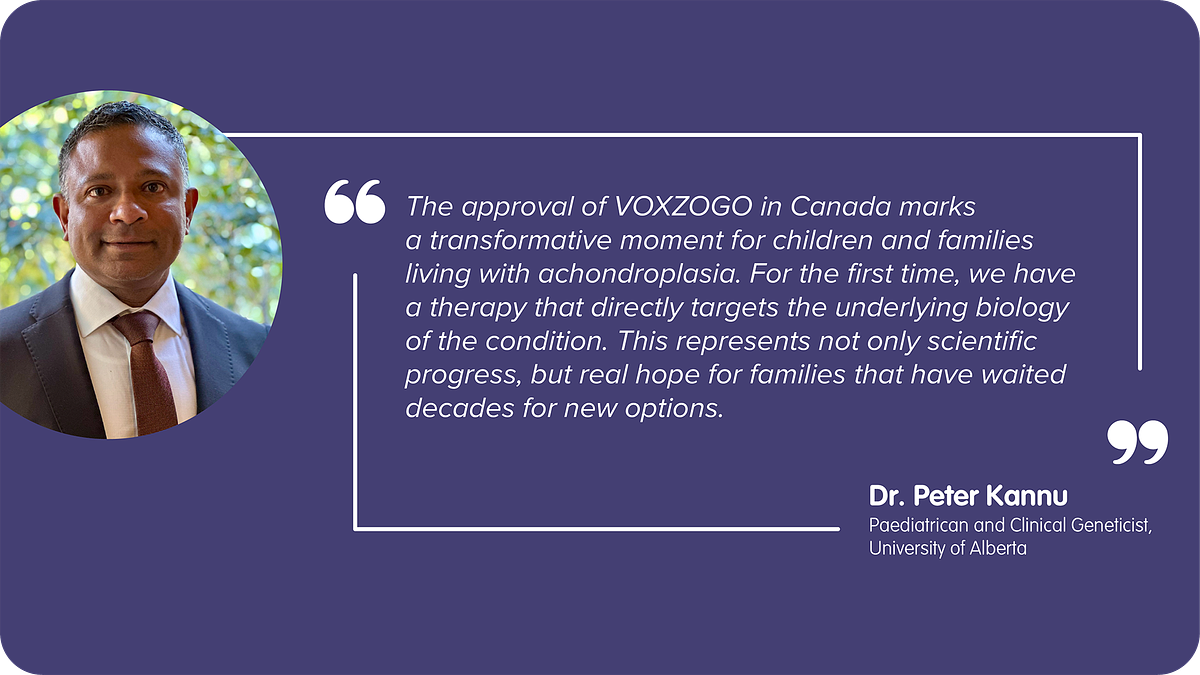
"The approval of VOXZOGO in Canada marks a transformative moment for children and families living with achondroplasia," said Dr. Peter Kannu, a Paediatrician and Clinical Geneticist at the University of Alberta, in a statement. "For the first time, we have a therapy that directly targets the underlying biology of the condition. This represents not only scientific progress, but real hope for families that have waited decades for new options."
A Scientific Breakthrough
Until now, management of achondroplasia has focused on treating symptoms and complications, such as spinal stenosis and sleep apnea, without any approved pharmacological options to address the root genetic cause. VOXZOGO, a C-type natriuretic peptide (CNP) analogue, fundamentally changes this paradigm.
The condition is caused by a mutation in the fibroblast growth factor receptor 3 (FGFR3) gene, which puts a constant "brake" on bone growth. VOXZOGO works by counteracting this effect, promoting endochondral ossification—the process by which bone tissue is created. By targeting this specific intracellular pathway, the therapy has been shown to not only increase linear growth but also improve body proportionality.
This approval follows similar authorizations by the U.S. Food and Drug Administration (FDA) in 2021 and the European Medicines Agency (EMA) the same year, establishing a new global standard of care for a condition that previously had no targeted treatment.
The Road from Approval to Access
While the announcement is a major victory, the authorization comes as a Notice of Compliance with Conditions (NOC/c). This regulatory pathway allows Health Canada to grant earlier market access to promising drugs for serious conditions, contingent upon the manufacturer providing further data to confirm the drug's long-term benefits.
For BioMarin, this means conducting post-market confirmatory trials to verify VOXZOGO's clinical benefit, likely focusing on its impact on final adult height. The company will also be subject to enhanced safety monitoring and reporting requirements.
The next, and perhaps most significant, hurdle is securing public reimbursement. With the drug's U.S. price tag running into the hundreds of thousands of dollars annually, the path to getting VOXZOGO listed on provincial and territorial drug formularies will be complex. The process involves a rigorous review by the Canadian Agency for Drugs and Technologies in Health (CADTH), which assesses a drug's clinical and cost-effectiveness before making recommendations to public payers.
Navigating these negotiations will be critical to ensuring that Health Canada's approval translates into tangible, equitable access for all eligible children across the country, a process that can often take months or even years.
Clinical Evidence and Global Experience
The conditional approval is supported by a robust clinical development program, including a pivotal Phase 3 study. The trial demonstrated that children treated with VOXZOGO grew an average of 1.57 cm more per year than those who received a placebo. Ongoing extension studies have shown these growth-promoting effects are sustained over several years of treatment.
The safety profile has been shown to be generally well-tolerated. The most common adverse events reported in clinical trials were mild to moderate injection site reactions. The product monograph notes the potential for transient decreases in blood pressure, advising that patients be well-hydrated and have eaten before the daily injection to mitigate this risk.
Canada's approval for children as young as four months old aligns with recent label expansions in the United States and Europe. This move toward earlier intervention is based on data suggesting that starting treatment at a younger age may maximize the potential benefits for growth and development over the long term.
BioMarin's Leadership in Rare Disease
For BioMarin, a California-based biotechnology firm founded in 1997, the Canadian approval of VOXZOGO reinforces its position as a global leader in the high-stakes world of rare disease therapeutics. The company has successfully brought eight commercial therapies to market, focusing exclusively on genetically defined conditions that often have few, if any, treatment options.
VOXZOGO is a cornerstone of its portfolio and a significant driver of revenue, with global sales projected to exceed $900 million in 2025. The company's strategy involves not only securing approvals in new markets like Canada but also expanding its leadership in skeletal conditions through ongoing research into next-generation therapies.
The approval of VOXZOGO in Canada is more than just a regulatory milestone; it represents a significant step forward in the treatment of a rare genetic condition. While the journey to ensure broad and equitable patient access is just beginning, the decision provides a long-awaited therapeutic option and a new sense of optimism for the Canadian achondroplasia community.