
- Market Value: The Structural Health Monitoring (SHM) market is valued at over USD 4.3 billion in 2025.
- Accuracy: The superpixel method achieves accuracy comparable to a laser Doppler vibrometer, a high-end laboratory instrument.
- Cost Savings: Systematic SHM can reduce infrastructure investment needs by up to 30% by optimizing repairs and deferring replacements.
Experts view this camera-based virtual sensor technology as a transformative advancement in infrastructure safety, offering a cost-effective, high-accuracy alternative to traditional monitoring methods while enabling broader adoption of predictive maintenance and digital twin technologies.
Virtual Sensors: A Camera-Based Leap in Infrastructure Safety
JEOLLANAM-DO PROVINCE, South Korea – January 12, 2026 – By Angela Gray
A groundbreaking development from researchers at Chonnam National University is set to revolutionize how we monitor the health of our most critical infrastructure. A team has pioneered a novel method that transforms ordinary cameras into highly accurate, low-cost virtual sensors, capable of detecting minute vibrations and structural flaws in everything from bridges and buildings to complex aerospace systems. This innovation, which uses intelligent pixel clustering, promises to make advanced safety monitoring more accessible and robust than ever before, addressing a critical global need for safer, more resilient infrastructure.
The High Cost of Aging Infrastructure
Across the globe, aging infrastructure poses a significant and growing challenge. The market for Structural Health Monitoring (SHM) reflects this urgency, valued at over USD 4.3 billion in 2025 and projected to grow exponentially. Governments and industries invest heavily in SHM to prevent catastrophic failures, reduce maintenance costs, and extend the lifespan of vital assets. However, the prevailing methods have long been hampered by a trade-off between cost, coverage, and accuracy.
Traditional approaches rely on physical, contact-based sensors like accelerometers. While effective, these sensors are expensive to purchase and install, and their measurements are confined to small, localized areas. This results in a low-resolution, incomplete picture of a structure's overall condition. On the other end of the spectrum, visual inspections are subjective and can only identify surface-level damage, often after it has become a serious problem.
In recent years, vision-based methods using cameras have emerged as a promising alternative, offering the potential for non-contact, full-field measurement. Yet, these too have struggled. Many existing systems are computationally intensive and vulnerable to real-world challenges like changing light conditions, low-texture surfaces, and subtle camera distortions, making them unreliable for critical applications.
A Virtual Leap Forward: From Pixels to Superpixels
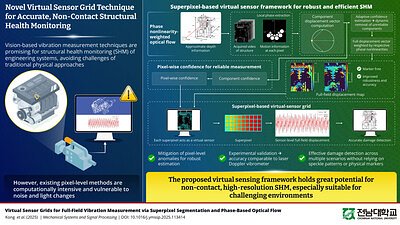
To overcome these hurdles, the research team led by Professor Gyuhae Park from the Department of Mechanical Engineering at Chonnam National University developed a novel framework centered on a concept they term 'superpixels.' Instead of analyzing each pixel in a video feed individually—a process prone to noise and error—their method intelligently groups pixels into clusters that exhibit similar vibrational behavior. These 'superpixels' act as a robust, adaptable grid of virtual sensors spread across the entire structure.
"Our approach utilizes superpixels, clusters of neighboring pixels with similar vibrational and structural behavior, as virtual sensors for motion estimation," explains Prof. Park. "This creates an adaptable virtual sensor grid for any structure, enabling robust and accurate full-field vibration measurement without the need for physical markers or contact sensors."
The method, detailed in the prestigious journal Mechanical Systems and Signal Processing, operates in three sophisticated stages. First, it uses an advanced phase-based optical flow algorithm to estimate motion at the pixel level from a standard video recording. Crucially, the system then performs a built-in reliability check, calculating a 'confidence score' for the displacement measurement of each pixel—a feature that sets it apart from other vision-based techniques. Finally, it uses this confidence map to group reliable pixels into superpixels, effectively filtering out noise and creating a high-fidelity map of the structure's dynamic response.
Experimental validation on a complex air compressor system demonstrated that the superpixel method achieves an accuracy comparable to that of a laser Doppler vibrometer, a high-end laboratory instrument, while simultaneously enabling effective damage detection without any physical contact.
The Expert Behind the Innovation
The credibility of this breakthrough is reinforced by the expertise of its lead researcher and the rigor of its publication. Professor Gyuhae Park is a globally recognized leader in smart sensing and structural diagnostics. A Fellow of the American Society of Mechanical Engineers (ASME) and consistently ranked among the top 2% of scientists worldwide, his work has been cited over 20,500 times. His lab at Chonnam National University has a long track record of pioneering research in advanced engineering.
The research was published in Mechanical Systems and Signal Processing, an elite journal with an impact factor of 8.9, placing it in the top quartile of its field. This signifies that the work has undergone a stringent peer-review process and is considered a significant contribution to engineering knowledge.
Paving the Way for Smart Cities and Digital Twins
The implications of this technology extend far beyond simple monitoring. By providing low-cost, high-resolution data on structural dynamics, the superpixel method is a key enabler for the next generation of smart infrastructure management, including predictive maintenance and the development of 'digital twins.'
A digital twin is a dynamic, virtual replica of a physical asset, updated in real-time with sensor data. This technology allows engineers to simulate stress, predict failures, and optimize maintenance schedules with unprecedented accuracy. Previously, the high cost of sensor deployment made creating true digital twins for large structures like bridges or wind turbines prohibitively expensive. This new camera-based approach tears down that economic barrier.
"Vibration-guided superpixel segmentation enhances robustness and interpretability of structural diagnostics even in complex environments," Prof. Park elaborates. "Our approach makes full-field structural monitoring accessible, low-cost, and deployable using ordinary cameras supporting applications in infrastructure monitoring, aerospace and mechanical equipment diagnostics, smart cities, robotics, and digital twins."
South Korea's Rising Tide of Innovation
This development is also a testament to South Korea's growing stature as a global hub of technological innovation. Research institutions like Chonnam National University are at the forefront of creating practical, high-impact solutions to global challenges. By focusing on cost-effectiveness and accessibility, this technology has the potential for widespread international adoption.
The economic benefits are substantial. By making advanced monitoring affordable, the technology can be deployed across a wider range of assets, shifting the paradigm from costly reactive repairs to cost-effective predictive maintenance. Studies have shown that systematic SHM can reduce infrastructure investment needs by up to 30% by safely deferring replacements and optimizing repairs. By democratizing access to this capability, the superpixel method could unlock billions in savings and, more importantly, significantly enhance public safety. As cities grow and infrastructure ages, innovations like this will be essential for building a smarter, safer, and more sustainable future.