
- 150,000 members: Blue Shield of California's Virtual Blue plan has surpassed 150,000 members.
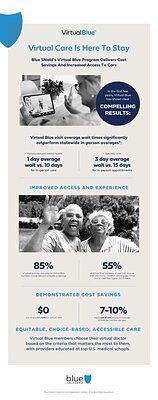
- $468 annual savings: The program delivers 7-10% lower overall cost of care, averaging $468 less per member per year.
- $17,280 savings for high-need patients: For members with complex chronic conditions, average annual savings reach $17,280.
Experts would likely conclude that Blue Shield of California's Virtual Blue plan demonstrates how integrated virtual-first healthcare can significantly improve access, reduce costs, and enhance patient satisfaction, positioning digital health as a permanent and essential component of the healthcare system.
Virtual Health's Big Win: Blue Shield's Digital Plan Delivers Real Savings
OAKLAND, CA – April 02, 2026 – Three years after its debut, Blue Shield of California's virtual-first health plan, Virtual Blue, has surpassed 150,000 members, presenting a compelling case study on how digital healthcare can address the industry's most persistent challenges: access, cost, and patient satisfaction. The program's success, detailed in a recent announcement, suggests that what began as a pandemic-era necessity is now a permanent and powerful fixture in the healthcare landscape.
By offering integrated care with $0 out-of-pocket costs for many virtual visits, the program is not only attracting a significant user base but also posting impressive metrics that are catching the attention of employers, policymakers, and competing health plans.
The Virtual Blueprint: Slashing Wait Times and Costs
The data released by Blue Shield of California paints a picture of a system dramatically outperforming traditional in-person care on key access and affordability metrics. Members of Virtual Blue are reportedly experiencing wait times of just one day for primary care and mental health appointments, a stark contrast to the 10-day statewide average for in-person visits. The gap is even wider for specialty care, with virtual appointments available in three days compared to the typical 15-day wait.
This rapid access is translating into significant financial benefits for both members and the health system. The nonprofit health plan reports that the program has delivered a 7-10% lower overall cost of care, averaging $468 less per member per year. A key driver of this saving is a more than 10% reduction in emergency room visits. Further data from the company indicates that 60% of surveyed members believe they would have otherwise used more expensive options like urgent care or an ER, or simply delayed care altogether.
The financial impact is particularly profound for patients with complex needs. For a subset of high-need members managing multiple chronic conditions, the reported average annual savings reached an astonishing $17,280.
"Virtual Blue has been a win for members, employers and our Blue Shield mission," said Tim Lieb, senior vice president of growth at Blue Shield of California, in a statement. "Members can get appointments faster and save on out-of-pocket costs; employers can offer more equitable access regardless of demographics; and as a nonprofit health plan, we're advancing our commitment to high‑quality, affordable care for all Californians."
Beyond the Screen: An Integrated Approach to Patient Care
Officials at Blue Shield are quick to differentiate Virtual Blue from the episodic telehealth services that became common during the pandemic. The program is built on a foundation of integrated, continuous care, facilitated by strategic partnerships with virtual care providers Accolade and TeleMed2U.
Accolade provides the virtual primary care backbone, emphasizing a team-based approach. Patients are connected with a primary care physician for long-term care, supported by care coaches, coordinators, and nurses. This structure is designed to manage chronic conditions, coordinate services, and provide holistic support, including mental health screenings, which are incorporated into 85% of virtual primary care visits. TeleMed2U complements this by offering access to a network of board-certified specialists across more than 20 fields, from cardiology to neurology.
Members access this ecosystem through the Blue Shield app and receive a home vitals kit—including devices like a blood pressure cuff and thermometer—to support remote diagnostics. The high level of patient satisfaction, reflected in a Net Promoter Score (NPS) of 89 out of 100 for its physicians in 2024, suggests the model is resonating with users who value convenience without sacrificing the quality of their care relationships.
Tackling Health Equity and Access Gaps
A core promise of virtual health has always been its potential to bridge long-standing gaps in healthcare equity. Blue Shield is positioning Virtual Blue as a key tool in this effort, aiming to expand access for residents in rural areas and designated Health Professional Shortage Areas (HPSAs).
"Virtual‑first care expands access and bridges critical care gaps," noted Dr. Carol Koeble, a regional medical director at Blue Shield who provides clinical leadership for the program. "It supports busy families, shift workers, those with mobility challenges, and people living in areas with provider shortages or disaster risks — and everyone in between."
The program's design intentionally addresses diversity. Through its partner Accolade, members can choose doctors based on criteria like gender, race, and language. The provider network is notably diverse, with about 70% identifying as female and 50% as people of color, and all are trained in LGBTQIA+ care. This is a significant feature in a state like California, where studies from public health agencies consistently show that people of color and low-income individuals face substantial barriers to care and experience poorer health outcomes. While specific demographic data on Virtual Blue's 150,000 members is not public, the program's structure is aligned with efforts to create a more culturally competent healthcare system.
Navigating a Competitive and Evolving Landscape
Blue Shield's success with Virtual Blue does not exist in a vacuum. The program is a prominent example of a nationwide shift as major health systems compete in a rapidly growing virtual care market, projected to expand exponentially over the next decade. In California, integrated healthcare giant Kaiser Permanente has also heavily invested in telehealth, reporting that 30% of its scheduled care visits were virtual in 2023, with patient satisfaction scores consistently high.
The performance and expansion of these programs are closely watched by regulators like the California Department of Managed Health Care (DMHC), which sets the standards for wait times and access that Blue Shield uses as a benchmark. As virtual-first plans become more common, the regulatory landscape will continue to evolve to ensure quality, safety, and reimbursement parity.
Building on its success, Blue Shield is embedding virtual care deeper into its offerings. The company recently added virtual primary care options to its Trio HMO plan for individual marketplace members and plans to continue rolling out Virtual Blue to more employer groups. This strategic expansion signals a firm belief that virtual care is not just an alternative, but an essential component of a more affordable and accessible healthcare future.
Topics & Related
Telehealth
Health IT
Software & SaaS
Cloud Migration
Related Company Pulse