
- 75% reduction in troubleshooting time for new technicians
- 23% cut in downtime costs
- 100 million maintenance events analyzed by Veryon AIRE
Experts agree that Veryon's AI-driven predictive maintenance marks a significant advancement in aviation safety, offering measurable efficiency gains while aligning with regulatory requirements for human oversight.
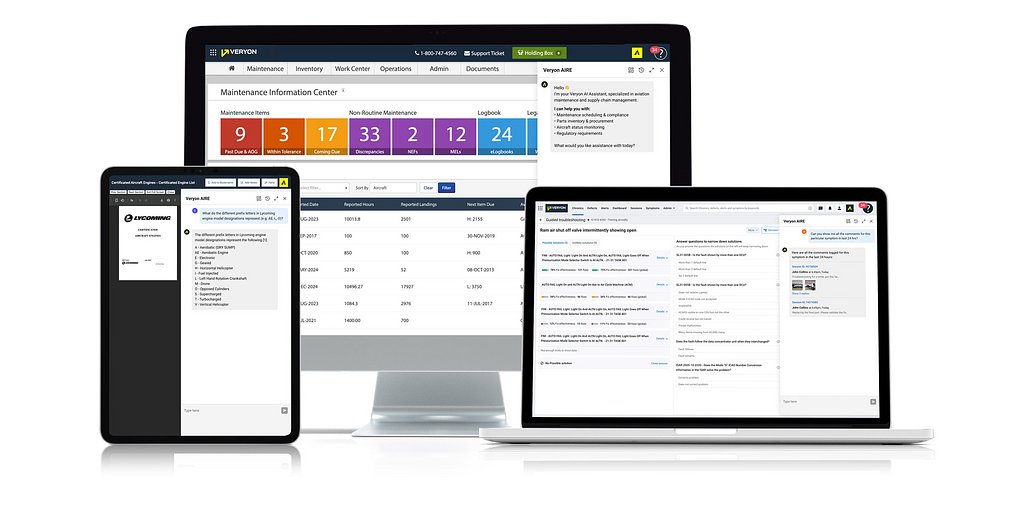
Veryon's AI Wins Top Awards, Signals New Era for Aviation Safety
SAN FRANCISCO, CA – March 25, 2026 – Aviation software provider Veryon has secured two prestigious industry awards for its artificial intelligence platform, Veryon AIRE, a recognition that highlights a significant shift in how the aviation industry approaches maintenance, reliability, and safety. The company was honored with the 2026 Artificial Intelligence Excellence Award in the Agentic AI category and named a Platinum winner in the Pinnacle Awards for Artificial Intelligence.
These accolades, presented by the Business Intelligence Group and the Pinnacle Awards program respectively, recognize organizations deploying responsible, results-driven AI. The wins validate Veryon's strategy of embedding advanced data intelligence directly into the daily workflows of maintenance professionals. By transforming a massive repository of historical maintenance data into actionable insights, the platform aims to move the industry from a reactive repair model to a proactive, predictive one.
"Veryon AIRE responsibly enables data visualization, easy-to-use AI-assist tools, and training algorithms to make our customers more effective, but with compliance and safety top of mind," said Bethany Little, Chief Executive Officer at Veryon, in a statement accompanying the announcement.
A New Era of Predictive Maintenance
The core of Veryon's innovation lies in its ability to predict and prevent issues before they ground an aircraft. For decades, aviation maintenance has largely operated on fixed schedules and in response to component failures. Veryon AIRE represents a fundamental change, leveraging AI to analyze vast datasets and identify patterns that precede malfunctions. The system integrates directly with existing software that technicians already use, such as Veryon Tracking and Veryon Defect Analysis, surfacing insights without requiring a separate, cumbersome process.
This proactive approach is powered by what the company calls the industry's largest de-identified maintenance dataset, containing over 100 million maintenance events, 5 million parts, and 3 million chronic defects. By mining this data, the platform can recommend the most likely fix for a given symptom, boosting first-time fix rates and dramatically reducing diagnostic time. The company reports that customers have seen up to a 75 percent reduction in troubleshooting time for new technicians and a 23 percent cut in downtime costs.
Veryon is not alone in this pursuit. The aviation industry is undergoing a broad transformation as major players like Delta TechOps with its APEX program and Lufthansa Technik with its "Condition Analytics" solution also invest heavily in predictive systems. This industry-wide trend underscores the immense pressure to enhance operational efficiency, reduce costly Aircraft on Ground (AOG) events, and bolster safety margins through technology.
The Power of Data and Agentic AI
Veryon's competitive edge is anchored in its proprietary dataset and its application of advanced AI, particularly Agentic AI. The win in the Agentic AI category is significant, as this technology represents a leap beyond simple predictive algorithms. Agentic AI involves creating autonomous software agents that can reason, plan, and execute complex, multi-step tasks with minimal human intervention. In the context of aviation maintenance, these agents can continuously monitor aircraft health data, cross-reference it with global fleet information, and proactively flag potential issues or even schedule maintenance tasks.
This capability is crucial for enabling a true transition from schedule-based maintenance to condition-based maintenance, where parts are serviced or replaced based on their actual wear and tear rather than a predetermined flight-hour count. The result is optimized maintenance schedules, reduced waste, and enhanced fleet reliability.
"Veryon AIRE harnesses anonymized maintenance events logged in our platform for over a decade, but with a highly trained LLM that has aviation experts at the wheel," Little stated. This combination of a massive, specialized dataset and expert human oversight is central to the platform's effectiveness. The recent release of Defect Analysis for Business Aviation is a practical application of this power, helping operators visualize data to catch chronic defects before they become disruptive and expensive.
Balancing Innovation with Safety in a Regulated Sky
Deploying any new technology in the safety-critical aviation sector is a monumental task, and AI is no exception. Global regulators, including the U.S. Federal Aviation Administration (FAA) and the European Union Aviation Safety Agency (EASA), are proceeding with caution, emphasizing that AI must be a tool to augment, not replace, human expertise.
Veryon's emphasis on "responsible AI" and "human-in-the-loop workflows" aligns directly with this regulatory philosophy. The FAA's roadmap for AI, published in July 2024, explicitly states that human oversight is mandatory for safety-critical operations. Similarly, EASA's updated AI Roadmap and the EU AI Act classify aviation AI systems as "high-risk," subjecting them to stringent requirements for transparency, robustness, and human oversight.
By focusing on predictive maintenance—an area widely considered a lower-risk and high-value application for AI—Veryon has found a strategic entry point that balances innovation with compliance. The AI acts as an incredibly powerful co-pilot for maintenance technicians, providing data-driven recommendations that a human expert ultimately validates. This approach not only meets current regulatory standards but also builds trust in the technology within a notoriously cautious industry.
The Broader Impact on Aviation and Beyond
The implications of this technology extend far beyond the maintenance hangar. For airlines and business jet operators, smarter maintenance translates directly to improved fleet availability, fewer unexpected AOG events, and significant cost savings. For the flying public, it means fewer delays, reduced cancellations, and the implicit promise of an even safer journey as potential failures are identified and fixed proactively.
The benefits ripple outward, even impacting the global tourism industry by contributing to a more reliable and efficient air travel ecosystem. As the AI platform continues to learn from every new maintenance event logged, its predictive capabilities become progressively more accurate. "As it learns from fleet behavior over time, it keeps getting smarter, ultimately helping teams get ahead of issues rather than constantly reacting to unscheduled maintenance events and unexpected AOGs," Little added.
This continuous learning cycle suggests that the efficiency and safety gains seen today are just the beginning. By turning decades of maintenance data into an intelligent, evolving system, Veryon is not just winning awards; it is helping to chart a new, more reliable future for the entire aviation industry.
Topics & Related
Software & SaaS
AI & Machine Learning
Agentic AI
Sustainability & Climate
Artificial Intelligence
Revenue
Product Launch
Related Company Pulse